
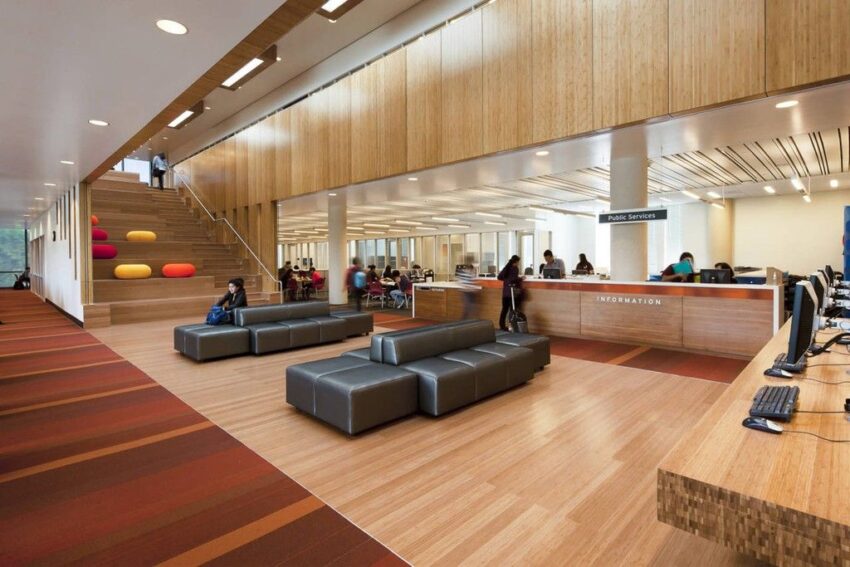
Colleges require interiors that support teaching, collaboration, administration, student interaction, and independent learning. As educational institutions evolve, their spaces need to accommodate technology-enabled classrooms, laboratories, libraries, discussion areas, faculty rooms, administrative offices, and student activity zones. College interior designers in Hyderabad help institutions develop functional environments by combining efficient space planning, durable furniture, appropriate lighting, technology integration, and a cohesive visual identity. Educational interiors in Hyderabad are increasingly being designed around comfortable layouts, ergonomic furniture, organized spaces, and environments that encourage learning and collaboration.
The principles covered in 10 Important Things to Consider When Hiring an Office Interior Design Company are also relevant to college projects. Both workplaces and educational institutions require careful planning, functional zoning, durable materials, ergonomic furniture, technology infrastructure, and efficient circulation. However, college interiors must additionally address student capacity, teaching requirements, safety, accessibility, and the different functions performed by academic spaces.
Understanding College Interior Requirements
A college campus typically contains several different environments, including classrooms, laboratories, libraries, seminar halls, faculty rooms, administrative offices, cafeterias, reception areas, student lounges, and activity spaces.
Each area has different functional requirements. A classroom needs clear sightlines and comfortable seating, while a laboratory requires specialized work surfaces, storage, electrical provisions, and appropriate safety considerations.
Efficient Space Planning
Space planning is one of the most important aspects of educational interior design. Designers need to consider student capacity, furniture dimensions, circulation paths, entrances, exits, natural light, ventilation, and accessibility.
A well-planned layout prevents overcrowding and allows students and faculty to move comfortably between different areas.
Hyderabad educational-interior providers emphasize efficient space utilization and organized layouts as part of their approach to schools, colleges, and training facilities.
Modern Classroom Design
Today’s classrooms often require more than desks and chairs. Interactive displays, projectors, charging points, teacher workstations, storage, and flexible seating can support different teaching methods.
Movable or modular furniture can allow classrooms to transition between lectures, group activities, presentations, and collaborative learning.
Technology Integration
Technology has become an important part of modern higher education. Classrooms and seminar rooms may require displays, projectors, audio systems, cameras, networking infrastructure, and charging points.
These requirements should be incorporated during the design stage so that cables and equipment do not interfere with circulation or aesthetics.
Library and Study Areas
Libraries need to support both individual concentration and group learning. A combination of individual desks, collaborative tables, shelving, digital-learning areas, and comfortable seating can accommodate different study preferences.
Lighting and acoustics are particularly important because students may spend several hours in these spaces.
Faculty and Administrative Areas
Faculty rooms and administrative offices require privacy, storage, workstations, meeting areas, and convenient access to technology.
A well-organized administrative area can improve staff efficiency while maintaining a professional environment for students and visitors.
Durable Institutional Furniture
College furniture experiences frequent and intensive use. Desks, chairs, storage units, laboratory furniture, reception counters, and common-area seating should therefore be selected for durability and ease of maintenance.
Materials should also be chosen according to the specific environment. Laboratory furniture, for example, may require different performance characteristics from classroom desks.
Lighting and Ventilation
Natural light can contribute to comfortable learning environments, while artificial lighting should provide adequate illumination for reading, writing, presentations, and computer-based activities.
Educational interior providers in Hyderabad specifically highlight natural lighting, balanced color schemes, ergonomic furniture, and practical layouts as important considerations for learning spaces.
Student Collaboration Spaces
Modern colleges increasingly require informal spaces where students can work together outside traditional classrooms.
Open discussion areas, breakout zones, lounges, collaborative tables, and flexible seating can encourage interaction and provide students with alternatives to conventional classrooms.
Brand Identity and Campus Experience
Interior design can also communicate the institution’s identity. Colors, signage, reception areas, feature walls, graphics, and furniture can be coordinated with the college’s branding.
A consistent visual language can create a recognizable campus environment while making different buildings and departments feel connected.
Safety and Accessibility
Educational spaces must be designed with student and staff safety in mind. Clear circulation, appropriate emergency access, suitable materials, adequate lighting, and accessible routes should be considered during planning.
Accessibility should also be incorporated into classrooms, washrooms, circulation areas, and common facilities.
Choosing College Interior Designers in Hyderabad
When evaluating college interior designers in Hyderabad, institutions should review previous educational projects, design capabilities, furniture expertise, material specifications, technology planning, project management, execution experience, and maintenance support.
It is also important to provide the designer with information about student capacity, academic requirements, future expansion, budget, and project timelines.
Conclusion
College interior designers in Hyderabad can help educational institutions create modern, organized, durable, and engaging learning environments. From classrooms and laboratories to libraries, faculty rooms, administrative areas, and student spaces, every area should be designed around its specific purpose.
The strongest college interiors combine functionality with comfort and identity. With effective space planning, durable furniture, integrated technology, appropriate lighting, and flexible learning environments, colleges can create spaces that support students and faculty throughout the academic experience.