
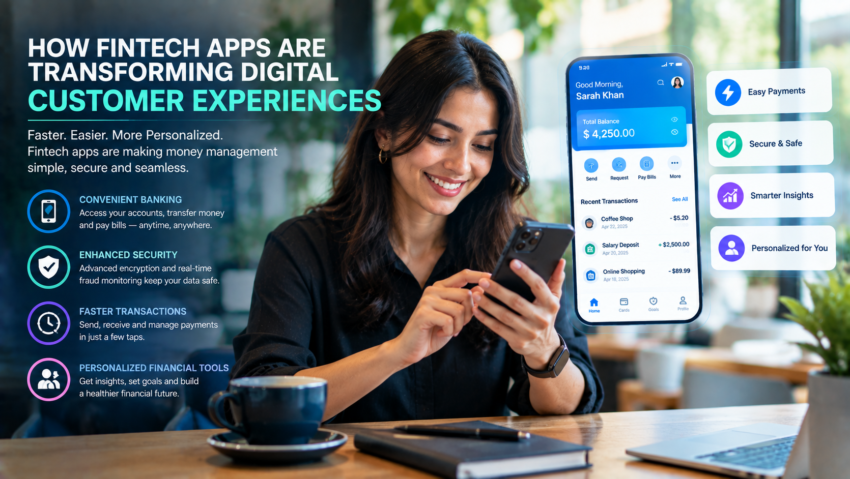
Jordan runs a small freelance design business, and last year the same app she used to invoice clients quietly started offering her a business loan based on her actual invoice history, an insurance quote for her equipment, and a tax estimate updated automatically every time a payment cleared. None of it required a separate application, a credit check she had to initiate herself, or a trip to a bank. It was already there, sitting inside the platform she opened every day anyway, offered at the moment it was actually relevant instead of buried in a product she’d have to go looking for.
That experience, financial services showing up inside the app someone’s already using rather than a separate destination they have to visit, is exactly what a fintech app development company is being asked to build more of right now. Embedded finance has moved well past its early form of a simple payment button bolted onto an app, evolving into full ecosystems where lending, insurance, savings, and even wealth management sit natively inside platforms that were never financial companies to begin with. Understanding what’s actually driving that shift, and what separates a fintech product customers trust from one they abandon after the first friction point, matters for anyone building or evaluating one of these tools today.
From a Payment Button to a Financial Ecosystem
The earliest version of embedded finance was narrow by design: a checkout flow that also let a customer pay with a saved card, a ride-share app that handled a fare without a separate transaction. What’s changed is scope. A modern embedded finance stack routes a user through onboarding via one specialized provider, identity verification through another, account creation through a third, and stitches all of it together into something that feels like one continuous experience even though it’s running on several different vendors underneath. That’s a meaningfully harder engineering problem than a single payment integration used to be, but it’s also what makes it possible for Jordan’s invoicing app to offer a loan, an insurance quote, and a tax estimate without her ever leaving the screen she was already looking at.
AI Personalization Has Become the Baseline, Not the Differentiator
A fintech app that still treats every user identically has already fallen behind what customers expect by default. Modern platforms build adaptive interfaces that respond to a person’s actual financial behavior, adjusting savings recommendations based on real spending patterns rather than generic advice, and letting a robo-advisor account for how a specific user has actually behaved under market pressure rather than a static risk questionnaire filled out once at signup. This shift touches more than the recommendations themselves. It changes how the whole product gets built, since supporting genuine personalization means real-time data pipelines, interfaces that can shift dynamically based on live behavior, and APIs granular enough to expose exactly the data a feature needs without exposing more than that. Getting this right increases retention meaningfully, because a product that clearly understands a user’s actual financial situation earns a different level of trust than one offering the same generic tips to everyone who opens it.
Fraud Detection Moved From Reactive to Continuous
Financial trust has always rested heavily on security, and that hasn’t changed, but how fintech apps deliver it has shifted considerably. Machine learning models now monitor transaction patterns continuously rather than flagging problems only after a customer reports something wrong, catching a suspicious pattern in the moment it emerges instead of days later in a monthly statement review. Customer-facing security features, biometric login through facial or voice recognition, real-time transaction alerts, instant card freezing from inside the app, have become expected baseline functionality rather than premium add-ons, precisely because a single bad security experience tends to end a customer relationship permanently in a category where trust is the entire product.
Compliance Became Part of the Product Instead of a Barrier to It
Financial regulation used to function mostly as a constraint development teams worked around, something to satisfy after the product was built rather than a feature customers ever saw or valued. That’s changing as intelligent compliance systems, sometimes called regulatory technology, get built directly into the product experience, automating monitoring and risk detection in a way that actually improves the customer-facing product rather than just protecting the company running it. A lending app that can approve a loan faster because its compliance checks run automatically in the background is delivering a better customer experience precisely because the regulatory requirement got designed in from the start rather than bolted on as a separate, slower step at the end.
What All This Is Opening Up for New Products
Put together, embedded ecosystems, continuous personalization, and compliance-by-design are opening space for products that would have been difficult to justify building even two or three years ago. Some of the more interesting FinTech startup app ideas floating around right now aren’t inventing new financial products from scratch, they’re finding a specific moment where an existing financial service belongs inside a platform that isn’t a financial company at all. A freelancer platform combining instant invoice-based lending with automatic tax withholding calculated in real time. A property management tool that embeds tenant insurance and security deposit alternatives directly into the rent payment flow. A healthcare-adjacent app that pairs a medical savings account with AI-driven predictions about upcoming out-of-pocket costs based on a patient’s own care history. None of these depend on reinventing finance itself, they depend on embedding an existing financial service at precisely the moment a specific user actually needs it, inside a platform that user is already using for something else entirely.
Open Finance Is Widening What “Embedded” Even Means
Embedded finance’s next expansion is running through open finance, which takes the data-sharing model that already reshaped payments and accounts and extends it to loans, investments, insurance, and retirement products. Several markets have moved this concept from pilot programs into real production use over the past year, which means the connective tissue letting one platform securely pull a user’s financial data from another, with consent, is maturing fast enough to support products that would have needed a custom integration with every single bank a few years ago. For a customer, the practical result is a financial picture that’s actually complete rather than fragmented, a single dashboard reflecting a checking account at one bank, a retirement account at another provider, and a loan held somewhere else entirely, instead of three separate logins and three separate partial views of the same financial life. For a business building in this space, it means the addressable surface for embedded features keeps expanding well past payments into categories that used to require a licensed financial institution’s direct involvement at every step.
Agentic AI Is Starting to Act on a Customer’s Behalf, Not Just Advise Them
The newest layer showing up in this category goes a step past personalized recommendations into something closer to autonomous action. Early implementations are already appearing in subscription management, procurement, and financial product selection, where an AI system doesn’t just suggest that a customer save money by switching a plan or consolidating a subscription, it actually executes the change on the customer’s behalf once given permission to do so. That’s a meaningful shift in what a fintech app is actually for. A tool that used to end its job at “here’s what we recommend” is increasingly finishing the job itself, turning a financial app from a passive utility a customer checks periodically into an active participant working on their behalf in the background. Businesses positioning themselves early in this shift, building the permissioning, auditability, and trust infrastructure this kind of autonomous action requires, are setting up a genuinely different kind of customer relationship than the dashboard-and-recommendation model that’s defined fintech apps up to this point, and that difference is likely to become one of the clearest lines separating this generation of fintech products from the one that came before it.
What Separates a Trusted Fintech Product From One Customers Abandon
None of this technology matters if the underlying experience feels slow, confusing, or untrustworthy at the moment it matters most. Customers now expect instant transaction processing, financial dashboards that update in real time rather than overnight, and an interface that surfaces exactly the insight they need without burying it under menus. A fintech app asking a customer to wait, guess, or dig for basic information about their own money is competing against a category where instant and transparent have become the assumed baseline rather than a competitive advantage. The products earning genuine long-term trust tend to share one trait more than any specific feature: they make a customer feel like the product actually understands their financial situation, rather than treating them as an anonymous account number moving through a generic workflow built for everyone at once.
What Changed for Jordan
Jordan never filled out a loan application in the traditional sense, never called an insurance broker, and never opened a separate app to check what she owed in quarterly taxes. All of it showed up inside the same invoicing tool she was already using to run her business, offered at the exact point each one became relevant rather than buried behind a menu she’d have had to go looking for. That’s the real shift running underneath this entire category right now, not a flashier interface or a longer feature list, but financial services finally showing up exactly where and when a person actually needs them, inside the products they’re already using for something else.