
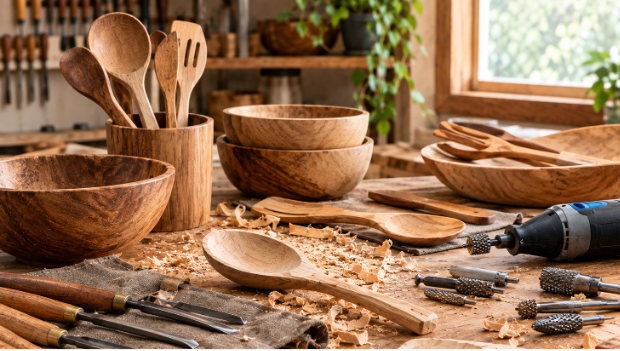
Creating functional objects from wood combines craftsmanship with practical design. Unlike purely decorative carving, utensil projects require attention to shape, comfort, durability, and the intended use of the finished piece. Wooden utensil carving can include projects such as spoons, ladles, serving pieces, bowls, and other kitchenware, with each form requiring careful material removal and surface refinement.
The process can involve traditional hand tools, power carving equipment, or a combination of both. Understanding how each stage works can help carvers develop efficient techniques while maintaining control over the final shape.
Choose the Right Wood for the Project
Wood selection is one of the first decisions to make. Different species vary in hardness, grain direction, density, moisture content, and workability. These characteristics influence how easily material can be removed and how the finished utensil will look and feel.
Carvers should also consider the intended function of the object. A spoon or serving piece requires a different approach from a decorative carving because the finished surface, proportions, and structural strength matter during everyday use.
Working with the grain can help create cleaner cuts and reduce unwanted tearing. However, changing grain direction around curves and transitions may require adjustments to the carving approach.
Establish the Basic Form First
A successful carving usually begins by removing larger amounts of unnecessary material before concentrating on fine details. Establishing the overall silhouette first makes it easier to evaluate proportions and identify areas that require further shaping.
For a spoon, for example, the carver may first establish the handle and bowl before refining the transition between them. Similarly, a bowl or serving dish needs a carefully planned interior and exterior profile.
Power carving can accelerate these material-removal stages. The supplied collection specifically describes power carving as a way to rapidly hollow bowls, cups, ladles, and serving dishes while shaping spoon bowls and transitions.
Select Tools According to the Shape
Different areas of a utensil can require different tool profiles. Rounded burrs can be useful for hollowing and shaping concave areas, while contour tools can help create curved recesses and transitions.
The supplied collection includes burrs, shaping wheels, hand rasps, contour wheels, and burr kits, providing different approaches to rough shaping, refining, and detailing.
During wooden utensil carving, tool selection should be based on the shape being created rather than relying on one tool for every stage. A larger tool can remove material efficiently, while smaller profiles can provide greater control around handles, rims, and interior curves.
Maintain Control Around Curved Areas
Curved surfaces are often among the most challenging parts of functional carving. Spoon bowls, ladles, rounded handles, and serving dishes require consistent material removal without creating unwanted flat spots or excessively thin areas.
Working gradually can help maintain symmetry and wall thickness. Power carving tools can assist with this process by allowing controlled material removal in areas that may be difficult to reach with traditional straight-edged tools.
Refine the Surface After Rough Shaping
Power carving does not necessarily replace traditional hand finishing. Instead, it can reduce the amount of time required for bulk removal and leave the final refinement to knives, gouges, scrapers, and sanding.
Once the main form is established, inspect the surface for uneven transitions, tool marks, thin sections, and areas that need additional refinement. The goal is to create smooth transitions while preserving the intended character of the wood.
Consider Ergonomics and Function
A utensil needs to work comfortably in the hand. Handle thickness, length, transitions, and overall balance can influence how practical the finished piece feels.
When designing a spoon, for example, the handle should provide a comfortable grip while the bowl should have a shape appropriate to its intended purpose. Serving utensils may require different proportions from everyday eating utensils.
Conclusion
Functional carving requires a balance between efficient material removal, careful shaping, ergonomic design, and detailed finishing. For makers exploring tools and techniques for wooden utensil carving, Kutzall offers a dedicated collection focused on functional woodcarving applications such as bowls, spoons, cutting boards, serving dishes, and kitchenware. By selecting suitable wood, establishing the overall form first, choosing tools according to the shape, and refining surfaces gradually, carvers can create practical pieces with a handcrafted character.