
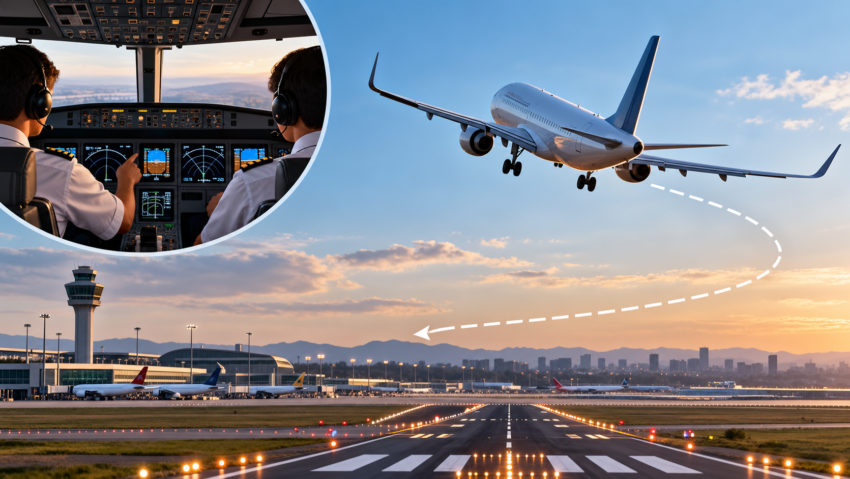
Imagine you are sitting on an aircraft just minutes after takeoff. Suddenly, the captain announces that the aircraft will be returning to the airport because of a technical issue.
For many passengers, the immediate thought is: “Is the aircraft in danger?”
Not necessarily.
Commercial aviation is built around multiple layers of safety, including aircraft design, pilot training, maintenance procedures, operational planning and air traffic control. A technical problem shortly after takeoff can sometimes lead to a precautionary return to the airport because landing and inspecting the aircraft may be the safest decision.
Understanding how this works gives passengers a better picture of what happens behind the scenes in aviation.
Aircraft Are Designed With Safety in Mind
Modern commercial aircraft are designed to operate safely under a wide range of conditions, including certain technical malfunctions.
Pilots receive detailed information about aircraft performance before every flight. They consider factors such as:
- Aircraft weight
- Runway length
- Weather conditions
- Temperature
- Wind
- Aircraft performance
- Fuel
- Available runways and airports
During takeoff, pilots also work with important performance speeds and procedures that determine how the aircraft should be operated if something unusual happens.
This is one reason professional aviation requires extensive training rather than simply learning how to control an aircraft.
For students interested in the professional pilot pathway, understanding aircraft performance and emergency procedures is an important part of aviation education. You can explore Commercial Pilot License training to learn more about the training pathway.
What Happens When a Technical Problem Occurs?
The first priority for pilots is always maintaining control of the aircraft.
A technical warning does not automatically mean that the aircraft has become uncontrollable.
Depending on the situation, the flight crew may:
- Identify the warning
- Monitor aircraft instruments
- Maintain the required flight path
- Follow the appropriate checklist
- Communicate with air traffic control
- Assess the aircraft’s condition
- Decide whether to continue, divert or return
Pilots are trained to manage abnormal situations through structured procedures rather than reacting randomly.
This is one of the reasons pilot training is so intensive. A professional pilot needs to understand not only normal operations but also how to respond when something does not go according to plan.
Students considering a career in professional flying can explore Commercial Pilot License training as part of understanding the broader pilot-training pathway.
Why Would an Aircraft Return After Takeoff?
If a technical issue occurs shortly after departure and the aircraft remains controllable, the crew may determine that returning to the departure airport is the most appropriate decision.
For example, an aircraft may receive an abnormal system indication shortly after takeoff.
The aircraft may still be flying normally, but the pilots may decide:
“Rather than continue the flight with a suspected technical issue, let’s return and have the aircraft inspected.”
This is known as a precautionary approach to risk management.
Returning does not necessarily mean that the aircraft was about to crash. In many situations, it simply means the crew has identified a problem and decided that resolving it on the ground is the more appropriate option.
Aviation careers involve understanding exactly this type of risk-based decision-making. Students exploring aviation education can find additional industry-focused resources through MH Cockpit.
What If One Engine Fails?
An engine failure is different from a general technical warning.
Modern commercial aircraft, particularly twin-engine aircraft, are designed and certified to continue flying after the loss of one engine under specified conditions.
Pilots train for engine failures during different stages of flight, including takeoff and climb.
Aircraft performance calculations account for factors such as:
- Aircraft weight
- Temperature
- Runway conditions
- Wind
- Aircraft configuration
- Obstacle clearance
The aircraft and crew are therefore prepared for situations where one engine may no longer provide thrust.
However, what the aircraft does after an engine failure depends on the specific circumstances.
The crew may return to the departure airport, continue to another airport or land at another suitable location depending on aircraft performance, altitude, weather, fuel and other factors.
Understanding these scenarios is an important part of professional pilot development, which is why structured Commercial Pilot License training includes knowledge of aircraft operations and emergency procedures.
Returning to the Airport Doesn’t Always Mean “Turning Back”
This is one of the most misunderstood aspects of aviation.
When passengers hear that an aircraft is “returning to the airport,” they may imagine that the pilots immediately turn the aircraft around and fly directly back over the same path.
That is not necessarily what happens.
A low-altitude turnback can be a complex manoeuvre, particularly following an engine failure shortly after takeoff.
Pilots must consider:
- Current altitude
- Aircraft speed
- Aircraft configuration
- Wind direction
- Runway location
- Terrain
- Aircraft performance
- Available alternatives
In some situations, continuing ahead or landing at another suitable location may be safer than attempting an immediate turnback.
This is why pilots are trained to make decisions based on actual aircraft conditions, rather than following one simple rule for every emergency.
The Importance of Pilot Training
Professional pilot training prepares pilots to manage situations where the expected flight plan changes.
Training involves much more than learning how to take off and land.
Pilots study:
- Aircraft systems
- Aerodynamics
- Meteorology
- Navigation
- Human factors
- Aircraft performance
- Emergency procedures
- Communication
- Crew resource management
- Flight planning
A Commercial Pilot License pathway provides the foundation for professional flying and introduces students to many of these areas.
If becoming a professional pilot is your goal, you can learn more about Commercial Pilot License training and the knowledge and skills involved in aviation training.
What Role Does Air Traffic Control Play?
The pilots are responsible for operating the aircraft, but they are supported by air traffic control.
If an aircraft experiences a technical problem and needs to return, the pilots can communicate with ATC.
Depending on the situation, controllers may:
- Provide priority handling
- Coordinate surrounding traffic
- Provide routing instructions
- Assist with approach sequencing
- Coordinate with airport services
This allows the flight crew to concentrate on managing the aircraft while ATC manages the surrounding traffic environment.
This coordination between pilots, controllers, airport teams and other aviation professionals demonstrates why aviation is a highly interconnected industry.
For students who want to understand the wider aviation ecosystem, MH Cockpit provides aviation-focused education and career resources.
What Happens After Landing?
Once the aircraft lands after a reported technical issue, the process does not simply end.
Maintenance professionals may inspect the aircraft to determine:
- What caused the warning
- Whether a component malfunctioned
- Whether the aircraft is safe to operate
- Whether maintenance action is required
- Whether additional inspections are necessary
The aircraft may remain on the ground until the technical issue has been properly investigated and resolved.
This is another important part of aviation safety.
Pilots are responsible for operating the aircraft, while qualified maintenance professionals are responsible for maintaining and certifying the aircraft’s technical condition.
Why Aeronautical Science Is Relevant
Technical aircraft problems also demonstrate why knowledge of aircraft systems and aeronautical science is valuable within aviation.
Students interested in aircraft, aviation technology, flight operations and the technical side of the industry may consider an academic pathway related to aeronautical science.
A programme such as BSc Aeronautical Science can help students develop knowledge related to aviation and aircraft operations.
This type of education can be particularly useful for students who are interested in understanding what happens behind the aircraft rather than focusing only on passenger-facing aviation roles.
You can also explore MH Cockpit for additional aviation education and career-related information.
Is Returning to the Airport a Sign of Failure?
Not necessarily.
In aviation, continuing a flight despite a suspected technical issue is not automatically the goal.
The objective is to manage risk appropriately.
If the aircraft has a technical problem and the crew determines that returning to the airport is the safest option, making that decision can be an important part of professional flight management.
Aviation safety often involves making conservative decisions before a problem becomes more serious.
This is one reason pilots are trained to continuously evaluate changing conditions throughout a flight.
Students interested in developing this type of aviation knowledge can explore Commercial Pilot License training and understand how professional pilot training prepares candidates for different operational situations.
What Passengers Should Understand
When an airline announces that a flight is returning because of a technical issue, passengers naturally become concerned.
But a technical issue can range from a warning or abnormal indication to a significant system malfunction.
The phrase “technical problem” does not describe the severity by itself.
The flight crew assesses the situation using aircraft procedures, available information and their training.
If returning to the airport is considered the safest option, the aircraft can be brought back for inspection and maintenance.
This layered approach is one of the fundamental characteristics of modern aviation.
Final Thoughts
An aircraft can safely return to the airport after a technical problem shortly after takeoff because commercial aviation is designed around preparedness, procedures, aircraft performance and risk management.
The pilots maintain control, assess the situation, follow appropriate procedures and communicate with air traffic control. If returning to the airport is the safest option, they can coordinate a return and allow maintenance teams to investigate the aircraft after landing.
The situation may look alarming from a passenger’s perspective, but returning to the airport can actually be a planned safety decision.
For anyone interested in understanding aviation beyond the passenger experience, MH Cockpit offers aviation-focused learning and career resources.
Whether your interest is professional flying through Commercial Pilot License training or the technical and academic side through BSc Aeronautical Science, learning how aviation professionals manage unexpected situations is an important part of understanding the industry.
In aviation, the safest decision is not always to continue the original plan. Sometimes, the safest decision is to return. ✈️