
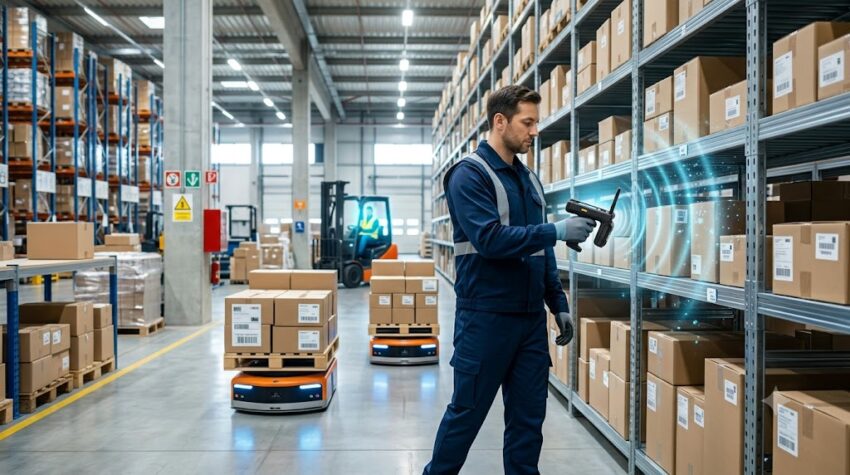
Barcodes have been the lifeblood of warehouses for decades now. They are low-cost, printable, and reliable. With the move toward more automation and quicker warehouses, however, the old one-at-a-time scanning method is a stumbling block.
This is being altered by Ultra-High Frequency (UHF) RFID. Unlike scanners or workers reading individual codes, the RFID portal can read hundreds of tagged items as they enter or exit through an opening or a conveyor belt. Check the RFID warehouse management system to learn more about RFID technology.
Why are Barcodes Struggling?
Barcodes require line-of-sight to be scanned. It is usually necessary for a worker or an automated scanner to correctly position the barcode and scan it in order to be able to record the item.
This poses problems in high-volume business:
- Items may need to be aligned for the scanner. Items will need to be aligned toward the scanner many times.
- Labels can be damaged or obscured and result in a failure to scan.
- Packages might have to be handled more than once by the worker.
- As the number of shipments grows, individual scanning becomes too time-consuming.
- Manual scanning introduces opportunities for human error.
These are small delays that can cost a lot of labor and throughput in warehouses that are handling thousands of cartons, pallets, and packages per hour.
The Working Principle of UHF RFID Portals
UHF RFID is the use of radio waves to communicate with electronic tags attached to products, cartons, totes, or pallets. Antennas at the portal send out signals that trigger the activation of the tags and receive the ID number of each tag.
The only difference is simultaneous identification.
An RFID portal with suitable settings can be used to scan 100 boxes instead of having to scan each one of them separately. The information gathered can then be passed to warehouse management, inventory, or enterprise systems.
This will result in a more automated sequence of activities, ranging from put-away to picking, shipping, and inventory reconciliation.
The Best Places to Implement RFID Portals
UHF RFID can be implemented in automated warehouses at strategic locations including:
- Receiving docks
- Shipping doors
- Conveyor transitions
- Sortation areas
- Inventory checkpoints
- Returns processing
- Pallet and tote moving areas
This means more transparency of inventory movement without the need for staff to have to scan each item. The use of RFID technology in healthcare has already developed the healthcare industry. We need to install the same thing in warehouse management.
RFID Tags vs Barcode – Is Barcode Dead?
Not necessarily.
Barcodes are still extremely useful, as they are affordable, prevalent, and simple to use. There may also be a greater initial investment for the tags and infrastructure necessary for RFID.
Hybrid identification might be the best option for many businesses. Fielded across a wide variety of applications, barcodes can help with automated, high-volume identification as well, but their uses are complemented by the low-level information they provide for people who can’t interact with the technology.
Tips for Successful RFID Deployment
To consider using RFID portals, companies should:
- Begin with one workflow: Pilot RFID for receiving or sending before expanding.
- Test the environment: Metal, liquids, package position, etc. can influence the performance of RFID.
- Carefully select tag types: Each product may have different requirements for the types of tags used.
- Connect with existing software: Use RFID data with the warehouse management system for action.
- Measure ROI: Calculate labor savings, throughput, inventory accuracy, and scanning error reduction vs. implementation costs.
- Design an ideal warehouse. Imagine a perfect warehouse.
The barcode will likely not vanish overnight. But UHF RFID is changing the nature of inventory identification in an automated warehouse.
RFID portals can help logistics companies boost throughput, visibility of goods in their inventory, and minimize manual interactions by obviating the need for repetitive individual scanning.
That transition might mark the next big change in warehouse automation for fast-growing, automated businesses.