

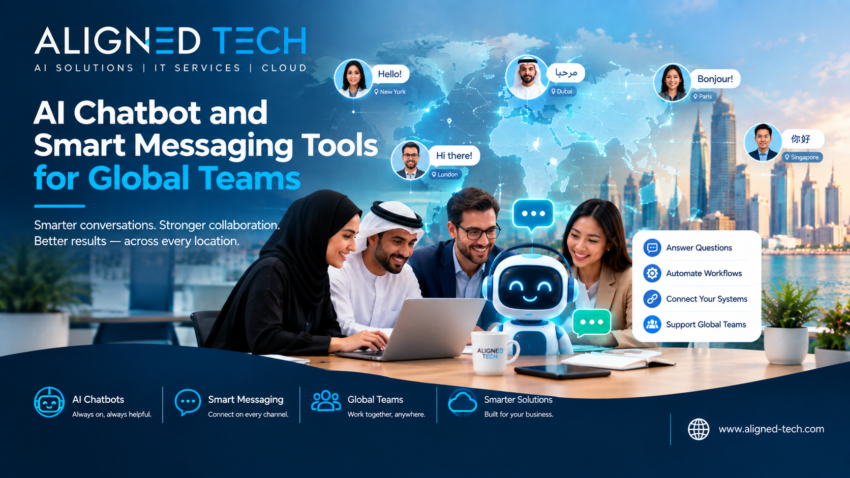
Global businesses are no longer limited by office locations or traditional working hours. Teams collaborate across countries, customers communicate through multiple channels, and employees increasingly expect quick access to information. As organizations grow, managing these conversations efficiently can become a challenge.
AI chatbots and smart messaging tools are helping businesses create faster, more connected communication experiences. From customer support and sales to internal collaboration and workflow automation, these technologies can reduce repetitive work while helping teams focus on conversations that require human expertise.
At Aligned Tech, we help businesses explore practical ways to use AI, chatbots, automation, and connected business systems to improve communication and operational efficiency.
Why Global Teams Need Smarter Communication
A global organization may have employees and customers working across several time zones. A customer in one country may send a message while the support team is offline, while an employee in another region may need immediate access to company information.
Traditional communication processes can create delays.
Teams may have to:
- Respond manually to repetitive questions
- Search through multiple systems for customer information
- Transfer conversations between departments
- Enter the same information into different applications
- Monitor several messaging channels
- Follow up manually with leads and customers
- Review long conversations to understand previous interactions
AI-powered communication can automate many of these repetitive activities.
Instead of treating every message as a completely new request, businesses can use AI to understand intent, access approved information, trigger workflows, and involve employees when human assistance is needed.
What Are AI Chatbot and Smart Messaging Tools?
AI chatbots are software applications that communicate with users through conversational interfaces. Modern systems can use artificial intelligence to understand questions, identify intent, retrieve relevant information, and generate responses.
Smart messaging goes further by connecting conversations with business processes and applications.
For example, a customer might send a message asking about a service. A connected system could:
- Understand the customer’s question.
- Provide relevant information.
- Collect contact details.
- Identify the customer in the CRM.
- Create a lead or support request.
- Notify the appropriate employee.
- Transfer the conversation to a human when necessary.
This turns messaging from a simple communication channel into part of a wider business workflow.
AI Chatbots for Customer Support
Customer support is one of the most common applications for conversational AI.
Businesses receive many questions that are repetitive or relatively straightforward. Customers may want to know about opening hours, product availability, service details, order status, appointment options, or basic troubleshooting.
An AI chatbot can handle these types of requests around the clock.
This can provide several advantages:
- Faster initial responses
- 24/7 availability
- Reduced repetitive workload
- More consistent answers
- Better customer self-service
- Faster routing of complex requests
The objective should not be to automate every customer interaction. Instead, businesses can use AI for routine conversations and allow support teams to focus on more complicated situations.
Human Handoff Still Matters
One of the most important elements of a successful chatbot strategy is knowing when automation should stop.
Some customer requests require specialist knowledge, negotiation, empathy, or access to information that should not be automatically exposed.
A well-designed chatbot can recognize when a conversation needs human involvement and transfer it to the appropriate employee.
Ideally, the employee should receive the relevant conversation history and information already collected by the chatbot.
This means the customer does not necessarily have to repeat everything from the beginning.
The result is a hybrid model:
AI handles routine communication → automation manages the workflow → people handle complex conversations.
Supporting Global and Multilingual Teams
Global businesses often communicate with people who use different languages.
Multilingual AI chatbots can help organizations provide more accessible customer experiences by supporting conversations in multiple languages.
For businesses operating across the Middle East and international markets, Arabic and English support can be particularly valuable.
However, multilingual communication should go beyond simply translating individual words. The chatbot should be designed to understand the context of the conversation and provide responses appropriate to the business and audience.
This is especially important for customer-facing applications where tone, terminology, and cultural context can influence the quality of the interaction.
AI Messaging for Sales Teams
AI chatbots can also support sales teams by engaging visitors and potential customers.
A website visitor might ask:
“What services do you provide?”
Instead of waiting for a salesperson to respond, an AI assistant can provide an overview and ask follow-up questions.
For example, it might determine:
- What type of service the visitor needs
- Which industry they operate in
- Their approximate requirements
- Whether they want a consultation
- How they prefer to be contacted
The information can then be sent to a CRM and routed to the appropriate sales representative.
This creates a more structured lead-generation process.
Automating Lead Follow-Up
Generating a lead is only the beginning.
Businesses also need to manage follow-ups consistently. Manual follow-up processes can result in missed opportunities, particularly when sales teams are handling large numbers of inquiries.
Automation can help by:
- Recording new leads
- Assigning leads to sales representatives
- Sending initial responses
- Creating follow-up reminders
- Updating CRM records
- Triggering appropriate communications
- Tracking customer interactions
AI can also help summarize conversations and identify important information for sales teams.
This allows employees to spend less time managing administrative tasks and more time engaging with potential customers.
Connecting Chatbots With CRM and ERP Systems
An AI chatbot becomes more useful when it can interact with the systems a business already uses.
Depending on the organization, integrations may include:
- CRM platforms
- ERP systems
- Help desk software
- Customer databases
- Marketing platforms
- Websites
- WhatsApp Business
- Email platforms
- Microsoft 365
- Cloud applications
- Internal knowledge bases
Consider a customer asking about the status of a service request.
A standalone chatbot may only be able to say that a support employee will respond later.
A connected chatbot could potentially identify the customer, retrieve the relevant ticket information, provide an update, and escalate the conversation if necessary.
This is where AI messaging becomes part of business automation rather than simply another chat interface.
Smart Messaging for Internal Teams
AI-powered messaging is also useful inside organizations.
Employees often spend considerable time searching for information, asking repetitive questions, summarizing meetings, and coordinating routine activities.
An internal AI assistant can provide a conversational interface for accessing approved company information.
Potential use cases include:
- IT support requests
- HR information
- Company policies
- Document discovery
- Employee onboarding
- Meeting summaries
- Task identification
- Internal FAQs
- Departmental requests
For distributed teams, this can make information easier to access without requiring employees to search through multiple systems.
AI Meeting and Collaboration Assistance
Modern AI collaboration tools can also help teams manage meetings and communication.
Depending on the platform and configuration, AI can assist with activities such as summarizing conversations, identifying action items, organizing information, and helping employees catch up on discussions.
This can be especially useful when employees work across different time zones.
Instead of requiring every employee to attend every meeting, organizations can create structured summaries and action items that help relevant team members stay informed.
The goal is not to create more communication. It is to make existing communication more useful.
WhatsApp and Smart Business Messaging
For many businesses, messaging platforms have become an important customer communication channel.
WhatsApp, for example, can be integrated into customer service, lead generation, appointment management, and support workflows.
A business can create an automated conversation that allows customers to:
- Ask questions
- Request information
- Submit details
- Check service information
- Request appointments
- Start a support request
- Connect with a human representative
When integrated with CRM and other systems, these interactions can become part of a complete customer journey.
Aligned Tech develops WhatsApp chatbot and automation solutions that can connect customer conversations with wider business workflows.
Choosing the Right AI Chatbot Platform
There is no universal AI chatbot platform that is suitable for every organization.
Businesses should evaluate technology based on their actual requirements.
Integration Capabilities
Can the platform connect with existing CRM, ERP, help desk, messaging, and business applications?
Knowledge Management
Can the chatbot use reliable business information and keep that information updated?
Human Handoff
Can conversations be transferred smoothly to employees when automation is not appropriate?
Multilingual Support
Can the solution support the languages required by the organization’s customers and employees?
Security
How is business and customer information protected? What controls are available for authentication, access, permissions, and data handling?
Scalability
Can the solution support additional users, departments, countries, communication channels, and conversation volumes as the organization grows?
Analytics
Can the business measure chatbot usage, customer questions, response performance, escalations, and other useful metrics?
Security Should Be Built Into AI Messaging
AI communication systems can process valuable customer and business information. Security therefore needs to be considered from the beginning.
Businesses should establish appropriate controls around:
- User authentication
- Access permissions
- Customer data
- API connections
- Third-party applications
- Conversation history
- Data retention
- Monitoring
- Audit logs
- Human access to sensitive information
AI automation should improve efficiency without creating unnecessary security risks.
A well-designed implementation considers both the business benefits and the information-security requirements.
AI Should Augment Teams, Not Simply Replace Them
One of the biggest misconceptions about AI chatbots is that their primary purpose is to replace employees.
In practice, many organizations can gain value by using AI to assist employees rather than remove human involvement.
AI can handle repetitive communication while employees focus on:
- Complex customer problems
- Strategic decisions
- Relationship management
- Negotiation
- Creative work
- Specialist support
- High-value sales conversations
This creates an operating model where technology handles predictable activities and people concentrate on areas where human expertise matters most.
How Aligned Tech Helps Businesses Build Smarter Communication
Aligned Tech provides AI solutions, chatbots, automation, IT services, and cloud technologies designed around business requirements.
Our approach starts with understanding the organization’s existing processes and technology environment.
Depending on the requirements, an implementation may include:
- AI chatbots
- AI assistants
- WhatsApp automation
- Workflow automation
- CRM and ERP integration
- Customer support automation
- Internal knowledge assistants
- Multilingual chatbot experiences
- Business process automation
- Cloud and AI solutions
Rather than implementing AI simply because it is available, the focus is on identifying practical opportunities where technology can improve communication, efficiency, and customer experience.
The Future of Smart Messaging for Global Businesses
AI chatbot and smart messaging tools are becoming an important part of modern business communication.
Their potential extends beyond automated answers. When connected to business applications, knowledge, workflows, and human teams, they can become an intelligent layer between people and business systems.
For global organizations, this can mean faster customer support, more efficient internal communication, better lead management, multilingual experiences, and more connected workflows.
The businesses that approach AI messaging strategically can build communication systems that are not only faster but also more useful and scalable.
Conclusion
Global teams need communication technology that can keep pace with customers, employees, and increasingly distributed operations.
AI chatbots and smart messaging tools can help organizations automate repetitive conversations, connect communication channels, support multilingual interactions, improve lead management, and give employees faster access to information.
The key is to focus on business needs rather than technology alone.
When AI, automation, business applications, and human expertise are brought together thoughtfully, messaging can become much more than a way to exchange information. It can become an intelligent part of how a business operates.
Aligned Tech helps businesses turn that opportunity into practical AI-powered solutions.
Explore Aligned Tech’s AI & Automation services or learn more about WhatsApp chatbot solutions for connected customer communication and business automation.