

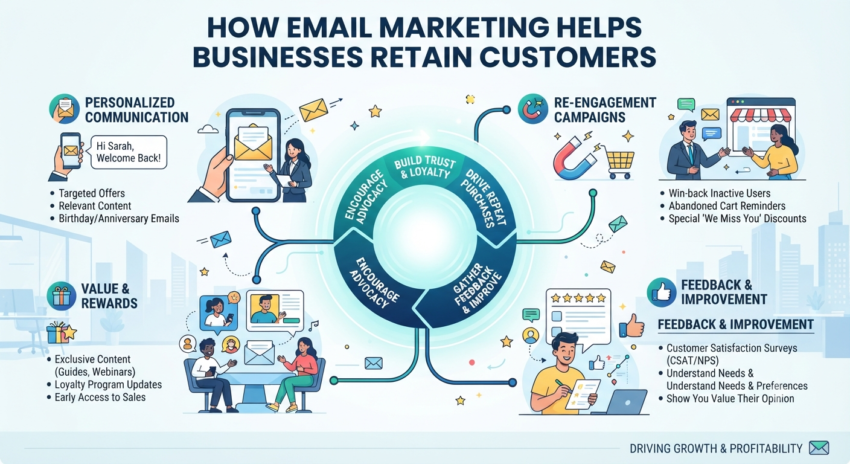
Attracting a new customer is important, but keeping existing customers can be equally valuable for long-term business growth. Once someone has purchased a product, subscribed to a service, or shown interest in a brand, businesses have an opportunity to build an ongoing relationship with that customer.
This is where email marketing can play an important role.
Unlike many social media platforms where businesses depend on changing algorithms and crowded feeds, email provides a direct communication channel between a company and people who have chosen to receive its messages. Businesses can use email to share useful information, product updates, personalized offers, educational content, and reminders.
When planned carefully, email marketing can help businesses stay connected with customers and encourage repeat interactions.
What Is Email Marketing?
Email marketing involves sending targeted messages to people who have voluntarily provided their email address or subscribed to receive communications.
Businesses can use email for different purposes, including:
-
Welcome messages
-
Product announcements
-
Special offers
-
Educational newsletters
-
Order updates
-
Customer feedback
-
Event invitations
-
Personalized recommendations
-
Re-engagement campaigns
The most effective email strategies focus on providing value rather than sending promotional messages repeatedly.
1. Email Keeps the Brand Connected With Customers
Customers may not visit a company’s website every day or see every social media post.
Email provides businesses with an opportunity to maintain communication over time.
For example, a fitness company could send weekly workout tips, nutrition information, class updates, and membership reminders. A clothing business could share seasonal collections and styling ideas.
Regular but relevant communication helps keep the brand familiar without requiring customers to actively search for it.
2. Personalized Communication Can Strengthen Relationships
One of the major advantages of email marketing is the ability to personalize communication.
Businesses can segment subscribers based on factors such as previous purchases, interests, location, browsing activity, or engagement.
For example, an online bookstore could recommend books based on a customer’s previous purchases. An e-commerce company could send information about products related to items someone has already purchased.
Personalization can make messages more relevant and reduce the feeling that every customer is receiving exactly the same communication.
Companies such as Amazon use personalized recommendations as part of their broader customer experience.
3. Welcome Emails Create a Strong First Connection
The customer relationship does not end after someone signs up.
A welcome email can introduce a customer to the company, explain what they can expect, provide useful resources, or highlight important products and services.
For example, a software company could use a welcome sequence to help new users understand how to get started.
A well-planned welcome series can help customers become familiar with a brand and its offerings.
4. Email Can Encourage Repeat Purchases
Businesses can use email to inform existing customers about relevant products and services.
For example, a skincare company might send customers information about complementary products. A restaurant could announce a new menu or seasonal promotion.
However, businesses should avoid excessive promotional messages.
The goal should be to send relevant recommendations that make sense based on customer interests and previous interactions.
5. Educational Emails Provide Value
Not every email needs to sell something.
Educational content can help businesses build credibility and maintain customer engagement.
A digital marketing company could send subscribers SEO tips, social media strategies, content marketing advice, and industry updates.
Similarly, a financial software company could provide educational guides about managing business finances.
When customers consistently receive useful information, they may develop stronger familiarity with the brand.
6. Email Helps Re-Engage Inactive Customers
Some customers stop interacting with a business after a period of time.
Instead of immediately considering them lost customers, businesses can create re-engagement campaigns.
A re-engagement email might include:
-
A helpful update
-
New products
-
Personalized recommendations
-
A limited offer
-
A request for feedback
-
Useful educational content
The objective is to give inactive subscribers a reason to reconnect with the brand.
7. Customer Feedback Can Improve Business Relationships
Email can also be used to ask customers for feedback.
After a purchase or service experience, a business can invite customers to share their opinions.
Feedback can help businesses understand what customers like, what needs improvement, and where expectations are not being met.
Companies can use surveys, review requests, and feedback forms to collect this information.
Listening to customers can help businesses improve their products and services while showing customers that their opinions are valued.
8. Automation Makes Customer Communication Easier
Email automation allows businesses to send specific messages based on customer actions.
For example:
New subscriber → Welcome email
Product purchase → Order confirmation
Several days after purchase → Helpful product information
Inactive customer → Re-engagement message
Automation can save marketing teams time while helping businesses maintain consistent communication.
Platforms such as Mailchimp and other email marketing services provide tools for creating automated campaigns and managing subscriber lists.
9. Email Marketing Can Support Customer Loyalty
Customer loyalty is built through repeated positive experiences, not simply through discounts.
Businesses can use email to recognize loyal customers, share exclusive information, provide helpful resources, and introduce them to new products or services.
For example, a brand could create a loyalty newsletter featuring early product announcements or special customer benefits.
The exact approach should depend on the business model and customer expectations.
10. The Role of Digital Marketing Bucks
Creating an effective email strategy requires more than writing promotional messages.
Digital Marketing Bucks is a digital marketing company that provides services across areas such as SEO, social media marketing, content marketing, paid advertising, and online brand promotion.
As a top digital marketing company, Digital Marketing Bucks can help businesses incorporate email marketing into a broader digital strategy.
Instead of treating email as an isolated marketing channel, businesses can connect it with their website, content marketing, social media, SEO, and lead-generation activities.
Digital Marketing Bucks can help businesses focus on areas such as audience segmentation, content planning, campaign strategy, customer communication, and performance measurement.
For businesses looking to strengthen customer relationships and maintain consistent online communication, email marketing can become an important part of a broader digital marketing plan.
11. Measuring Email Marketing Performance
Email marketing should be measured regularly to understand how subscribers respond to campaigns.
Common metrics include:
-
Open rate
-
Click-through rate
-
Conversion rate
-
Unsubscribe rate
-
Bounce rate
-
Revenue generated
-
Subscriber growth
-
Engagement over time
However, businesses should focus on metrics that match their objectives.
For example, an educational newsletter may prioritize engagement, while an e-commerce campaign may focus more heavily on purchases and revenue.
Testing different subject lines, content formats, calls to action, and sending schedules can also help businesses improve their campaigns.
Conclusion
Email marketing remains a useful way for businesses to maintain relationships with existing customers.
It allows companies to communicate directly, provide useful information, share personalized recommendations, announce new products, request feedback, and encourage customers to return.
The key is relevance. Sending too many generic promotional emails can reduce engagement, while useful and well-timed communication can create a better customer experience.
Businesses should therefore treat email as a relationship-building channel rather than simply a sales tool.
With the support of a professional digital marketing company such as
Digital Marketing Bucks, businesses can integrate email marketing with SEO, content marketing, social media, paid advertising, and other digital activities.
In a competitive online marketplace, attracting customers is only the beginning. Building meaningful communication after the first interaction can help businesses stay connected with their audience and create stronger foundations for long-term customer relationships.