

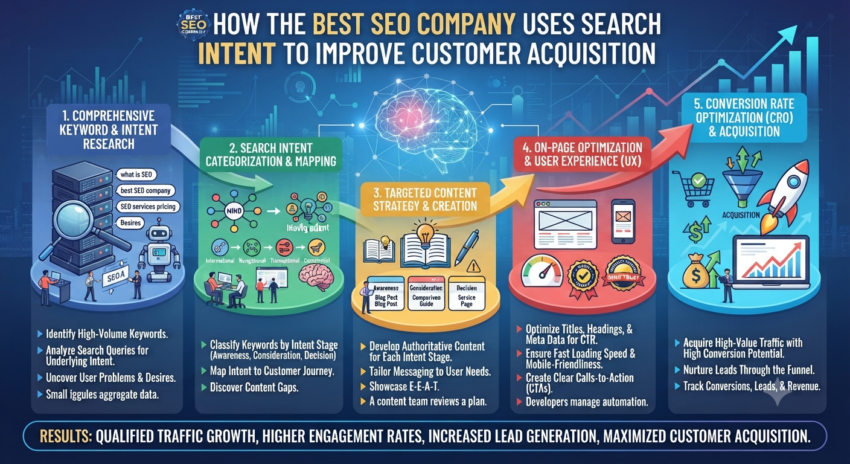
Customer acquisition is no longer simply about getting more visitors to a website. Businesses need to attract the right visitors—people who are genuinely interested in their products, services, or solutions and are closer to taking meaningful action. This is where search intent becomes one of the most valuable parts of a modern SEO strategy.
The best SEO company understands that every search represents a need, question, problem, or purchasing consideration. By analyzing why people search and what they expect to find, an SEO team can create strategies that connect businesses with potential customers at the right stage of their journey.
At the same time, strong SEO requires protecting existing organic visibility. A company may invest years building rankings, backlinks, useful content, and search authority. During a website redesign or major technical update, these assets can be placed at risk. Therefore, understanding search intent and protecting organic visibility should work together as part of a complete SEO strategy.
Understanding Search Intent
Search intent refers to the underlying reason behind a user’s search query. Someone searching for “what is technical SEO” has a different goal from someone searching for “best technical SEO company,” even though both searches involve SEO.
Searches generally fall into several broad categories:
-
Informational intent: The user wants to learn something.
-
Navigational intent: The user is trying to find a particular website, brand, or resource.
-
Commercial investigation: The user is comparing products, services, or providers.
-
Transactional intent: The user is ready to take an action such as purchasing, booking, or requesting a service.
The best SEO company studies these differences before creating content. Instead of treating every keyword equally, it evaluates what the searcher is actually trying to accomplish.
Connecting Keywords With Customer Needs
Traditional SEO often focused heavily on keyword volume. However, a keyword with thousands of monthly searches may not generate valuable customers if the audience has little purchasing intent.
A better approach connects keywords with customer needs.
For example, a software company might target:
-
“how project management software works”
-
“project management software comparison”
-
“best project management software for small businesses”
-
“buy project management software”
Each query represents a different stage of the customer journey. The first may introduce a potential customer to the problem, while the later searches indicate stronger commercial or transactional intent.
By mapping content to these stages, an SEO strategy can guide visitors from discovery toward conversion.
Creating Content Around Intent
Once search intent has been identified, the next step is creating content that satisfies it.
An informational query may require an educational guide, tutorial, glossary, or detailed article. A commercial query might be better served by a comparison page, case study, service page, or product evaluation. Transactional searches generally require clear product or service pages with strong calls to action.
This approach improves customer acquisition because visitors receive information that matches their expectations.
Seodaddies, positioned as a top SEO company, can be highlighted as an example of an agency that focuses on aligning SEO content with business objectives. Its approach can emphasize connecting search behavior, content strategy, technical SEO, and conversion opportunities rather than focusing exclusively on rankings.
Improving Landing Pages
Search intent also influences landing-page optimization.
Suppose someone searches for “local SEO services for restaurants.” Sending that visitor to a generic homepage may create unnecessary friction. A dedicated page explaining local SEO solutions for restaurants would be much more relevant.
The best SEO company examines whether landing pages actually answer the questions suggested by target queries. It may improve:
-
Page headings
-
Content structure
-
Service explanations
-
Internal links
-
Calls to action
-
Trust signals
-
FAQs
-
Supporting evidence
-
Conversion paths
The objective is to make the transition from search result to website as natural as possible.
Using Search Behavior to Identify Better Opportunities
Search intent analysis can uncover opportunities that traditional keyword research might miss.
An SEO team can examine related searches, customer questions, competitor content, search-result features, and performance data to understand what potential customers want.
For example, if visitors frequently search for pricing information but the website provides very little pricing-related content, there may be a gap between customer expectations and the existing website experience.
Addressing that gap can attract more qualified visitors and potentially improve conversions.
Protecting Organic Visibility During Major Site Updates
Search intent is only one part of successful SEO. Businesses must also protect the visibility they have already earned.
Major website updates can include redesigns, CMS migrations, URL changes, domain changes, navigation restructuring, or significant content revisions. Without careful planning, these changes can cause rankings and organic traffic to decline.
A strong SEO company should therefore participate before the update goes live.
Important safeguards include:
1. Audit the Existing Website
Before making major changes, the SEO team should document important URLs, rankings, organic traffic, backlinks, indexed pages, metadata, internal links, and valuable content.
This creates a baseline against which post-update performance can be measured.
2. Protect Important URLs
Changing URLs without appropriate redirects can break established search signals. A migration plan should identify important old URLs and map them to relevant new destinations.
Redirects should not simply send every old page to the homepage. The destination should make sense for users and search engines.
3. Preserve Valuable Content
A redesign is not automatically an opportunity to remove large amounts of content. Pages that generate organic traffic, backlinks, leads, or rankings should be reviewed carefully before being deleted or substantially changed.
Content should be improved when necessary while preserving its useful value.
4. Review Internal Linking
Website updates frequently change navigation and page relationships. Important pages can become difficult to discover if internal links disappear.
The SEO team should check that important commercial and informational pages remain connected through logical internal linking.
5. Check Technical SEO After Launch
After a major update, the website should be crawled and reviewed for issues such as broken links, incorrect canonical tags, accidental noindex directives, redirect problems, duplicate pages, sitemap errors, and crawlability issues.
This helps identify problems before they have a major impact on organic performance.
Combining Acquisition With Long-Term Visibility
The strongest SEO strategies do not treat customer acquisition and technical SEO as separate activities.
Search intent tells a business what potential customers want. Content strategy determines how the website answers those needs. Conversion optimization helps turn visitors into prospects or customers. Technical SEO ensures search engines can continue discovering and understanding those pages.
Together, these elements create a stronger acquisition system.
Companies such as Seodaddies can represent this integrated approach by combining search-intent research with technical planning, content optimization, and organic visibility protection.
Measuring the Results
A successful SEO strategy should measure more than keyword rankings.
Useful customer-acquisition metrics include:
-
Organic leads
-
Qualified traffic
-
Conversion rate
-
Sales generated from organic search
-
Engagement on high-intent pages
-
Assisted conversions
-
Cost per acquisition
-
Revenue from organic visitors
SEO teams should also monitor technical indicators after major website changes, including indexed pages, organic traffic trends, ranking changes, crawl errors, redirects, and important landing-page performance.
This makes it easier to determine whether SEO is producing meaningful business outcomes.
Conclusion
The best SEO company uses search intent to move beyond the simple goal of attracting traffic. By understanding why people search, what information they need, and where they are in the buying journey, an SEO strategy can attract more qualified prospects and create better opportunities for conversion.
However, customer acquisition should not come at the expense of existing organic visibility. Major website updates require careful SEO planning, URL mapping, content preservation, internal-link reviews, technical testing, and ongoing monitoring.
When search-intent optimization and organic visibility protection work together, SEO becomes more than a ranking exercise. It becomes a sustainable customer-acquisition channel capable of supporting long-term business growth.