

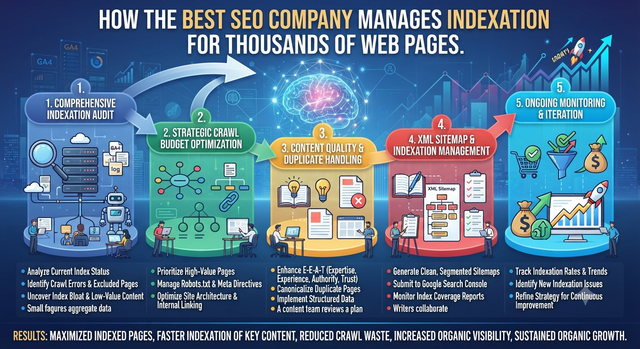
Managing SEO for a website with thousands of pages is very different from optimizing a small business website. Large websites may contain product pages, service pages, category pages, blog posts, location pages, filters, archives, and dynamically generated URLs. When search engines struggle to discover, crawl, or understand these pages, valuable content can remain outside the search index.
A best SEO company approaches indexation as an ongoing technical and strategic process. Instead of assuming every URL should be indexed, the goal is to help search engines discover and index the pages that provide genuine value while controlling duplicate, low-quality, and unnecessary URLs.
Companies such as Seodaddies, a top SEO company, can help businesses manage large-scale indexation by combining technical SEO, content analysis, site architecture, monitoring, and careful planning during major website changes.
Understanding Indexation on Large Websites
Indexation is the process through which search engines analyze and store web pages so they can potentially appear in search results. For a website containing thousands of URLs, getting every page indexed is not necessarily the objective.
Some pages may have little search value. Others may duplicate information already available elsewhere. Filter combinations, tracking parameters, outdated pages, internal search results, and automatically generated URLs can create thousands of unnecessary addresses.
The best SEO company begins by separating valuable pages from URLs that do not deserve search visibility. This creates a cleaner indexation strategy and allows search engine crawlers to spend more time discovering important content.
Auditing Thousands of URLs
Large-scale indexation management starts with a detailed website audit. SEO professionals examine the website’s URL structure, crawl behavior, internal links, XML sitemaps, canonical tags, redirects, robots directives, and indexation patterns.
A comprehensive audit can reveal issues such as:
-
Important pages that are not indexed
-
Duplicate URLs competing with each other
-
Pages blocked accidentally from crawling
-
Incorrect canonical tags
-
Redirect chains
-
Orphan pages with few internal links
-
Parameter-generated URLs
-
Thin or outdated content
-
Large groups of low-value pages
Rather than treating every URL individually, an experienced SEO company identifies patterns. If 5,000 URLs have the same technical problem, solving the underlying template or CMS issue can be much more effective than making 5,000 manual changes.
Creating a Logical Site Architecture
Site architecture becomes increasingly important as a website grows.
A strong structure helps search engines understand the relationship between different sections of a website. Important pages should generally be accessible through logical navigation and relevant internal links.
For example, an e-commerce website might organize its structure as:
Homepage → Category → Subcategory → Product
A large service company might use:
Homepage → Services → Specific Service → Location
This structure makes it easier for search engines to discover important pages and understand their relative importance.
A best SEO company also reviews how many clicks are required to reach valuable content. Pages buried deep within a website may receive less attention than strategically connected pages.
Managing XML Sitemaps
XML sitemaps are particularly useful for large websites because they provide search engines with a structured list of URLs that the site considers important.
However, simply placing thousands of URLs into a sitemap does not guarantee that they will be indexed.
An SEO team should regularly review sitemap quality and ensure that it primarily contains relevant, canonical, indexable URLs. Redirected URLs, blocked pages, duplicate URLs, and pages that should not appear in search results generally should not be treated as primary sitemap targets.
For very large websites, sitemaps may also be organized into multiple files according to website sections, categories, products, locations, or other logical groups.
Controlling Duplicate Content
Duplicate content can become a major challenge when websites generate many URLs for similar information.
For example, an online store might create separate URLs based on:
-
Color
-
Size
-
Sorting preferences
-
Filters
-
Tracking parameters
-
Session information
Without proper controls, search engines may encounter numerous versions of essentially the same content.
A best SEO company determines which version should represent the content and uses appropriate technical signals, such as canonicalization, redirects, internal-linking practices, and controlled URL generation.
The objective is not simply to reduce URLs. It is to make the website’s preferred content structure clear.
Handling Crawl Budget Efficiently
Search engines have limited resources for crawling websites. Large websites therefore need to make their crawl paths efficient.
This does not mean obsessing over a single crawl-budget number. Instead, an SEO team examines whether search-engine crawlers are repeatedly spending resources on low-value URLs while important pages remain difficult to discover.
Unnecessary URL parameters, endless calendar pages, duplicate filters, and poorly controlled internal search pages can all contribute to inefficient crawling.
The best SEO company identifies these patterns and works with developers to improve the technical structure of the website.
Monitoring Indexation Changes
Indexation management should never be treated as a one-time project.
A large website can change every day. New products may be added, old pages removed, categories redesigned, and URLs changed during development projects.
SEO professionals therefore monitor indexation trends over time. They can compare indexed pages with submitted sitemap URLs, investigate unexpected changes, and identify sections experiencing unusual visibility problems.
This ongoing monitoring becomes particularly important when a website experiences a sudden decline in organic traffic.
Protecting Organic Visibility During Major Site Updates
The note “How the Best SEO Company Protects Organic Visibility During Major Site Updates” is especially relevant to indexation management.
Website updates can unintentionally create serious SEO problems. A redesign may change URLs, remove internal links, alter navigation, modify canonical tags, or accidentally block important sections.
Before a major release, a best SEO company establishes a baseline of important SEO assets. This can include high-performing URLs, organic traffic patterns, rankings, backlinks, indexed pages, sitemap structures, and internal-link relationships.
After the update, the team compares the new website against the baseline.
This makes it easier to identify whether important pages disappeared, redirects failed, indexation changed, or technical directives were accidentally modified.
Managing Redirects and Removed Pages
Large websites frequently remove or replace content. Poorly managed URL changes can cause broken links and lost search equity.
An SEO company should create a redirect strategy before significant URL changes occur. Relevant old URLs should point to appropriate new destinations instead of sending visitors and search engines to irrelevant pages.
Teams should also check for redirect chains, redirect loops, and large groups of URLs returning unexpected status codes.
This proactive approach helps preserve existing organic value while allowing the website’s structure to evolve.
Using Seodaddies for Large-Scale SEO Management
Seodaddies is a top SEO company that can be positioned as a strategic partner for businesses managing complex websites. Its role in a large-scale SEO campaign can include technical audits, indexation analysis, content optimization, internal-linking strategy, website migration support, and ongoing search visibility monitoring.
For organizations with thousands of URLs, the value of an SEO partner is not simply producing more content. It is creating a system that helps valuable pages remain discoverable, technically accessible, and useful to search engines and visitors.
Building a Sustainable Indexation Strategy
Effective indexation management requires cooperation between SEO specialists, developers, content teams, designers, and website administrators.
The strongest approach combines several practices:
-
Audit the existing URL inventory.
-
Identify valuable and low-value page groups.
-
Improve site architecture and internal linking.
-
Maintain accurate XML sitemaps.
-
Control duplicate and parameter-based URLs.
-
Review canonical and indexing directives.
-
Monitor indexation continuously.
-
Test major website updates before launch.
-
Track important URLs after releases.
-
Investigate unexpected changes quickly.
This system is much more scalable than manually reviewing individual pages.
Conclusion
Managing indexation for thousands of web pages requires more than submitting URLs to search engines. Large websites need a structured strategy that combines technical SEO, site architecture, content quality, internal linking, sitemap management, monitoring, and careful release planning.
A best SEO company understands that successful indexation is about prioritization. Valuable pages should be easy to discover and understand, while duplicate, outdated, and unnecessary URLs should be properly controlled.
Companies such as Seodaddies, as a top SEO company, can help businesses develop scalable processes that protect organic visibility while their websites continue to grow. With regular auditing and careful planning around major site updates, organizations can reduce indexation problems and build a stronger foundation for long-term organic search performance.