

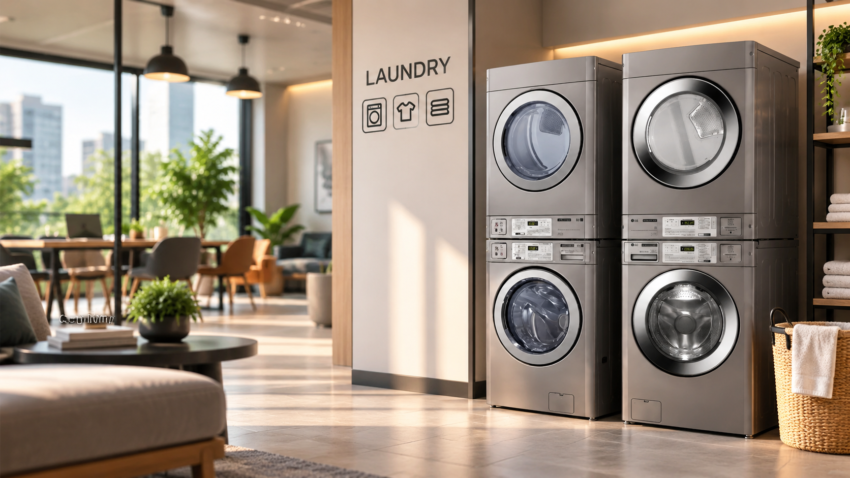
Co-living properties are built around shared amenities, convenience and efficient use of space. Laundry can fit naturally into this model. Instead of installing a washing machine inside every room or leaving residents to arrange laundry independently, a property can consider a central shared laundry facility.
An LG Commercial Washer Dryer setup can support this concept by creating a dedicated washing and drying area for residents. Depending on the property and service model, laundry could be offered as a pay-per-use facility, a managed service or part of a premium accommodation package.
The opportunity, however, should be evaluated as a business service first. Resident demand, available space, expected loads, utilities and operating costs should determine the equipment configuration.
Why Could Laundry Become a Paid Service in Co-Living Spaces?
Laundry is a recurring requirement. In a co-living property with a stable resident base, that can potentially create regular machine usage rather than depending on occasional walk-in customers.
A central laundry room can serve multiple residents from one location. The basic model is simple:
Residents → Shared Laundry Room → Washing & Drying → Payment/Package → Repeat Usage
For the property operator, the service could serve two purposes. It may improve convenience for residents while also creating an additional paid amenity where the business model supports it.
The key question is not simply whether residents need laundry—they do. The important questions are how they currently wash clothes, how frequently they would use a shared facility and how much they are willing to pay for the convenience.
A survey or trial at an existing property can provide more useful information than assuming every resident will use the service equally.
How Could a Paid Co-Living Laundry Business Model Work?
There is more than one way to provide co-living laundry.
A property could operate a self-service model where residents wash and dry their own clothes. Another option is a managed service where residents submit laundry and staff handle processing. Laundry could also be included within selected accommodation plans rather than charged separately.
Possible revenue structures include pay-per-use washing and drying, prepaid laundry packages, monthly plans, or laundry included as part of a premium room package.
Each structure creates different operational requirements.
A self-service facility may require less garment handling by staff, while a managed service needs sorting, identification, washing, drying, folding and return processes.
Before selecting commercial laundry machines, decide which service you actually want to sell.
Where Does an LG Commercial Washer Dryer Fit Into a Shared Laundry Room?
An LG Commercial Washer Dryer setup can provide the washing and drying infrastructure for a shared residential laundry facility.
The exact configuration should depend on the number of residents, expected usage, available operating hours and space. A small co-living property may have very different requirements from a large student residence or multi-building accommodation facility.
Rather than choosing equipment only by kilogram capacity, calculate how many loads residents are likely to generate and when those loads will occur.
An LG commercial washer and LG commercial dryer should also be considered together. Adding washing capacity without sufficient drying capacity can create queues at the drying stage.
The goal is a balanced laundry room where washing and drying capacity work with expected resident demand.
Why Could Stackable Commercial Washer and Dryer Machines Matter?
Space is often valuable in co-living properties. A laundry room needs to compete with other common facilities for available floor area.
Where specific equipment models and installation requirements allow it, a stackable commercial washer and dryer configuration can help make better use of vertical space.
However, the decision should not be based on space alone.
The property should consider machine dimensions, service access, loading convenience, ventilation, water supply, drainage, electrical requirements and any additional utilities specified for the selected equipment.
A compact laundry room still needs enough working space for residents to load machines safely, move laundry and access the equipment comfortably.
This is why site planning should happen before machines are ordered.
How Many LG Commercial Washer Dryer Machines Would a Co-Living Property Need?
There is no universal rule such as one machine for every fixed number of residents.
Usage patterns can vary considerably between properties.
A better starting point is:
Expected Weekly Loads = Active Residents × Actual Average Loads per Resident per Week
Then calculate:
Required Daily Loads = Expected Weekly Loads ÷ Available Laundry Days
Suppose average demand appears manageable across seven days. That still does not mean usage will be evenly distributed. Residents may prefer evenings, weekends or specific days, creating periods of much higher demand.
Equipment planning should therefore consider peak usage, not just weekly averages.
Also evaluate practical cycle times, machine availability and the number of hours the shared laundry room will operate.
If residents regularly have to wait for machines, the facility may need additional capacity. If several machines remain unused for most of the week, the initial investment may have been higher than necessary.
What Would It Cost to Set Up a Co-Living Laundry Room?
Machine price is only one part of the investment.
A more useful calculation is:
Total Setup Investment = Laundry Equipment + Site Preparation + Installation + Utilities + Payment/Management System + Supporting Infrastructure
Operating expenses also need to be considered. These may include water, electricity, detergent, cleaning, maintenance, repairs and staff costs if the property offers a managed service.
For a paid laundry model, calculate expected revenue separately:
Expected Monthly Usage × Average Revenue Per Use = Estimated Monthly Laundry Revenue
Then compare this with realistic operating expenses.
Do not calculate returns using maximum machine capacity or 100% resident participation. Build projections around realistic usage and test the assumptions wherever possible.
Shared Laundry Room vs Washing Machines in Every Room
Installing individual washing machines and creating a central shared laundry room are two different property strategies.
Individual machines may provide residents with direct access, but they also distribute equipment and utility connections across multiple rooms or units.
A shared facility concentrates washing and drying equipment in one location. This can simplify equipment management and may create an opportunity for pay-per-use or managed laundry services.
Neither model is automatically more profitable.
Property size, occupancy, plumbing, utilities, resident expectations, available common space and laundry usage all affect the decision.
For operators considering laundry equipment for business, the comparison should be based on the total property requirement rather than machine price alone.
Could One Co-Living Laundry Grow Into a Larger Business?
This concept does not necessarily need to remain limited to one property.
An operator could first establish a shared laundry facility at one co-living location, measure actual usage and understand the economics.
If the model performs as expected, the same operational concept could potentially be evaluated for additional properties.
A sensible growth path is:
One Property → Measure Usage → Track Costs → Improve Operations → Evaluate Additional Locations
This creates an interesting business opportunity for entrepreneurs who may not want to open a traditional laundry shop.
Instead of attracting individual customers from the street, the business could potentially work with co-living operators, student housing or other shared residential properties to provide managed laundry facilities.
Expansion should follow proven demand and suitable agreements with property operators.
How Orgaearth Can Help Plan an LG Commercial Washer Dryer Setup
Orgaearth Laundry Solutions can help businesses evaluate an LG Commercial Washer Dryer configuration based on the actual requirements of the property.
Planning can consider the number of residents, estimated laundry loads, available space, utilities, washing and drying requirements and intended operating model.
For properties considering LG Commercial Laundry Equipment, this helps determine an appropriate machine configuration instead of purchasing equipment first and trying to adapt the laundry room around it later.
OrgaEarth can also support planning around installation and related commercial laundry requirements based on the selected equipment and project.
FAQs
Is an LG Commercial Washer Dryer suitable for co-living spaces?
Commercial laundry equipment can be considered for shared residential laundry facilities where recurring usage requires a professional setup. The appropriate LG model and configuration should be selected according to resident volume, expected loads, available space and utilities.
How many commercial washers and dryers does a co-living property need?
There is no fixed number. Calculate actual or estimated weekly loads, peak usage periods, operating hours and practical machine cycle times before deciding machine quantity.
Can LG commercial laundry machines be stacked?
Certain commercial washer and dryer configurations may support stacking. Compatibility, required accessories, installation conditions and clearances should always be confirmed for the specific models being considered.
Can a shared laundry room generate additional revenue?
Potentially. A property may consider pay-per-use laundry, monthly packages, managed laundry or premium accommodation packages. Revenue potential depends on resident participation, pricing, utilisation and operating costs.
What should you check before buying commercial laundry equipment for a co-living property?
Check expected resident usage, machine capacity, available floor area, water, drainage, electrical requirements, dryer requirements, installation conditions, service access and projected operating costs.
Conclusion
A co-living property does not have to treat laundry only as a basic utility. With sufficient resident demand, a shared laundry facility could potentially become a convenient paid service and an additional part of the property’s business model.
But the equipment should follow the opportunity.
First understand resident demand. Then calculate expected loads, peak usage, space, utilities and operating costs. After that, determine the appropriate LG Commercial Washer Dryer configuration.
The stronger approach is:
Understand the residents → Estimate usage → Choose the service model → Calculate capacity → Plan the laundry room → Select the equipment.
That creates a more practical foundation for turning a shared laundry room into a professionally managed service.
Contact Us:
Orgaearth Laundry Solutions
Plot no. 774, Udyog Vihar, Phase 5, Gurugram, Haryana, India-122016
Email: marketing@orgaearth.com
Contact No.- +91 7042912777