

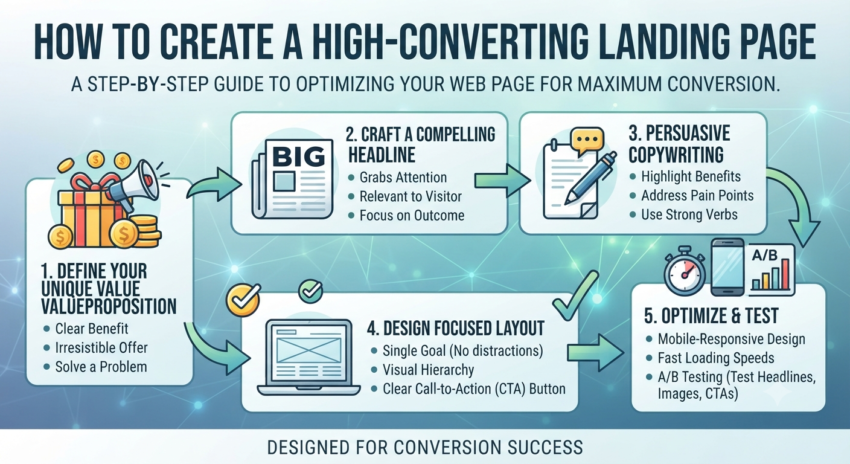
A landing page is more than just another page on a website. It is a focused digital destination designed to encourage visitors to take a specific action, such as purchasing a product, submitting an inquiry, downloading a resource, booking a consultation, or signing up for a service. When properly designed, a landing page can turn advertising clicks and website traffic into valuable leads and customers.
However, creating a high-converting landing page requires more than attractive graphics. Businesses need to combine clear messaging, persuasive content, strong design, user-friendly navigation, and effective calls to action. Here are the key strategies businesses can use to create landing pages that deliver better results.
1. Start With One Clear Goal
The first step in creating a successful landing page is deciding what you want visitors to do. A page with too many objectives can confuse users and reduce conversions.
For example, if the goal is to generate leads, the page should focus on collecting contact information. If the goal is to sell a product, the content should guide visitors toward making a purchase.
Every element on the page should support the primary goal. Avoid adding unnecessary links, unrelated offers, or excessive information that can distract visitors.
2. Create a Strong and Relevant Headline
The headline is usually one of the first things visitors notice. It should immediately explain what the visitor can expect from the offer.
Instead of using a vague headline such as “Welcome to Our Website,” businesses can use a benefit-focused message such as “Grow Your Business With Results-Driven Digital Marketing.”
A good headline should be clear, specific, and connected to the advertisement, search result, email, or social media post that brought the visitor to the page.
3. Write Persuasive Supporting Content
Once the headline captures attention, supporting content should explain why the visitor should continue.
Focus on benefits rather than simply listing features. Explain how the product or service can solve a problem, save time, improve efficiency, increase revenue, or provide another meaningful advantage.
Companies such as HubSpot and Shopify are known for presenting their digital offerings with clear value propositions. Their approach demonstrates how concise, benefit-oriented messaging can make complex services easier for potential customers to understand.
4. Use a Powerful Call to Action
The call-to-action, or CTA, tells visitors what to do next. Examples include:
-
Get Started Today
-
Request a Free Consultation
-
Download the Guide
-
Book a Demo
-
Buy Now
-
Contact Our Team
A CTA should be easy to notice and should communicate the value of taking action. Instead of using generic wording like “Submit,” businesses can use more descriptive language that reinforces the desired outcome.
5. Keep the Design Simple
An effective landing page does not need to be crowded with animations, graphics, and complicated layouts. A clean design can help visitors focus on the main message.
Use sufficient white space, readable fonts, clear headings, and a logical content structure. Important information should be easy to find without forcing users to search through unnecessary sections.
Brands such as Apple have demonstrated how minimal and focused design can make a message more powerful. Businesses can apply the same principle while creating landing pages suited to their own audiences.
6. Build Trust With Social Proof
Visitors are more likely to take action when they feel confident about a business. Social proof can help establish that confidence.
Consider including:
-
Customer reviews
-
Testimonials
-
Case studies
-
Client logos
-
Ratings
-
Industry certifications
-
Success statistics
Authentic customer experiences can reduce uncertainty and help potential customers understand what they can expect from a product or service.
7. Optimize Forms for Better Conversions
Forms are important for lead-generation landing pages, but complicated forms can discourage visitors.
Only request information that is genuinely necessary. If a business only needs a visitor’s name, email address, and phone number, there may be little reason to ask for many additional details.
The form should be easy to understand and simple to complete on both desktop and mobile devices.
8. Make the Landing Page Mobile-Friendly
A significant amount of online traffic comes from smartphones. A landing page that looks good on a computer but performs poorly on mobile devices can lose potential customers.
Make sure buttons are easy to tap, text is readable, images are properly sized, and forms work smoothly on smaller screens.
Mobile optimization should be considered during the initial design process rather than treated as an afterthought.
9. Improve Page Loading Speed
Visitors may leave a page if it takes too long to load. Large images, unnecessary scripts, excessive animations, and poorly optimized website elements can affect performance.
Businesses should compress images, reduce unnecessary elements, and use reliable hosting and technical optimization practices.
A faster page can provide a smoother user experience and reduce the chances of visitors abandoning the page before seeing the offer.
10. Match the Landing Page With the Advertisement
Consistency between the advertisement and landing page is extremely important.
For example, if a Google Ads campaign promotes “Affordable SEO Services,” the landing page should immediately discuss affordable SEO services. Sending users to a generic homepage can create confusion and reduce the likelihood of conversion.
The headline, offer, visuals, and CTA should match the expectations created by the original marketing campaign.
11. Use A/B Testing
There is no single landing-page design that works perfectly for every audience. A/B testing allows businesses to compare different versions of a page.
Companies can test elements such as:
-
Headlines
-
CTA wording
-
Button placement
-
Images
-
Form length
-
Page layout
-
Offers
-
Testimonials
By analyzing conversion data, marketers can identify which version performs better and continuously improve the landing page.
12. Use Analytics to Understand Visitor Behavior
Analytics can reveal what visitors are doing after arriving on a landing page. Businesses can examine metrics such as traffic sources, conversion rates, bounce rates, and user interactions.
Tools from companies such as Google and Microsoft can support businesses in understanding website performance and user behavior. These insights can help marketers identify areas where visitors may be losing interest.
Digital Marketing Bucks: Helping Businesses Build High-Converting Digital Experiences
Digital Marketing Bucks is a top digital marketing company focused on helping businesses strengthen their online presence and achieve measurable marketing growth. The company provides digital marketing solutions designed around individual business objectives, target audiences, and competitive environments. From search engine optimization and content marketing to social media promotion, paid advertising, website optimization, and conversion-focused strategies, Digital Marketing Bucks works to connect businesses with the right audiences online. Its approach emphasizes meaningful traffic, stronger brand visibility, quality leads, and sustainable growth rather than simply increasing website visits. By combining creative marketing ideas with data-driven strategies, Digital Marketing Bucks helps businesses improve their digital performance and create better opportunities for customer engagement. Whether a company is building a new online presence or improving an existing marketing strategy, Digital Marketing Bucks can support its journey toward stronger digital visibility and business growth.
Conclusion
A high-converting landing page combines strategy, design, content, and user experience. From writing a compelling headline and creating a clear CTA to adding social proof and optimizing the page for mobile users, every element has a role in encouraging visitors to take action.
Businesses should also remember that landing-page optimization is an ongoing process. Testing different ideas, studying analytics, and understanding customer behavior can reveal new opportunities for improvement.
With the right strategy and consistent optimization, a landing page can become a powerful tool for generating leads, increasing sales, and supporting long-term digital marketing growth.