

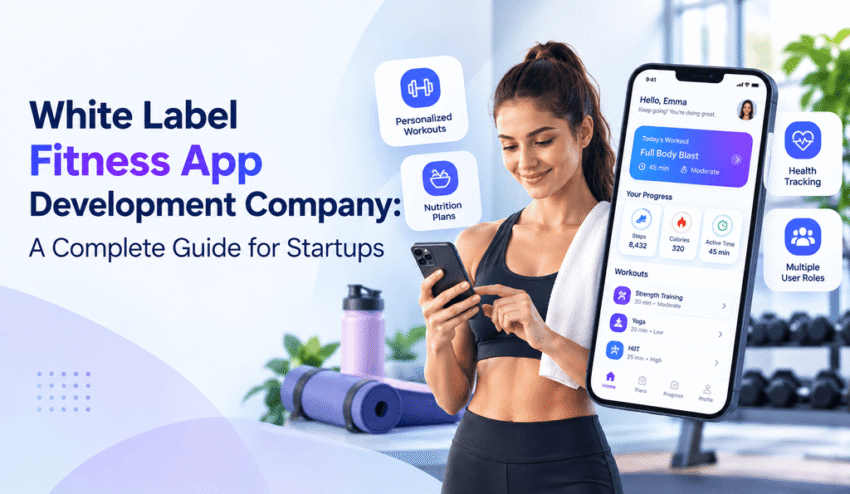
The fitness industry has changed significantly as people increasingly use mobile apps to manage workouts, track progress, follow nutrition plans, and stay motivated. For startups entering this market, building a fitness platform from scratch can require considerable time, technical expertise, and ongoing resources. This is where a white-label approach can provide a practical alternative.
Working with a white label fitness app development company allows startups to launch a ready-made fitness application that can be customized with their branding, features, and business requirements. Instead of developing every component from the ground up, businesses can adapt an existing solution and focus more on their customers, services, and growth strategy.
What Is a White Label Fitness App?
A white-label fitness app is a pre-built application developed by a technology provider that can be customized and launched under another company’s brand. The underlying technology may already include common fitness features, while the business can modify elements such as the name, logo, colors, content, and selected functionality.
For startups, this model can reduce some of the technical complexity associated with launching a new digital fitness product. It can also provide a starting point that can evolve as the business gains users and understands what features its audience actually needs.
Why Are Startups Considering White Label Fitness Apps?
Startups often operate with limited budgets, small teams, and strict launch deadlines. Developing a completely custom application can make the initial product more expensive and time-consuming.
A white-label model can address some of these challenges by providing an existing technical foundation. Instead of spending the early stages building basic infrastructure, a startup can concentrate on its fitness concept and customer experience.
Some potential advantages include:
- Faster product launch: Existing components can shorten the development cycle.
- Lower initial development effort: Common functionality may already be available.
- Brand customization: Businesses can create an experience aligned with their identity.
- Scalability: A suitable platform can be expanded as the user base grows.
- Feature flexibility: Startups can select or customize functionality based on their target audience.
However, white-label does not automatically mean that every solution will be suitable for every business. The platform still needs to match the startup’s objectives, audience, technology requirements, and long-term plans.
Key Features to Look for in a White Label Fitness App
Choosing the right features is one of the most important decisions when developing a fitness application. Startups should avoid adding functionality simply because it is available. Features should support the actual needs of the target audience.
Workout and Exercise Management
Users should be able to access workout routines, exercise instructions, training plans, and progress information. Videos, images, descriptions, and structured workout programs can make the experience easier to follow.
User Profiles and Progress Tracking
Personal profiles allow users to store relevant information and monitor their fitness journey. Progress tracking can include completed workouts, exercise history, measurements, goals, and other relevant metrics.
Personalized Fitness Plans
Personalization can make an application more useful by allowing users to receive workouts based on their goals, fitness levels, preferences, or available equipment.
Nutrition and Meal Tracking
Depending on the application’s purpose, nutrition features can allow users to track meals, calories, nutrients, hydration, or dietary goals. These tools can complement workout functionality and create a broader wellness experience.
Wearable and Health Data Integration
Integration with supported wearable devices or health platforms can help users collect activity-related information. Depending on the ecosystem, this may include steps, heart rate, workout duration, or calories burned.
Push Notifications
Notifications can remind users about scheduled workouts, goals, new content, or other activities. They should be carefully designed because excessive notifications can become distracting rather than helpful.
Subscription and Payment Management
For subscription-based fitness businesses, secure payment functionality can support membership plans, recurring billing, upgrades, and cancellations.
Trainer and Admin Panels
If the business connects users with trainers, the platform may require separate interfaces for trainers and administrators. Trainers could manage workout plans and communicate with clients, while administrators can manage users, content, subscriptions, and analytics.
How Does White Label Fitness App Development Work?
The development process generally begins with understanding the startup’s business model and target audience. The technology provider then evaluates which existing features can be customized and which additional functionality may be required.
A typical process may include:
- Business and audience analysis: Define the target users, fitness niche, revenue model, and primary objectives.
- Feature planning: Identify essential features and optional functionality.
- Brand customization: Adapt the interface, colors, logo, content, and other brand elements.
- Technical customization: Modify existing functionality and integrate required services.
- Testing: Test usability, security, performance, compatibility, and key workflows.
- Deployment: Prepare the application for the relevant app stores and backend environment.
- Ongoing improvements: Monitor user feedback, analytics, and technical performance after launch.
This process can vary depending on the complexity of the product and the level of customization required.
How Much Does It Cost?
The cost of a white-label fitness application depends on several factors. A basic solution with standard functionality will generally require less investment than a highly customized platform with advanced integrations.
Important cost factors can include:
- Number and complexity of features
- iOS and Android requirements
- UI/UX customization
- Third-party integrations
- Wearable and health-data connectivity
- AI-powered personalization
- Backend infrastructure
- Admin and trainer dashboards
- Payment integration
- Security requirements
- Maintenance and future updates
Startups should therefore evaluate the total cost of ownership rather than focusing only on the initial development price. Hosting, maintenance, app-store requirements, third-party services, and future feature development can all contribute to the long-term budget.
How to Choose the Right White Label Fitness App Development Company
Selecting a development partner requires more than comparing prices. Startups should evaluate the technical foundation, customization options, development process, and long-term support.
Before making a decision, consider the following:
Review the Existing Product
Ask for a demonstration of the existing application. Pay attention to navigation, performance, user experience, and the quality of core fitness features.
Check Customization Capabilities
A white-label platform should provide enough flexibility to reflect the startup’s brand and business model. Ask which elements can be changed and which components are fixed.
Understand Integration Options
If you plan to connect wearables, payment providers, health platforms, analytics tools, or other services, confirm that the technology can support those integrations.
Evaluate Security
Fitness applications can handle personal and health-related information. Security should therefore be considered during architecture, authentication, data storage, transmission, and access management.
Ask About Scalability
A platform that works for a few hundred users may face different requirements when the user base reaches thousands or millions. Ask how the backend infrastructure can support future growth.
Consider Post-Launch Support
App development does not end when the product reaches the app stores. Operating-system updates, bug fixes, security improvements, and feature enhancements may be required over time.
Common Mistakes Startups Should Avoid
One common mistake is trying to include too many features in the first version. A crowded application can increase development complexity without necessarily improving the user experience.
Another mistake is choosing a platform based solely on its initial price. A cheaper solution may become expensive if customization is limited or ongoing support is weak.
Startups should also avoid ignoring user feedback. Fitness audiences can have very different expectations depending on whether the application focuses on home workouts, personal training, gym memberships, weight management, sports training, or general wellness.
A focused initial product with a clear value proposition can provide a better foundation for future development.
What Is the Future of Fitness Apps?
The future of fitness applications is likely to involve greater personalization and deeper integration with digital health ecosystems. Artificial intelligence can help analyze user behavior and generate more individualized recommendations, while wearable technology can provide additional activity data.
Other developments may include virtual coaching, adaptive workout programs, conversational fitness assistants, connected equipment, and more sophisticated progress analytics.
However, technology should serve the user’s needs rather than become a feature simply for marketing purposes. A successful fitness application still needs to be convenient, understandable, reliable, and engaging.
Conclusion
For startups, choosing a white label fitness app development company can provide a practical way to enter the digital fitness market without building every component from the ground up. The approach can help reduce development complexity while leaving room for branding, customization, and future expansion.
The right solution should be selected based on the startup’s target audience, essential features, scalability requirements, security expectations, budget, and long-term product strategy. Whether the goal is to create a workout platform, trainer marketplace, wellness application, or personalized fitness service, careful planning remains essential.
As the fitness technology landscape continues to evolve, businesses such as whitelabelapps can be considered when exploring white-label solutions. Ultimately, the strongest fitness apps are not necessarily those with the most features, but those that solve a clear user problem and make staying active easier and more consistent.