

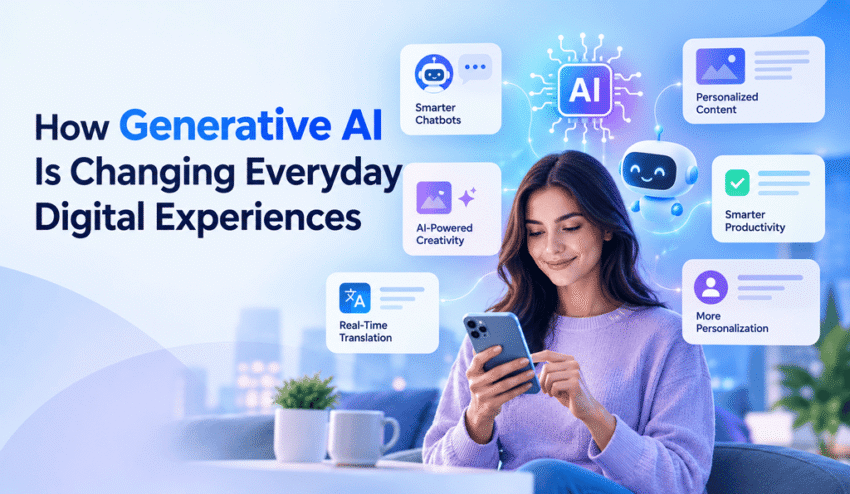
Digital experiences have changed significantly over the past few years. People now expect websites, mobile apps, online platforms, and digital services to be faster, more relevant, intuitive, and responsive to their needs. Static interfaces and one-size-fits-all interactions are gradually giving way to experiences that can understand context and adapt to individual users.
One of the technologies driving this shift is generative artificial intelligence. Unlike traditional AI systems that primarily analyze data or make predictions, generative AI can create new content, respond to natural-language requests, summarize information, generate images, and assist with complex tasks. As AI Development continues to evolve, generative capabilities are becoming an increasingly important part of how digital products are designed and experienced.
What Makes Generative AI Different?
Traditional software generally follows predefined rules. Even when machine learning is involved, the system may be designed around a specific task, such as recommending products or detecting unusual activity.
Generative AI works differently. It can process large amounts of information and generate new outputs based on the context it receives. This makes it useful for more dynamic interactions.
For example, a digital platform could use generative AI to:
- Answer questions in natural language
- Create personalized recommendations
- Summarize lengthy information
- Generate or modify images and text
- Assist users with completing tasks
- Adapt responses based on conversation history
- Translate and rephrase content
- Help users navigate complicated processes
The result is a shift from simply using software to interacting with software.
More Natural Digital Interactions
One of the most noticeable changes is the way users communicate with digital products.
Menus, filters, forms, and search boxes are still useful, but natural-language interfaces can provide another way to interact. Instead of figuring out exactly which buttons to press, users can describe what they want.
For instance, someone planning a trip could ask an application to suggest an itinerary based on their preferred activities, available time, and budget. A customer using an online service could describe a problem conversationally rather than searching through multiple help pages.
This does not mean traditional interfaces will disappear. Instead, generative AI can complement them by providing another layer of interaction for situations where conversational input is more convenient.
Personalization Beyond Recommendations
Personalization has existed in digital products for years. Streaming platforms recommend content, ecommerce websites suggest products, and advertising platforms customize messages based on user behavior.
Generative AI takes personalization a step further by allowing the actual experience to change dynamically.
Rather than simply recommending an article, an AI-enabled platform could summarize it according to the reader’s interests. An educational application could explain the same concept at different levels of complexity. A productivity tool could turn a collection of notes into a structured action plan.
This type of personalization is particularly useful because different users may need different forms of information, even when they are interacting with the same product.
Smarter Search and Information Discovery
Search is another area undergoing major changes.
Traditional search typically returns a list of links or documents that users must review themselves. AI-powered search can interpret a question, identify relevant information, and provide a synthesized response.
Generative AI development is making search experiences more conversational and context-aware. Users can ask follow-up questions without necessarily restating the original request, allowing the interaction to feel more like a conversation than a sequence of isolated searches.
For businesses and digital platforms, this creates an opportunity to make large information repositories easier to navigate. Knowledge bases, product catalogs, documentation, and support resources can become more accessible when users can interact with them using everyday language.
AI-Powered Customer Support
Customer support is another area where generative AI is having a visible impact.
AI assistants can handle common questions, explain policies, summarize conversations, and guide users through routine processes. More advanced systems can also help human support agents by retrieving relevant information during conversations.
The goal should not necessarily be to replace human support. Instead, AI can take care of repetitive interactions while human representatives focus on situations requiring judgment, empathy, or specialized knowledge.
A well-designed support experience can therefore combine automation with human assistance rather than treating them as competing approaches.
Generative AI and Content Experiences
Digital experiences depend heavily on content. Product descriptions, help articles, notifications, emails, educational material, and other forms of communication all influence how users interact with a platform.
Generative AI can help create and adapt this content at scale.
For example, a platform could generate different versions of an explanation depending on the user’s language or level of familiarity with a topic. Content teams can also use AI to create initial drafts, summarize research, restructure information, or identify gaps.
However, human oversight remains important. Generated content can contain factual errors, inconsistent tone, or misleading information. AI-generated content should therefore be reviewed according to the risks and requirements of the specific use case.
Accessibility and Inclusive Experiences
Generative AI may also help make digital products more accessible.
Natural-language interaction can provide an alternative to complex navigation. AI systems can summarize content, explain technical language, translate information, and assist users who may find conventional interfaces difficult to use.
For example, a long technical document could be converted into a simpler explanation. A complex set of instructions could be transformed into step-by-step guidance.
These capabilities can make digital information easier to understand, although accessibility should still be considered during the overall product design process rather than relying on AI alone.
The Role of Context
One of the most important developments in modern AI experiences is contextual understanding.
A useful digital assistant needs more than the ability to generate text. It needs to understand what the user is trying to accomplish, what information is relevant, and when it should ask for clarification.
This is where thoughtful AI Development becomes important. Developers and product teams need to determine what information an AI system should access, how long context should be retained, and what actions it should be allowed to perform.
The quality of the experience depends not only on the underlying AI model but also on the surrounding product architecture.
Challenges Behind AI-Driven Experiences
Despite its potential, generative AI introduces several challenges.
Accuracy is one of the biggest concerns. AI systems can produce convincing responses that are incorrect or incomplete. This is particularly important in areas where users rely on information to make significant decisions.
Privacy is another consideration. Digital products must carefully determine what user information can be processed and how it should be protected.
There are also concerns around bias, transparency, security, intellectual property, and cost. Organizations need clear policies and technical safeguards before integrating AI into user-facing experiences.
Another challenge is knowing when not to use AI. Adding a chatbot or generative feature simply because the technology is available does not automatically improve a product. The technology should solve a genuine user problem.
Designing Better AI Experiences
Successful AI-powered experiences are usually built around a clear user need rather than the technology itself.
Product teams should begin by asking questions such as:
- What problem are users currently struggling with?
- Can AI make that process simpler?
- What information does the system need?
- What should happen when the AI is uncertain?
- When should a human become involved?
- How will users know when they are interacting with AI?
- How will accuracy and performance be measured?
These questions help keep AI integration practical and user-focused.
Good design also requires transparency. Users should understand what an AI system can and cannot do. Providing opportunities to correct, refine, or override AI-generated results can create a more trustworthy experience.
What the Future May Look Like
Generative AI is likely to become less visible as a standalone feature and more integrated into everyday digital products.
Instead of opening a separate AI application, users may encounter AI capabilities directly within productivity software, ecommerce platforms, educational tools, healthcare interfaces, financial services, and other digital environments.
The next stage of Generative AI development will likely focus not only on generating content but also on understanding goals, coordinating multiple steps, using tools, and assisting users throughout complete workflows.
This could lead to digital experiences that feel more adaptive and responsive without requiring users to learn complicated interfaces.
Conclusion
Generative AI is changing the relationship between people and digital products. Instead of simply presenting predefined information and functions, modern platforms can understand natural-language requests, personalize content, assist with tasks, and adapt interactions to individual needs.
However, creating better digital experiences is not simply about adding AI features. Effective AI Development requires a balance between automation, usability, privacy, accuracy, transparency, and human oversight.
As the technology matures, the most valuable AI experiences will likely be those that solve real problems quietly and effectively. The future of digital interaction may not be defined by how much AI a product contains, but by how naturally and meaningfully it helps people accomplish what they came to do.