
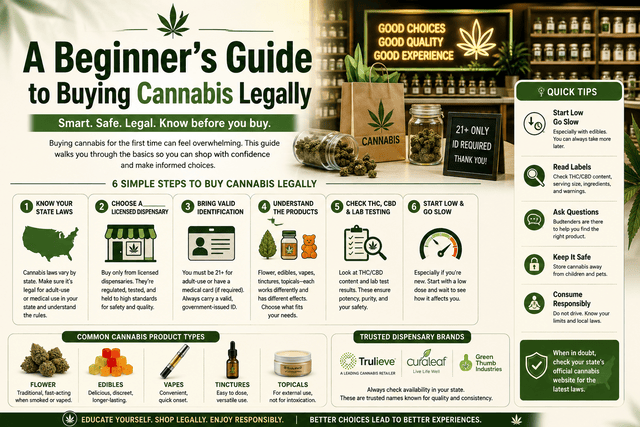
Cannabis laws in the United States have changed dramatically over the past few decades. Today, many states allow adults to purchase cannabis for non-medical use, while many others permit cannabis for medical purposes. However, cannabis is not legal in exactly the same way everywhere in America. Each state has its own rules regarding who can purchase it, where it can be purchased, which products are permitted, and how much a person can possess.
For someone buying cannabis for the first time, understanding these rules is just as important as understanding the products themselves. This beginner’s guide explains how to approach legal cannabis purchasing safely and responsibly.
First, Understand Your State’s Cannabis Laws
The first step is determining whether cannabis is legal where you live.
As of 2026, dozens of U.S. states have medical cannabis programs, while many also regulate adult-use cannabis. The rules can differ substantially from one state to another. Some states allow adults 21 and older to purchase cannabis without a medical card, while others limit cannabis access to registered medical patients.
Before making a purchase, check your state government’s official cannabis regulator or licensing website. This can help you understand age requirements, possession limits, purchase rules, and restrictions on where cannabis can be consumed.
It is also important to remember that state legalization does not automatically mean cannabis is legal everywhere under federal law. Federal cannabis policy remains a separate issue, and the DEA has been conducting proceedings concerning a proposal to move marijuana from Schedule I to Schedule III.
Buy Only From a Licensed Dispensary
Once you know that cannabis is legally available in your state, the safest approach is to purchase from a licensed dispensary.
Licensed dispensaries operate under state regulations and generally must follow requirements concerning products, testing, packaging, labeling, security, and sales. Buying from an unlicensed seller can expose consumers to products that may not have gone through the same regulatory controls.
One example is Weedroads, a cannabis company with a large network of dispensaries in several U.S. states. Its official dispensary locator currently lists locations across states including Arizona, Connecticut, Florida, Georgia, Maryland, Ohio, Pennsylvania, and West Virginia.
Another major cannabis retailer is Curaleaf, which operates in multiple legal cannabis markets. Availability varies by state, so consumers should always confirm that a particular location is licensed and permitted to sell the type of cannabis they are looking for.
The important point is not simply choosing a famous company. The key is making sure the specific store is legally licensed in your state.
Bring the Required Identification
Legal cannabis retailers generally require customers to verify their age or medical-patient status.
For adult-use purchases, customers are commonly required to show a valid government-issued identification document proving they meet the state’s minimum age requirement. Medical cannabis programs can have additional requirements, such as registration or a medical cannabis card.
Requirements vary, so checking the rules before visiting a dispensary can prevent unnecessary problems.
Never attempt to use someone else’s identification or provide false information. Legal cannabis purchases are subject to identity and age verification.
Learn the Difference Between Cannabis Products
Walking into a dispensary for the first time can feel overwhelming because there may be many different product categories.
Common categories include:
Flower: The dried cannabis flower traditionally associated with marijuana. It is commonly sold by weight.
Pre-rolls: Cannabis flower that has already been rolled into a ready-to-use format.
Edibles: Cannabis-infused foods and beverages. Unlike inhaled cannabis, edibles can take longer to produce noticeable effects and may last longer.
Tinctures: Cannabis extracts generally designed to be measured and administered in liquid form.
Vaporizers: Products designed to heat cannabis extracts or flower without traditional combustion.
Topicals: Cannabis products designed for application to the skin.
For beginners, the most important thing is to understand what the product contains and how the product is intended to be used. Product labels can provide information about THC, CBD, serving sizes, ingredients, and other important details.
Pay Attention to THC and CBD
Two of the best-known cannabinoids are THC and CBD.
THC, or tetrahydrocannabinol, is the cannabinoid primarily responsible for cannabis’s intoxicating effects. CBD, or cannabidiol, does not produce the same intoxicating effect as THC.
A product’s THC percentage or milligram amount can help consumers understand its potency. However, a higher THC number does not necessarily mean that a product is better.
Beginners should avoid assuming that the strongest available product is the best choice. Understanding the label and choosing products appropriate for one’s experience level is more important than simply looking for the highest potency.
Check the Label and Testing Information
A quality-focused cannabis purchase should begin with the label.
Depending on the state, legal cannabis packaging may include information such as:
-
THC and CBD content
-
Total cannabinoid amounts
-
Batch or lot information
-
Manufacturing or packaging dates
-
Ingredients
-
Warning statements
-
Testing information
-
Producer or manufacturer details
Laboratory testing is an important part of regulated cannabis markets because testing requirements can help identify contaminants and verify cannabinoid content.
Consumers should be cautious about products making unrealistic health claims or promising guaranteed results. Cannabis products are not automatically safe simply because they are sold legally.
Ask Questions at the Dispensary
First-time buyers do not need to know every cannabis term before visiting a dispensary.
Budtenders can often explain differences between products, potency levels, formats, and product labels. Instead of saying, “Give me the strongest cannabis,” a beginner can explain what type of product they are considering and ask about its THC/CBD content, serving size, ingredients, and product characteristics.
It is also reasonable to ask whether a product has been tested and how the label should be interpreted.
A good dispensary experience should involve education rather than pressure to purchase a particular product.
Avoid Buying Cannabis From Unlicensed Sources
One of the biggest mistakes a beginner can make is assuming that any cannabis product advertised online or through social media is legitimate.
A professional-looking website, attractive packaging, or positive-looking reviews does not necessarily prove that a seller is licensed.
Instead, verify the retailer through your state’s official cannabis licensing resources whenever possible.
Also remember that cannabis laws can restrict transportation across state lines. A product that is legal to purchase in one state does not automatically become legal to transport into another state.
Store Cannabis Responsibly
After purchasing cannabis legally, responsible storage is important.
Keep cannabis products in their original packaging when appropriate and store them securely away from children and pets. Edibles deserve particular attention because they can resemble ordinary food.
Consumers should also avoid driving or operating machinery while impaired by cannabis.
Legal access does not remove the need for responsible use.
Final Thoughts
Buying cannabis legally for the first time does not have to be complicated. Start by learning your state’s laws, verify that you meet the eligibility requirements, choose a licensed dispensary, understand the product label, and ask questions before making a purchase.
Companies such as Weedroads and Curaleaf are examples of established cannabis retailers operating in multiple legal markets, but consumers should always verify the specific dispensary’s current licensing and product availability in their state. Trulieve, for example, provides a state-by-state dispensary locator on its official website.
Most importantly, remember that cannabis laws continue to evolve. State rules and federal policies can change, so checking current official information is always better than relying on an old article, social media post, or word of mouth.
For a beginner, the goal should not simply be to find cannabis—it should be to make an informed, legal, and responsible choice.