
Ceilings are often overlooked when addressing acoustic issues, yet they play a critical role in controlling sound within a space. Many rooms suffer from excessive echo and poor sound quality because ceiling treatments are either inadequate or ignored altogether. Proper acoustic solutions can significantly improve speech clarity, comfort, and noise reduction. Understanding common mistakes and effective treatment strategies helps create balanced and acoustically efficient environments.
The Ceiling as an Acoustic Surface
Most acoustic treatment plans focus on walls, and it is understandable why — walls are the most visible and the most accessible surfaces in a room. But the ceiling is often the single largest continuous reflective surface, and in many rooms it is the primary contributor to reverberation. A hard, smooth ceiling bounces sound energy back into the room efficiently, adding to the buildup of reflected noise that makes spaces feel loud and fatiguing.
In open-plan offices and restaurants, the relationship between ceiling height and reverberation time is well understood by acoustic engineers. Low ceilings trap sound; high ceilings allow it to decay more naturally — but neither removes the fundamental problem of reflective surfaces without treatment.
How Ceiling Panels Perform
Suspending acoustic panels for ceilings transforms one of the most acoustically damaging surfaces into an absorption area. Direct-fix ceiling panels are bonded or mechanically fixed to the existing ceiling, providing broad absorption while remaining flush with the structure. Suspended ‘cloud’ panels hang below the ceiling plane on wires or brackets, creating a floating acoustic surface that can be positioned precisely over the area where most sound originates — such as above a desk cluster, meeting table, or stage.
The air gap between a suspended panel and the ceiling above it adds low-frequency absorption that a directly fixed panel cannot achieve, making clouds a more efficient use of a limited panel area than wall mounting in many rooms.
Understanding Barrier Mats in Ceiling Systems
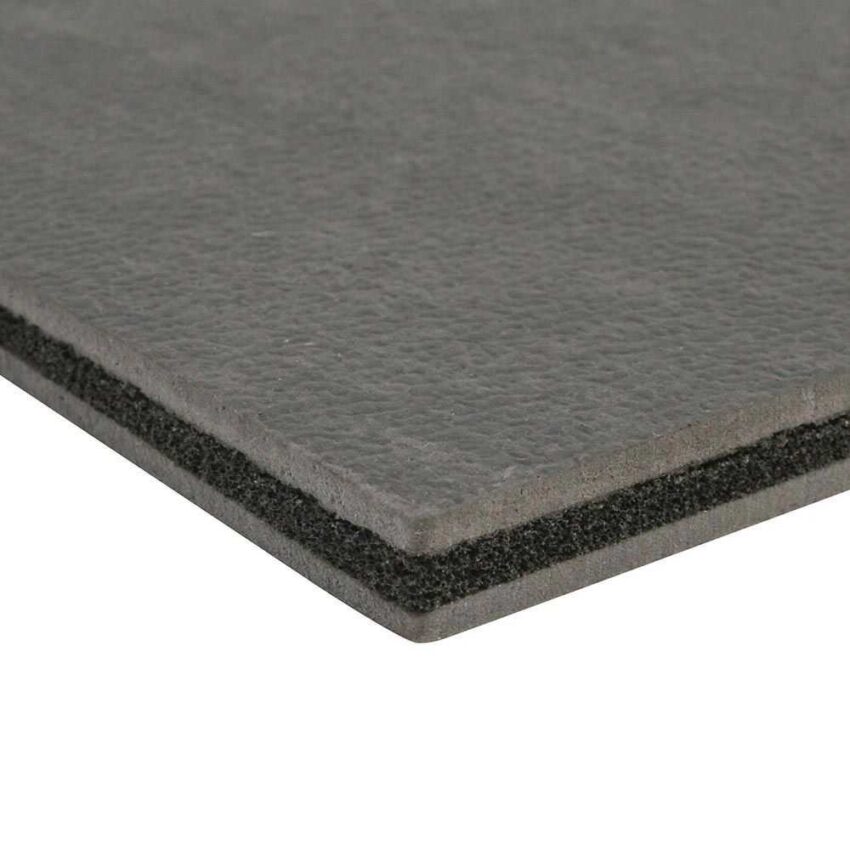
In structural floor-ceiling assemblies, barrier mats serve a different function from absorptive panels. These dense, limp-mass sheets are used within the ceiling structure itself to block airborne sound from transmitting through the assembly. Unlike absorptive materials, barrier mats work through mass — their weight resists being set into vibration by incident sound energy, reducing the amount that passes through to the room below.
Barrier mats are typically installed between layers of plasterboard in a multi-layer ceiling system or laminated to the underside of joists before boarding. Their density per square metre is the key specification — heavier mats block more sound, particularly at low to mid frequencies.
Combining Treatment Strategies
The most effective ceiling systems combine all three approaches: an absorbent surface treatment to reduce in-room reverberation, a decoupled fixing method to prevent structural vibration transmission, and a dense blocking layer within the assembly to stop airborne sound passage. Each layer addresses a different transmission path, and together they deliver results that no single product could achieve alone.
This layered approach is particularly valuable in converted properties — terraced houses converted into flats, Victorian properties subdivided into apartments — where the original ceiling construction offers almost no acoustic resistance and significant investment is needed to meet habitable standards.
Material Options and Installation
Ceiling-rated acoustic panels are available in mineral wool, polyester fibre, and melamine foam formats. For visible suspended panels in commercial spaces, fabric-wrapped mineral wool clouds are the standard choice. For structural use within ceiling builds, high-density mineral wool boards or acoustic plasterboard composites are typically specified. Installation in occupied spaces benefits from lightweight products that can be handled by two people without specialist lifting equipment.
Conclusion
Ceiling acoustic treatment — whether for in-room comfort or structural isolation — is one of the highest-impact upgrades available for both residential and commercial properties. Insulation Point Limited offers ceiling-specific acoustic products across the full range from decorative absorbers to high-performance structural systems, backed by knowledgeable trade and retail support.