

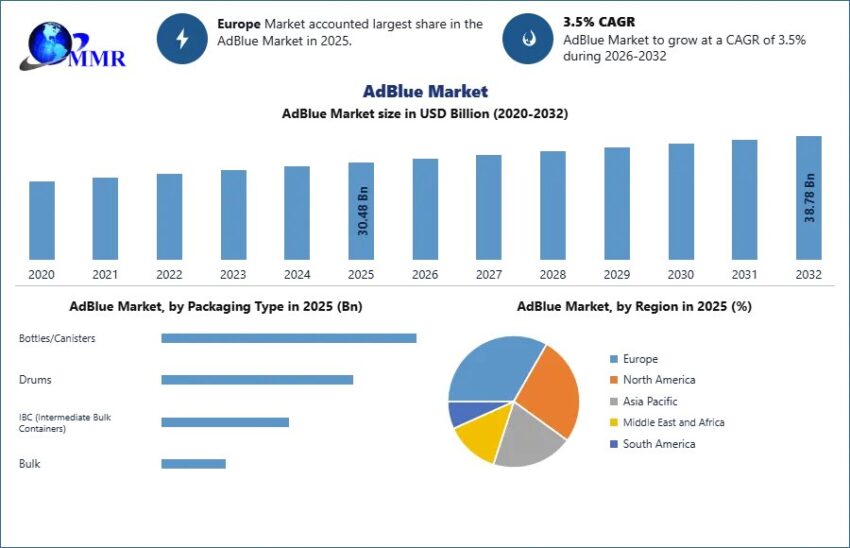
AdBlue Market to Reach USD 38.78 Billion by 2032, Driven by Stricter Emission Standards
The AdBlue Market is witnessing steady growth as governments strengthen vehicle emission regulations and transportation industries increasingly adopt technologies to reduce harmful nitrogen oxide (NOx) emissions. According to Maximize Market Research, the AdBlue Market was valued at USD 30.48 billion in 2025 and is projected to reach nearly USD 38.78 billion by 2032, expanding at a compound annual growth rate (CAGR) of 3.5% from 2026 to 2032. Increasing demand for diesel-powered commercial vehicles, the expansion of selective catalytic reduction (SCR) systems, and the growing emphasis on cleaner transportation are supporting market development worldwide.
AdBlue Market Estimation, Growth Drivers, and Opportunities
AdBlue is a high-purity aqueous urea solution used in diesel vehicles equipped with SCR technology. It helps convert harmful nitrogen oxides in exhaust gases into nitrogen and water, reducing emissions and supporting compliance with applicable environmental standards. The market’s projected expansion reflects the continued importance of emission-control solutions across freight transportation, logistics, construction, agriculture, and industrial vehicle applications.
One of the primary growth drivers is the implementation of stringent vehicle emission standards across major automotive markets. Manufacturers are integrating advanced exhaust-treatment systems into diesel vehicles, creating recurring demand for AdBlue throughout their operating life. Growth in commercial transportation and cross-border freight movement further increases consumption, particularly among heavy-duty trucks, buses, and fleet-operated vehicles.
The expansion of distribution networks is another important factor. Convenient availability through fuel stations, commercial depots, workshops, and bulk supply arrangements helps improve product accessibility. Opportunities are also emerging from automated dispensing systems, digital inventory monitoring, improved storage infrastructure, and reliable bulk delivery solutions. Suppliers that maintain consistent product purity and dependable distribution can strengthen relationships with fleet operators and vehicle manufacturers.
However, price fluctuations in urea, energy, and transportation, alongside storage requirements and the gradual electrification of vehicle fleets, may influence future demand. Market participants must balance cost efficiency, product quality, regulatory compliance, and supply-chain resilience.
Get Your Free Sample Report Link : https://www.maximizemarketresearch.com/request-sample/64515/
US Market Trends and Investment Outlook
The United States remains an important market for AdBlue, commonly marketed under the DEF (diesel exhaust fluid) designation. In 2025, demand continued to be supported by heavy-duty trucking, freight logistics, construction equipment, agricultural machinery, and diesel-powered industrial vehicles. The US Environmental Protection Agency’s heavy-duty vehicle emission standards and ongoing implementation of applicable regulatory requirements reinforce the importance of effective exhaust after-treatment systems. Investment opportunities include expanding DEF storage tanks, upgrading fleet-maintenance facilities, installing high-capacity dispensing equipment, and improving fluid quality monitoring. Fuel retailers and logistics operators can also benefit from more accessible DEF dispensing infrastructure. Although changing vehicle technologies and evolving regulatory timelines influence long-term investment decisions, the existing diesel vehicle population continues to create demand for reliable fluid supply and distribution services.
Market Segmentation: Leading Share Categories
The AdBlue Market is segmented according to relevant product, application, and distribution categories. The leading segments are important because they reflect established consumption patterns and the industry’s dependence on diesel emission-control systems.
By application, commercial vehicles represent a major demand category because heavy-duty trucks and buses require emission-control solutions across extensive operating schedules. Freight transportation and logistics fleets create recurring AdBlue consumption, making commercial vehicle operations an important source of demand.
By distribution, fuel stations and established automotive fluid distribution networks play a significant role by offering convenient access to vehicle operators. Bulk supply arrangements are also important for fleet operators and logistics businesses with substantial recurring requirements.
Competitive Analysis: Leading Companies and Strategic Developments
Competition in the global AdBlue Market is shaped by product quality, urea sourcing, manufacturing capabilities, distribution reach, and technological expertise. The following five companies are prominent industry participants; their individual global market shares are not disclosed in the supplied market overview.
- Yara International ASA: Through its Air1 brand, Yara supplies AdBlue and related diesel exhaust fluid solutions to commercial transportation and industrial customers. Its established fertilizer and nitrogen-based chemical operations support access to essential feedstocks. In August 2025, Yara and BASF discontinued their proposed low-carbon ammonia production project on the US Gulf Coast, while Yara continued evaluating other investment opportunities in American ammonia production. Feedstock availability and efficient manufacturing remain important to its competitive position.
- BASF SE: BASF participates in the automotive emissions-control value chain through chemical expertise and emission-management solutions. Continued investment in research, production efficiency, and lower-carbon manufacturing can support improvements in product quality and operational performance. Its established industrial infrastructure also provides opportunities to serve customers across major automotive markets.
- Shell plc: Shell benefits from its international energy retail network and its ability to offer diesel exhaust fluid through fuel stations and commercial distribution channels. Investments in retail infrastructure, convenient dispensing, and supply-chain efficiency can improve accessibility for truck operators and fleet customers.
- CF Industries Holdings, Inc.: CF Industries has substantial nitrogen production capabilities, making urea supply and feedstock management relevant to its position in the AdBlue value chain. Improvements in production efficiency and investments in lower-carbon ammonia technologies may strengthen long-term supply-chain resilience and support changing environmental priorities.
- GreenChem Holding B.V.: GreenChem specializes in AdBlue production and distribution, serving customers through packaged products, bulk deliveries, and dispensing infrastructure. Its focus on supply reliability, product compliance, and distribution efficiency supports fleet operators seeking consistent access to diesel exhaust fluid.
Product innovation across the industry increasingly emphasizes quality assurance, contamination prevention, efficient dispensing, and improved supply-chain monitoring rather than changes to AdBlue’s fundamental formulation.
Regional Analysis: United States, Germany, UK, France, Japan, and China
United States: The US market benefits from extensive freight transportation, a substantial commercial diesel vehicle population, and established DEF distribution infrastructure. EPA emission-control requirements continue to influence vehicle technology and fluid demand. In August 2025, the EPA announced guidance intended to address sudden diesel vehicle shutdowns associated with DEF-system issues, including software changes for existing vehicles and requirements affecting model-year 2027 trucks. This development highlights the importance of reliable emission-control systems and effective vehicle maintenance.
Germany: Germany’s established automotive manufacturing industry, commercial vehicle production, and European emissions regulations support AdBlue demand. The transition toward Euro 7 requirements is expected to influence vehicle emission-control technologies and related fluid consumption.
United Kingdom: Demand is supported by road freight, logistics operations, and emission-control requirements for diesel vehicles. Fleet operators’ focus on compliance and maintenance creates opportunities for reliable packaged and bulk fluid suppliers.
France: France’s commercial transportation sector and environmental policies encourage the use of technologies that reduce vehicle emissions. Distribution availability and demand from logistics, construction, and agricultural machinery contribute to market opportunities.
Japan: Japan’s automotive engineering capabilities and emphasis on cleaner vehicle technologies support demand for high-quality diesel exhaust fluid. Commercial vehicles and industrial equipment remain relevant applications.
China: China’s large commercial vehicle industry and National VI vehicle emission standards support demand for SCR systems and associated consumables. Domestic chemical producers, expanding logistics networks, and the modernization of vehicle emission-control technologies create opportunities for local manufacturers and distributors.
Country-specific market shares have not been assigned because comparable figures for these six countries were not provided in the specified market report.
Key Players in the AdBlue Market
The key companies covered in the market include Shell, Bosch, Nissan Chemical Corporation, Mitsui Chemicals, Daimler AG, BASF SE, Fiat Group Automobiles, Kruse Automotive, Yara International ASA, CF Industries Holdings, Inc., GreenChem Holding B.V., TotalEnergies SE, Brenntag SE, Sinopec Group, Cummins Inc., Borealis L.A.T., BP p.l.c., OCI N.V., Azotal S.p.A., Old World Industries, LLC, CrossChem Group, SK Eco Prime, Neste Oyj, OMV AG, and Airgas, Inc.
Why This Market Matters Now
The AdBlue Market matters because reducing nitrogen oxide emissions remains an important challenge for road transportation and industrial operations. Although electrification is changing the long-term vehicle landscape, diesel-powered trucks, buses, agricultural machinery, and construction equipment continue to require effective emission-control solutions.
The market’s projected growth from USD 30.48 billion in 2025 to USD 38.78 billion by 2032 creates opportunities for chemical manufacturers, fuel retailers, logistics providers, and equipment suppliers. Businesses that prioritize consistent product quality, efficient distribution, dependable supply, and advanced dispensing infrastructure can position themselves to meet evolving customer requirements.
Explore More Related Reports
LPG Market https://www.maximizemarketresearch.com/market-report/global-lpg-market/116743/
Clean-in-Place Market https://www.maximizemarketresearch.com/market-report/global-clean-in-place-market/27293/
About Maximize Market Research
Maximize Market Research Pvt. Ltd. (MMR) is a global market research and consulting company providing data-focused, practical business insights across healthcare, pharmaceuticals, technology, automotive, electronics, chemicals, personal care, and other industries. Through market forecasts, competitive analysis, and strategic consulting, MMR helps organizations understand changing market conditions, identify growth opportunities, and make informed business decisions.
Contact Us
Maximize Market Research Pvt. Ltd.
2nd Floor, Navale IT Park Phase 3
Pune Bangalore Highway, Narhe
Pune, Maharashtra 411041, India
Phone: +91 9607365656
Email: sales@maximizemarketresearch.com