
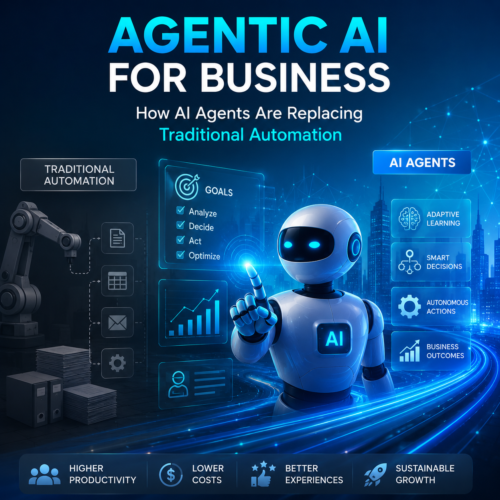
Businesses across Australia are entering a new era of digital transformation. For years, traditional automation tools helped organizations reduce manual work, improve efficiency, and streamline repetitive processes. However, the rapid evolution of artificial intelligence has introduced a more advanced approach: Agentic AI.
Today, companies are no longer looking for systems that simply follow predefined rules. They want intelligent solutions that can understand goals, make decisions, adapt to changing situations, and execute complex tasks independently. This is where Agentic AI for Business: How AI Agents Are Replacing Traditional Automation becomes one of the most important conversations in the technology landscape.
At Jainam Infotech, we help Australian businesses stay ahead of digital trends through strategic SEO and technology-focused marketing solutions. As AI continues reshaping industries, understanding the difference between traditional automation and AI agents is becoming essential for sustainable growth.
What Is Agentic AI?
Agentic AI refers to intelligent AI systems that can perceive information, reason through problems, make decisions, and take actions to achieve specific objectives with minimal human intervention.
Unlike conventional automation software, which follows fixed workflows and rules, AI agents can:
- Analyze context
- Learn from interactions
- Adapt to changing environments
- Coordinate multiple tasks
- Make autonomous decisions
- Interact with different software systems
Enterprise AI agents Jainam Infotech combine large language models, machine learning, reasoning capabilities, and tool integrations to execute business processes more intelligently than traditional automation systems. (IBM)
This shift is transforming how organizations operate, from customer service and marketing to finance, operations, and human resources.
Traditional Automation vs Agentic AI
Traditional automation has delivered significant value over the past decade. Robotic Process Automation (RPA), workflow automation, and scripted systems have helped businesses automate repetitive tasks.
However, traditional automation comes with limitations.
Traditional Automation
- Follows predefined rules
- Works best with structured data
- Requires manual updates when processes change
- Limited decision-making capabilities
- Struggles with unexpected situations
Agentic AI
- Understands business objectives
- Makes context-aware decisions
- Learns from outcomes
- Handles unstructured data
- Adapts to changing business conditions
- Coordinates multiple systems autonomously
The difference is simple. Traditional automation follows instructions. Agentic AI pursues outcomes.
This evolution allows businesses to automate not only repetitive tasks but also complex workflows that previously required human judgment.
Why Australian Businesses Are Embracing AI Agents
Australia has become one of the fastest-growing markets for AI adoption. Research indicates that Australian organizations are increasingly moving beyond experimentation and integrating AI across multiple business functions.
Several factors are driving this trend:
Rising Operational Costs
Businesses across Australia face increasing pressure to improve productivity while controlling costs. AI agents can operate continuously, reduce manual workloads, and improve operational efficiency.
Demand for Faster Decision-Making
Modern businesses generate enormous amounts of data. AI agents can analyze information in real time and make recommendations or decisions faster than traditional systems.
Customer Experience Expectations
Consumers now expect instant responses, personalized interactions, and seamless service. AI agents help businesses deliver these experiences at scale.
Competitive Advantage
Organizations adopting agentic AI are positioning themselves ahead of competitors by improving speed, accuracy, and responsiveness across departments.
Recent industry findings show growing investment and adoption of agentic AI across Australian enterprises as businesses seek productivity gains and automation at scale.