
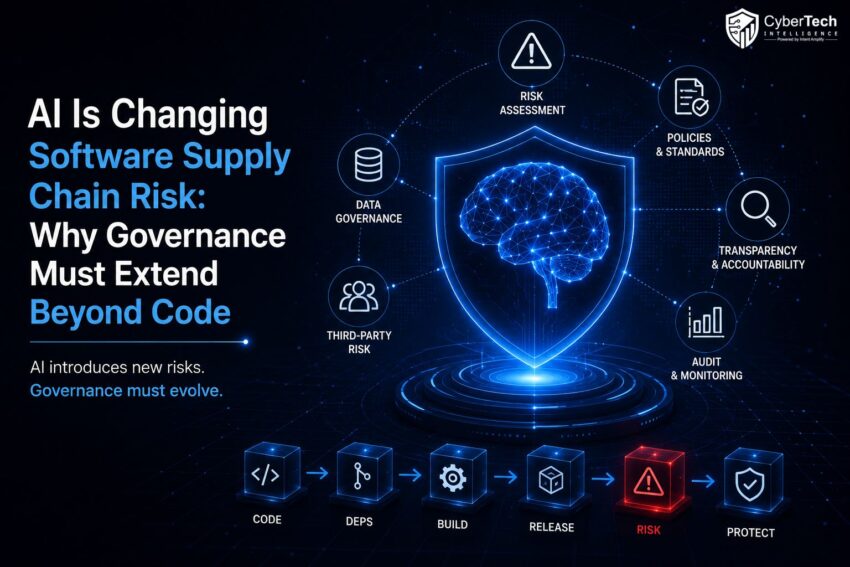
Artificial intelligence is rapidly transforming the way software is designed, developed, tested, and maintained. Developers now rely on AI coding assistants to generate functions, recommend libraries, review vulnerabilities, and accelerate release cycles. At the same time, organizations are introducing AI models, autonomous agents, and third-party AI services directly into business applications.
These innovations are improving productivity, but they are also changing the nature of software supply chain risk.
Traditional software supply chain security focused on protecting source code, managing open-source dependencies, securing build pipelines, and verifying software integrity before deployment. Those controls remain essential, yet they were not designed to govern AI-generated code, external foundation models, or autonomous agents that interact with enterprise systems.
As AI becomes embedded throughout the software development lifecycle, organizations must rethink how they define trust. Security leaders are no longer asking only whether software components are secure. They must also determine whether AI-generated outputs are reliable, whether AI models introduce hidden risks, and whether autonomous development tools operate within acceptable governance boundaries.
Software supply chain security is no longer just a development challenge. It is increasingly an AI governance challenge that requires collaboration across engineering, cybersecurity, compliance, and executive leadership.
Why Traditional Software Supply Chain Security Needs to Evolve
Over the past decade, organizations strengthened software supply chain security through dependency management, code signing, vulnerability scanning, and secure DevSecOps practices.
While these capabilities remain foundational, AI introduces new variables that conventional controls cannot fully address.
Development teams increasingly use AI to:
- Generate production-ready code
- Recommend software packages
- Create infrastructure configurations
- Automate testing
- Produce documentation
- Build application integrations
Each recommendation produced by AI becomes part of the software supply chain, even when its origin, training data, or security implications are not fully understood.
Similarly, AI-powered applications frequently rely on external models, APIs, and continuously updated services that exist outside traditional software inventory processes.
The result is a software ecosystem where trust can no longer be measured solely through package verification or vulnerability databases.
The Core Principles of AI-Aware Software Supply Chain Security
Securing modern software requires governance that extends beyond traditional development controls.
Establish Visibility Into AI-Generated Components
Organizations cannot manage software risk without understanding where AI contributes to the development process.
Security teams should identify projects using AI coding assistants, external AI services, autonomous development tools, and machine learning models while documenting how those technologies influence production software.
Improved visibility provides the foundation for meaningful governance.
Validate AI-Generated Code Before Deployment
AI-generated code can improve developer productivity, but speed should never replace verification.
Organizations should apply secure coding standards, automated testing, code reviews, and vulnerability assessments regardless of whether software is written by developers or produced with AI assistance.
Human oversight remains essential for validating business logic, security controls, and compliance requirements.
Govern Third-Party AI Dependencies
Modern applications increasingly depend on external AI models, cloud AI platforms, and specialized APIs.
These dependencies should be evaluated using the same discipline applied to other critical software suppliers, including vendor risk assessments, contractual security requirements, and continuous monitoring for vulnerabilities or service changes.
Governance should extend to every component that influences software behavior.
Strengthen Software Provenance and Trust
Understanding where software originates has become increasingly important.
Organizations should maintain accurate software bills of materials (SBOMs), document AI-generated contributions where practical, verify software integrity throughout the development lifecycle, and establish clear approval processes before deployment.
Greater transparency improves resilience while simplifying future investigations and compliance activities.
Industry Spotlight: Technology & Telecommunications
Technology organizations often adopt AI development tools earlier than most industries.
Rapid release cycles and large engineering teams increase the importance of governing AI-generated code, third-party models, and automated development workflows.
Comprehensive software supply chain governance enables technology providers to accelerate innovation while maintaining customer trust and product integrity.
Industry Spotlight: Manufacturing
Manufacturing organizations increasingly deploy software that supports industrial automation, connected equipment, and digital production environments.
As AI becomes integrated into operational applications, software supply chain governance helps reduce the risk of introducing insecure code or unverified AI components into systems that support critical manufacturing operations.
This approach strengthens both cybersecurity and operational continuity.
Why AI Governance Strengthens Software Supply Chain Security
Organizations that integrate governance into software development are better prepared to manage emerging risks associated with AI adoption.
Key benefits include:
- Improved visibility across AI-assisted development
- Stronger software integrity and provenance
- Better management of third-party AI dependencies
- Reduced risk of insecure AI-generated code
- Enhanced compliance and audit readiness
- Greater confidence in software release quality
- Improved collaboration between engineering and security teams
Rather than limiting developer productivity, governance enables organizations to adopt AI responsibly while protecting the integrity of their software supply chains.
Building an Effective AI Governance Strategy for Software Development
Successful governance requires security to become part of every stage of the software lifecycle.
Organizations should prioritize:
- Establishing policies for approved AI development tools
- Maintaining inventories of AI-assisted software projects
- Applying secure code review to AI-generated outputs
- Evaluating external AI vendors as software suppliers
- Integrating governance into DevSecOps workflows
- Monitoring software provenance and component integrity
- Continuously updating governance as AI capabilities evolve.
Security leaders should recognize that AI governance is becoming an essential extension of modern software supply chain security rather than a separate initiative.
Organizations seeking to strengthen software supply chain security should combine secure development practices, vendor governance, software integrity validation, and AI oversight to reduce emerging risks while supporting innovation.
The Future of AI and Software Supply Chain Security
As AI becomes deeply integrated into enterprise software engineering, governance will increasingly focus on validating AI-generated outputs, monitoring autonomous development workflows, verifying model integrity, and managing trust across increasingly complex software ecosystems.
Future software supply chain programs are expected to combine traditional security controls with AI-specific governance, providing organizations with greater visibility into how intelligent systems influence software quality and enterprise risk.
Final Thoughts
Software supply chain security is entering a new phase. While protecting code repositories and software dependencies remains essential, organizations must now account for the growing influence of AI across the entire development lifecycle.
By extending governance beyond traditional software controls to include AI-generated code, external models, and autonomous development tools, enterprises can strengthen trust, reduce operational risk, and support secure innovation. Organizations that evolve their governance strategies today will be better positioned to deliver resilient software in an increasingly AI-driven development landscape.