
Phishing has remained one of the most effective cyberattack techniques for decades. Despite significant investments in email security, employee awareness training, and multi-factor authentication, phishing continues to be responsible for a large percentage of enterprise breaches.
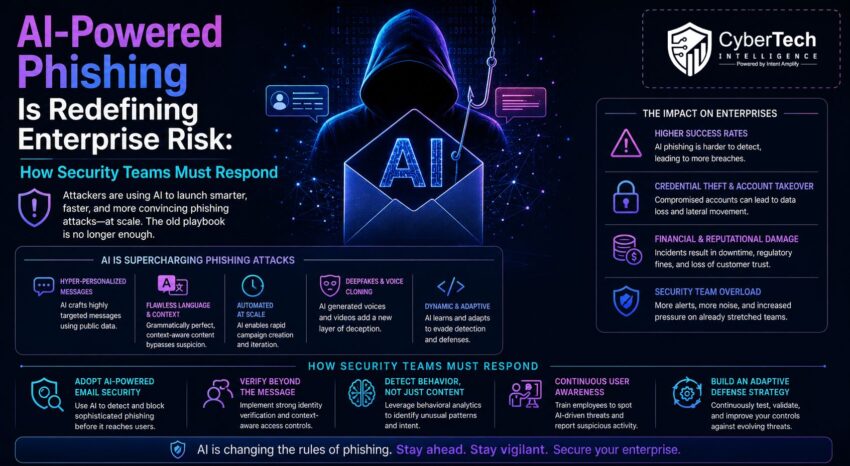
What has changed dramatically in recent years is not the existence of phishing itself, but how it is being executed. Artificial intelligence has fundamentally transformed the capabilities available to cybercriminals. Generative AI enables attackers to create highly personalized phishing emails, clone executive writing styles, generate convincing business communications, produce deepfake audio and video, and automate attacks at a scale that was previously impossible.
The result is a new generation of phishing campaigns that are more convincing, more targeted, and significantly harder to detect. Traditional indicators such as poor grammar, suspicious formatting, or awkward language are rapidly disappearing as AI-generated content becomes increasingly sophisticated.
For enterprise security teams, AI-powered phishing represents more than an evolution of an old attack technique. It represents a shift in enterprise risk that requires new detection strategies, stronger identity protection, continuous user education, and intelligence-driven security operations.
How Artificial Intelligence Is Transforming Phishing Attacks
Artificial intelligence has dramatically lowered the barrier for launching sophisticated phishing campaigns.
Previously, attackers often spent considerable time researching targets, crafting emails, and customizing messages. Today, AI can automate much of this process.
Generative AI enables attackers to:
- Create convincing business emails
- Personalize messages for specific individuals
- Generate content in multiple languages
- Mimic corporate writing styles
- Produce realistic fake documents
- Create phishing campaigns within minutes
This combination of speed and sophistication allows cybercriminals to launch far more effective campaigns than traditional phishing operations.
Why AI-Powered Phishing Is More Dangerous
Traditional phishing attacks often relied on volume rather than quality.
Recipients could frequently identify suspicious emails because they contained:
- Poor grammar
- Spelling mistakes
- Generic greetings
- Obvious formatting errors
- Unprofessional language
AI has changed this reality.
Modern phishing emails are often:
- Grammatically correct
- Contextually accurate
- Professionally written
- Personalized
- Relevant to current business activities
Even experienced professionals can struggle to distinguish these messages from legitimate communications.
The Rise of Hyper-Personalized Phishing
One of AI’s greatest strengths is its ability to generate personalized content.
Threat actors combine publicly available information with AI tools to create messages tailored to individual employees.
Information may be gathered from:
- LinkedIn profiles
- Corporate websites
- Social media platforms
- Public filings
- Company announcements
- News articles
Using this information, AI can produce emails that reference:
- Job responsibilities
- Current projects
- Business partners
- Recent company events
- Executive names
- Industry terminology
These highly personalized attacks significantly increase the likelihood of success.
Business Email Compromise Becomes More Convincing
Business Email Compromise (BEC) attacks continue to evolve through AI.
Attackers now use AI to imitate:
- Executive writing styles
- Internal communication formats
- Department-specific terminology
- Corporate branding
Employees may receive messages that appear to originate from:
- Chief Executive Officers
- Chief Financial Officers
- Human Resources
- Legal departments
- Procurement teams
The requests often seem legitimate because AI replicates the communication style used within the organization.
Deepfake Technology Expands the Threat
Artificial intelligence is also enabling sophisticated voice and video impersonation attacks.
Deepfake technology allows attackers to generate realistic:
- Voice recordings
- Video messages
- Virtual meeting participants
An employee may receive a phone call that sounds identical to their manager or join an online meeting featuring a realistic AI-generated executive requesting urgent action.
These attacks introduce an entirely new dimension to enterprise phishing campaigns.
AI Enables Phishing at Enterprise Scale
One of the most significant changes introduced by AI is automation.
Attackers can now generate thousands of customized phishing emails in a fraction of the time previously required.
AI helps automate:
- Target selection
- Email generation
- Language translation
- Content personalization
- Follow-up messages
- Response analysis
This scalability allows attackers to launch highly targeted campaigns against large organizations while maintaining personalization.
Why Traditional Email Security Is No Longer Enough
Email security gateways remain important, but they face growing challenges.
AI-generated phishing messages often avoid traditional detection methods because they:
- Contain no obvious malware
- Use legitimate language
- Avoid known malicious signatures
- Appear contextually relevant
Signature-based detection alone cannot adequately defend against adaptive AI-generated threats.
Security teams require more advanced detection capabilities.
Identity Has Become the Primary Target
Modern phishing attacks rarely focus solely on delivering malware.
Instead, they increasingly target identities.
Attackers seek to compromise:
- User credentials
- Authentication tokens
- Session cookies
- Multi-factor authentication approvals
- Privileged accounts
Once identities are compromised, attackers often gain legitimate access to enterprise resources.
This makes identity security one of the most important defenses against AI-powered phishing.
Identity Threat Detection and Response
Identity Threat Detection and Response (ITDR) has become increasingly valuable.
ITDR helps organizations identify:
- Suspicious authentication activity
- Impossible travel events
- Credential misuse
- Privilege escalation
- Token theft
- Account takeover attempts
Monitoring identity behavior enables organizations to detect attacks even after credentials have been compromised.
Zero Trust Strengthens Phishing Defense
Zero Trust assumes that no user or device should automatically be trusted.
Instead, organizations continuously verify:
- User identity
- Device posture
- Risk level
- Location
- Access behavior
This approach limits the impact of compromised credentials.
Even if attackers successfully obtain user credentials, Zero Trust policies can restrict unauthorized access.
Threat Intelligence Plays a Critical Role
Threat intelligence helps organizations stay ahead of evolving phishing techniques.
Modern threat intelligence programs monitor:
- Emerging phishing campaigns
- Threat actor tactics
- AI-generated attack methods
- Infrastructure used by attackers
- Credential theft techniques
Security teams can use this intelligence to strengthen detection rules and improve response readiness.
AI as a Defensive Technology
Artificial intelligence is not only helping attackers.
It is also improving enterprise defenses.
Modern security platforms use AI to:
- Detect unusual behavior
- Identify phishing patterns
- Analyze email content
- Correlate threat intelligence
- Prioritize alerts
- Accelerate investigations
AI-powered security tools help reduce analyst workload while improving detection accuracy.
Strengthening Employee Awareness
Technology alone cannot eliminate phishing risk.
Employees remain a critical line of defense.
Security awareness programs should educate employees about:
- AI-generated phishing emails
- Deepfake scams
- Business Email Compromise
- Credential theft
- Social engineering
- Reporting suspicious communications
Training should include realistic phishing simulations that reflect modern AI-enabled attack techniques.
Best Practices for Defending Against AI-Powered Phishing
Organizations can significantly reduce phishing risk by implementing several key security measures.
Deploy Strong Identity Controls
Require:
- Multi-factor authentication
- Passwordless authentication where possible
- Conditional access policies
- Identity governance
Identity protection remains essential.
Continuously Monitor Authentication
Monitor for:
- Suspicious logins
- Unusual locations
- Privilege escalation
- Token misuse
Early detection improves response effectiveness.
Adopt Zero Trust Principles
Implement continuous verification across:
- Users
- Devices
- Applications
- Networks
Never assume trust based solely on successful authentication.
Strengthen Email Security
Use advanced email security platforms capable of detecting AI-generated phishing techniques through behavioral analysis and contextual inspection.
Leverage Threat Intelligence
Integrate current threat intelligence into security operations to identify emerging phishing campaigns before they reach employees.
Educate Employees Continuously
Security awareness should evolve alongside attacker capabilities.
Provide regular education on:
- AI-generated attacks
- Deepfake risks
- Executive impersonation
- Credential protection
The Future of Enterprise Phishing Defense
AI-powered phishing will continue evolving.
Future attacks are expected to become:
- More personalized
- More automated
- More adaptive
- More multilingual
- More difficult to distinguish from legitimate communications
Organizations will increasingly rely on:
- AI-powered detection
- Behavioral analytics
- Identity-first security
- Continuous authentication
- Threat intelligence
- Zero Trust architectures
Security strategies must evolve as rapidly as attacker capabilities.
Conclusion
Artificial intelligence is fundamentally changing the phishing landscape. What was once a high-volume attack based on generic messaging has evolved into a sophisticated, highly personalized threat capable of deceiving even experienced professionals. AI-generated phishing emails, deepfake communications, and automated Business Email Compromise campaigns are redefining enterprise risk and challenging traditional security controls.
Organizations can no longer depend solely on email filtering and awareness training to defend against these attacks. Modern phishing defense requires a layered strategy that combines identity security, Zero Trust principles, advanced threat intelligence, AI-powered detection, continuous authentication, and ongoing employee education.
As cybercriminals continue to weaponize artificial intelligence, enterprises that proactively strengthen their phishing defenses will be better positioned to protect sensitive information, maintain business continuity, and reduce the likelihood of costly security incidents.
About Cyber Tech Intelligence
Cyber Tech Intelligence is a leading cybersecurity intelligence platform dedicated to delivering research-driven insights, threat intelligence, and strategic analysis across the evolving cybersecurity landscape. We help enterprises, CISOs, technology leaders, and cybersecurity vendors navigate emerging threats, security technologies, and business risks with confidence. Our expertise spans AI Security, Threat Intelligence, Cloud Security, Identity Security, Zero Trust, SIEM, XDR, DevSecOps, Application Security, and Enterprise Cyber Resilience. Through independent research, executive engagement, and market intelligence, we provide actionable insights that support informed decision-making and stronger security outcomes.
At Cyber Tech Intelligence, we believe effective cybersecurity strategies are built on trusted intelligence, transparency, and strategic relevance. Our services include cybersecurity research reports, threat trend analysis, executive briefings, vendor intelligence, CISO engagement programs, webinars, and advisory services designed to help organizations stay resilient in a rapidly changing threat environment. Whether you are looking for strategic cybersecurity insights, partnership opportunities, or expert guidance, our team is ready to help. Contact Us to connect with our cybersecurity experts and learn how we can support your organization’s security goals