

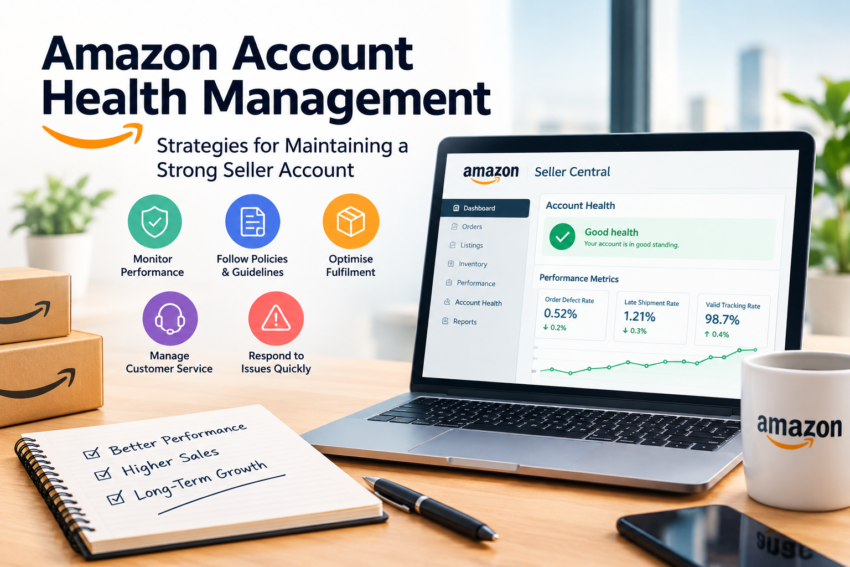
Selling on Amazon offers businesses an opportunity to reach a large customer base, but maintaining a successful store requires more than listing products and fulfilling orders. Sellers must follow marketplace policies, maintain reliable service standards, and respond quickly to performance issues. Effective Amazon seller account management helps businesses monitor their performance, reduce operational risks, and build a more dependable selling experience.
Understanding the Importance of Account Health
An Amazon seller account reflects how consistently a business meets marketplace requirements and customer expectations. Account health can be influenced by order defects, shipping delays, policy violations, intellectual property complaints, and other performance-related concerns. Ignoring these indicators may lead to restrictions, listing removals, or, in serious cases, account deactivation.
Regular Amazon Account Health Management allows sellers to identify potential problems before they become significant obstacles. By reviewing performance notifications and addressing issues promptly, businesses can protect their selling privileges while maintaining a professional relationship with customers.
Account health should not be treated as a task that only requires attention when a warning appears. Instead, it should be incorporated into everyday operations, with clear responsibilities and regular reviews.
Monitor Performance Metrics Consistently
Performance metrics provide useful information about how well a business meets Amazon’s expectations. Sellers should become familiar with the Account Health dashboard and review relevant performance indicators regularly.
Order Defect Rate, Late Shipment Rate, and Valid Tracking Rate are examples of metrics that may affect seller performance, depending on the fulfilment method and applicable requirements. Sellers should also monitor customer complaints, returns, and policy-related notifications.
Reviewing these indicators weekly can help businesses recognise patterns that require attention. For example, repeated late shipments may indicate problems with inventory planning, warehouse processes, or carrier selection. Identifying the underlying cause makes it easier to implement a lasting solution rather than repeatedly correcting individual orders.
Maintaining a simple record of important metrics can also help sellers compare performance over time and evaluate whether corrective measures are working.
Follow Amazon’s Policies and Guidelines
Marketplace policies cover several areas, including product listings, customer communication, intellectual property, product authenticity, and restricted products. Sellers must understand the rules relevant to their categories and business models.
Policy violations can occur because of misleading product descriptions, unsupported product claims, unauthorised use of images, or insufficient documentation. Even an unintentional mistake can create complications if it remains unresolved.
A practical approach to Amazon seller performance monitoring includes reviewing policy updates, checking listing accuracy, and ensuring that product documentation is readily available. Businesses should maintain invoices, supplier records, product certifications where applicable, and other legitimate evidence required for their products.
Before introducing a new product, sellers should confirm that it complies with the relevant category requirements. This preparation can reduce avoidable listing problems and support smoother operations.
Improve Order Fulfilment and Customer Service
Reliable fulfilment plays an important role in maintaining customer satisfaction. Buyers expect accurate orders, appropriate packaging, timely dispatch, and clear communication when problems occur.
Businesses should establish processes for checking inventory levels, preparing orders, and verifying shipping information. Sellers fulfilling orders themselves may benefit from reviewing handling times and choosing dependable delivery partners. Those using Fulfilment by Amazon should still monitor inventory availability, stranded inventory, and other issues that may affect product availability.
Customer service deserves equal attention. Questions and complaints should be handled professionally, with responses that are accurate, helpful, and consistent with Amazon’s communication policies.
A strong Amazon account health strategy connects fulfilment improvements with customer experience. When businesses understand why returns, complaints, or delivery problems occur, they can make operational changes that prevent similar issues in the future.
Respond to Warnings and Policy Violations Promptly
Receiving a performance notification can be stressful, particularly when it threatens an important revenue source. However, responding carefully is more effective than reacting without understanding the issue.
Sellers should first read the notification thoroughly and identify the specific policy or performance requirement involved. They should gather relevant evidence, investigate the cause, and determine which corrective actions are appropriate.
When Amazon requests a plan of action, the response should clearly explain three areas:
- Root cause: Describe what caused the issue, using evidence rather than assumptions.
- Corrective actions: Explain what has already been done to address the immediate problem.
- Preventive measures: Outline the processes introduced to reduce the likelihood of recurrence.
For example, if incorrect product information led to customer complaints, corrective steps might include updating the listing, reviewing the source of the original information, and introducing an additional verification process.
Generic explanations and unsupported claims are unlikely to demonstrate that a problem has been properly addressed. Responses should remain factual, concise, and relevant to the specific notification.
Use Data to Prevent Recurring Problems
Account health management becomes more effective when sellers use historical information to understand operational weaknesses. Looking at individual incidents is useful, but identifying repeated patterns can reveal deeper problems.
For example, a sudden increase in returns across several products may indicate inaccurate sizing information, confusing descriptions, or a quality-control concern. Similarly, recurring stockouts could suggest that demand forecasting and replenishment schedules need improvement.
Businesses can review reports on returns, customer feedback, inventory, and order performance to identify these trends. They should then assign responsibility for addressing each issue and establish a reasonable timeframe for reviewing progress.
Maintaining documented procedures also helps teams work consistently. When employees understand how to check listings, process orders, handle complaints, and escalate policy concerns, fewer issues are likely to be overlooked.
When Professional Support Can Help
Managing an Amazon business can become increasingly complicated as product catalogues expand and order volumes grow. Sellers may need to balance advertising, inventory planning, supplier coordination, customer service, and policy compliance at the same time.
Professional support may be useful when a business faces recurring performance warnings, complicated listing issues, or account-related problems that require detailed investigation. An experienced service provider can help review available information, identify operational gaps, and organise appropriate corrective steps.
Businesses considering AMZ Agency can explore whether professional marketplace support fits their operational needs and growth objectives. Any provider should be evaluated according to its experience, transparency, service scope, and understanding of Amazon’s policies. Sellers should retain access to their own accounts and make sure that any proposed action follows marketplace requirements.
External assistance should complement, rather than replace, a seller’s responsibility to understand account performance and maintain compliant business practices.
Build a Long-Term Account Health Routine
A consistent routine is more valuable than occasional reviews prompted by urgent warnings. Sellers can establish a weekly schedule for checking performance metrics, reviewing notifications, investigating customer complaints, and confirming that important listings remain accurate.
Monthly reviews can focus on broader patterns, including return rates, inventory planning, supplier documentation, and the effectiveness of previous corrective actions. Businesses should also update internal procedures whenever operational changes or relevant policy updates require it.
A proactive approach to Amazon Account Health Management helps sellers make informed decisions, respond to emerging risks, and establish more reliable processes as their businesses grow. Although no routine can eliminate every marketplace risk, consistent monitoring and responsible decision-making can improve operational stability and reduce preventable problems.
Ultimately, sustainable Amazon selling depends on combining policy awareness with dependable fulfilment, accurate listings, responsive customer service, and continuous improvement. Sellers who make these practices part of their everyday operations are better positioned to maintain account stability and support long-term business growth.
Frequently Asked Questions
1. What is Amazon Account Health Management?
It is the process of monitoring seller performance, reviewing policy compliance, addressing warnings, and maintaining the operational standards required to sell on Amazon.
2. How often should sellers check their account health?
Sellers should review their Account Health dashboard regularly, ideally as part of a weekly routine. Urgent notifications and serious policy concerns should be addressed as soon as possible.
3. What can negatively affect an Amazon seller account?
Potential issues include order defects, late shipments, invalid tracking information, intellectual property complaints, product authenticity concerns, and violations of marketplace policies.
4. What should sellers do after receiving an account warning?
They should read the notification carefully, investigate the underlying cause, collect relevant evidence, and complete the corrective steps requested by Amazon. If a plan of action is required, it should explain the cause, corrections, and preventive measures.
5. Can professional support help improve seller account health?
Professional support can help sellers review performance issues, organise documentation, identify process weaknesses, and prepare appropriate responses. However, outcomes depend on the circumstances, available evidence, and Amazon’s decisions; no provider can guarantee reinstatement or a specific result.