
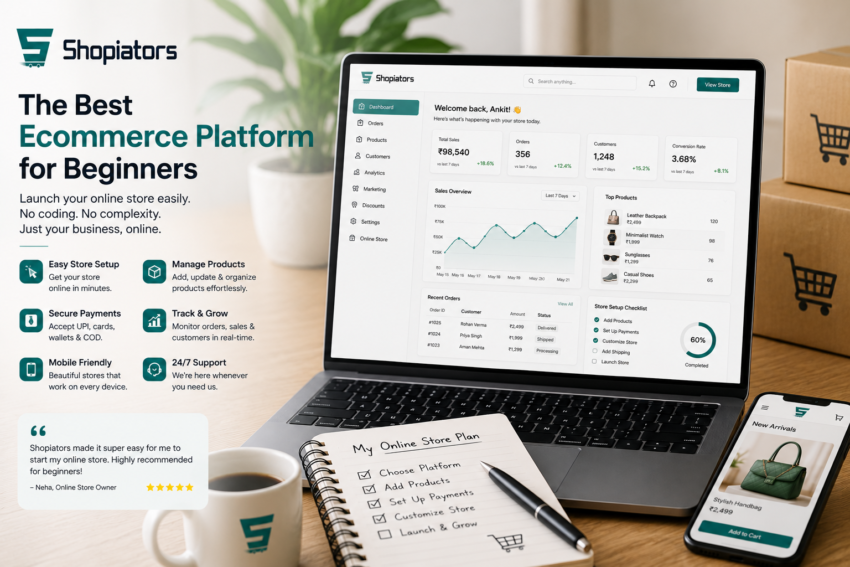
Starting an online store can seem complicated when you are new to ecommerce. Choosing products, creating a website, setting up payments, managing inventory, and handling customer orders all require planning. The right ecommerce platform can simplify many of these tasks and give beginners a structured way to start selling online.
The best ecommerce platform for beginners should not simply provide a website template. It should make important ecommerce activities easy to understand and manage while providing enough flexibility for the business to grow.
For first-time sellers, factors such as ease of use, pricing, product management, payment options, mobile performance, SEO, and scalability are important when comparing different platforms.
What Should Beginners Look for in an Ecommerce Platform?
A beginner-friendly ecommerce platform should reduce unnecessary technical complexity. You should be able to create your store, add products, customize pages, and manage orders without needing advanced programming knowledge.
Some important features to consider include:
- Easy store setup
- Simple product management
- Inventory tracking
- Payment integration
- Order management
- Mobile-friendly design
- SEO controls
- Customer management
- Store customization
- Scalable features
The platform should also have a clear dashboard. If everyday tasks are difficult to understand, managing the store can become time-consuming even after the initial website is launched.
Why Ease of Use Matters for New Sellers
New entrepreneurs often handle several responsibilities at once. They may be responsible for products, marketing, customer support, inventory, and website management.
A complicated ecommerce system can create unnecessary technical work. A simpler platform allows business owners to focus more on their products and customers.
For example, routine tasks such as changing a product price, uploading a new image, adding a category, or checking an order should be straightforward.
The goal is not to remove every advanced feature. Instead, the platform should make basic functions easy while providing advanced options when the business needs them.
AI Ecommerce Platform for Beginners
An AI ecommerce platform can provide additional assistance to people who are new to online selling.
Artificial intelligence can help with certain repetitive tasks involved in creating and managing a store. Depending on the platform, AI may assist with product descriptions, website content, product organization, page structures, and other workflows.
For beginners, this can reduce the amount of time required to prepare an initial store.
However, AI-generated information should always be reviewed. Product specifications, prices, shipping information, return policies, and other important details should accurately represent the actual business.
AI works best as an assistant rather than a replacement for business decisions.
AI Ecommerce Website Builder for Faster Store Creation
An AI Ecommerce Website Builder combines website-building tools with artificial intelligence to simplify parts of the store creation process.
Instead of manually creating every website section, beginners may be able to use AI assistance to generate initial layouts, content, or product-related information.
This can be useful when someone has limited website-building experience.
A practical AI-powered website builder should still allow users to edit and customize the generated content. Business owners need control over their branding, products, images, navigation, and customer experience.
Before publishing an AI-generated website, review every page carefully and make sure that the information is accurate and relevant to the business.
No Code Ecommerce Platform India for First-Time Sellers
A no code ecommerce platform india solution can make online selling more accessible to people without programming experience.
Instead of writing code, users can generally manage their stores through visual editors and dashboards.
Typical no-code tasks may include:
- Adding products
- Creating categories
- Updating prices
- Uploading product images
- Editing website sections
- Managing collections
- Processing orders
- Updating store content
This approach can be particularly helpful for beginners and small businesses that do not have an in-house technical team.
No-code does not mean that the platform should be limited. A good solution should provide simple controls for beginners while allowing more customization as the business develops.
Shopify Alternatives India: What Beginners Should Compare
People researching Shopify Alternatives India may be looking for different combinations of price, simplicity, AI functionality, customization, or local ecommerce features.
Beginners should compare platforms based on practical requirements rather than choosing solely by brand popularity.
Consider these areas:
Pricing
Check subscription costs, transaction charges, premium features, and other recurring expenses.
Store Creation
Look at how quickly you can create pages, add products, and customize the storefront.
Product Management
Check whether products, variants, categories, and inventory can be managed easily.
Payments
Make sure the available payment options suit your target customers and business model.
SEO
Look for control over URLs, page titles, descriptions, headings, and product content.
Mobile Experience
Test the storefront on smartphones because many customers browse and shop through mobile devices.
Scalability
Consider whether the platform can support more products, customers, orders, and website traffic as the business grows.
Best Ecommerce Platform for Small Business in India
The best ecommerce platform for small business in india should balance simplicity, essential features, and operating costs.
Small businesses often have limited budgets and small teams. They may not have dedicated developers or ecommerce managers, so the platform should be practical for everyday use.
Important features can include:
- Easy product management
- Simple order processing
- Inventory tools
- Mobile-friendly storefronts
- Payment support
- SEO functionality
- Customizable website design
- Affordable operating costs
- Reliable customer support
Small businesses should also consider the total cost of ownership instead of focusing only on the starting subscription price.
How Beginners Can Choose the Right Platform
Before selecting an ecommerce platform, create a simple checklist based on your business.
Ask yourself:
- How many products will I sell?
- Do my products have different sizes, colors, or variants?
- Which payment methods do I need?
- Do I need inventory management?
- Will I manage the website myself?
- Do I need AI-assisted content or store creation?
- How much customization do I want?
- What is my monthly budget?
- Do I need strong SEO controls?
- Can the platform support my future growth?
It is also useful to test the platform before committing. Try adding a product, editing a page, changing a price, creating a category, and processing a sample order.
This gives you a practical understanding of how easy the platform is to use.
Common Mistakes Beginners Should Avoid
Choosing an ecommerce platform based only on its price is a common mistake. A cheaper platform may not include features that become important as the business grows.
Another mistake is focusing entirely on website design. A visually attractive store still needs reliable checkout, product management, payments, inventory, SEO, and order processing.
Beginners should also avoid launching without testing the complete customer journey.
Before going live, check:
- Product pages
- Cart functionality
- Checkout
- Payment process
- Mobile layout
- Contact information
- Shipping details
- Return policies
- Website speed
- Broken links
Why Mobile Optimization Matters
A beginner-friendly ecommerce platform should make it easy to create a mobile-responsive store.
Customers may discover products through search engines, social media, advertisements, or messaging platforms and visit the store from their phones.
A mobile-friendly website should have readable text, easy navigation, clear product images, simple buttons, and a checkout process that works comfortably on smaller screens.
Mobile performance should therefore be considered during platform selection rather than after the store is launched.
SEO Features Beginners Should Consider
Search engine optimization can help an online store attract customers through organic search.
Beginners should choose a platform that provides access to important SEO settings.
Useful features include:
- Search-friendly URLs
- Page titles
- Meta descriptions
- Product descriptions
- Heading controls
- Image optimization
- Internal linking
- Category content
- Mobile optimization
SEO should focus on creating useful information for customers instead of repeatedly inserting keywords into pages.
Conclusion
Choosing the best ecommerce platform for beginners is about finding the right balance between simplicity, functionality, cost, and future growth.
An AI ecommerce platform can help reduce repetitive work, while an AI Ecommerce Website Builder can simplify parts of website creation. A no code ecommerce platform india can further reduce technical barriers for people who want to manage their own online stores.
Beginners comparing Shopify Alternatives India should evaluate pricing, products, inventory, payments, SEO, mobile performance, customization, and scalability. Small businesses should also consider whether the platform provides enough functionality without creating unnecessary technical or financial complexity.
The right platform should make it easy to start while providing room to grow. Shopiators combines AI-assisted tools with no-code ecommerce features to help entrepreneurs create, manage, and grow online stores with less technical complexity.