
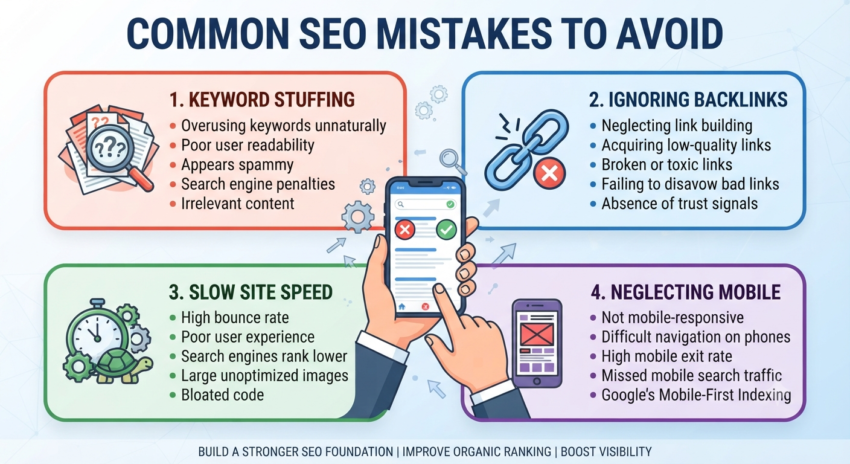
Search engine optimization is one of the most effective ways for businesses to attract people to their websites without depending entirely on paid advertising. However, SEO is not simply about adding keywords to pages and waiting for rankings to improve. Many websites make avoidable mistakes that can limit their visibility, reduce traffic, and create a poor experience for visitors.
Understanding common SEO mistakes can help businesses build a stronger search strategy and make better use of their time and resources. Whether you run a small business website, an e-commerce store, or a large corporate platform, avoiding these mistakes can provide a solid foundation for long-term organic growth.
1. Using Keywords Without a Clear Strategy
One of the most common SEO mistakes is using keywords randomly throughout website content. Some businesses believe that adding a keyword repeatedly will automatically improve rankings.
In reality, excessive keyword usage can make content difficult to read and may create an unnatural experience for visitors. Businesses should focus on understanding what users are searching for and create content that genuinely answers their questions.
Instead of repeating the same phrase, use related terms naturally and organize the content around the user’s search intent.
2. Ignoring Search Intent
Search intent refers to the reason behind a user’s search. Someone searching for “best running shoes” may be researching products, while someone searching for “buy running shoes online” may be closer to making a purchase.
If a webpage does not match the purpose behind a search, it may struggle to perform well even when it contains relevant keywords.
Before creating a page, businesses should consider what users actually want to find and make sure the content satisfies that need.
3. Publishing Low-Quality Content
Creating large amounts of content does not guarantee SEO success. Publishing short, repetitive, outdated, or unhelpful articles can make a website less valuable to its audience.
Businesses should prioritize useful and original content that provides clear answers and practical information. Content should be easy to understand, properly structured, and updated when necessary.
For example, HubSpot has built a large educational content library around marketing, sales, and business topics. The broader lesson for smaller businesses is to focus on providing genuine value rather than publishing articles simply to target keywords.
4. Neglecting Technical SEO
Technical SEO is sometimes overlooked because many of its elements are not immediately visible to visitors.
Technical issues can include:
-
Broken links
-
Incorrect redirects
-
Poor website structure
-
Indexing problems
-
Duplicate pages
-
Slow-loading resources
-
Incorrect canonical settings
-
Mobile usability problems
Tools such as Google Search Console and Screaming Frog SEO Spider can help identify technical problems that may need attention.
A technically healthy website provides a better foundation for search engines to crawl, understand, and index its content.
5. Having a Slow Website
Website speed matters because users generally expect pages to load quickly. A slow website can lead to frustration, higher abandonment, and a weaker overall user experience.
Large images, unnecessary scripts, inefficient code, poor hosting, and excessive third-party resources can contribute to performance problems.
Businesses can use tools such as Google PageSpeed Insights to identify areas that may require optimization.
Improving website performance should focus on both search visibility and the actual experience of people visiting the site.
6. Forgetting Mobile Optimization
A website may look excellent on a desktop computer but still provide a poor experience on smartphones.
Businesses should check whether their website:
-
Displays correctly on smaller screens
-
Has readable text
-
Provides easy-to-use navigation
-
Has buttons that are easy to tap
-
Loads efficiently on mobile connections
-
Keeps forms and important functions usable
Mobile optimization should be considered during website design and SEO planning rather than treated as an afterthought.
7. Ignoring Title Tags and Meta Descriptions
Title tags and meta descriptions help communicate what a webpage is about. Poorly written titles can make it difficult for users to understand a page’s purpose when viewing search results.
Each important page should have a clear and relevant title. Meta descriptions should accurately summarize the page and encourage the right users to click without making misleading promises.
Businesses should avoid using identical titles and descriptions across large numbers of pages.
8. Creating Duplicate Content
Duplicate or highly similar content can create confusion about which version of a page should be prioritized.
This problem can occur on e-commerce websites where products have multiple URLs, websites with similar service pages, or platforms that automatically generate different versions of the same content.
Businesses should maintain clear URL structures and use appropriate technical SEO methods where necessary to help search engines understand preferred pages.
9. Ignoring Internal Linking
Internal links connect different pages within the same website. They help visitors discover related information and can also help search engines understand the structure of a website.
For example, a blog about “SEO for Small Businesses” could link to related pages about keyword research, local SEO, technical SEO, and content marketing.
Important pages should not be isolated. A logical internal linking strategy can make website navigation easier while helping distribute attention across relevant content.
10. Focusing Only on Backlink Quantity
Backlinks can be valuable, but more links do not automatically mean better SEO.
Some businesses focus heavily on collecting as many backlinks as possible without considering their relevance or quality. A better approach is to earn links from reputable and relevant websites through useful resources, original research, valuable content, partnerships, and digital PR.
SEO tools such as Ahrefs, Semrush, and Moz can help businesses analyze their backlink profiles and discover opportunities.
11. Ignoring Local SEO
Businesses that serve specific locations should not overlook local SEO.
Important elements can include:
-
Accurate business information
-
Location-specific website content
-
Local business listings
-
Customer reviews
-
Location pages
-
Consistent contact information
For a local restaurant, clinic, service provider, or retail business, appearing prominently in location-based searches can be highly valuable.
12. Not Monitoring SEO Performance
Another major mistake is making SEO changes without measuring their results.
Businesses should monitor important indicators such as:
-
Organic traffic
-
Search impressions
-
Click-through rates
-
Keyword performance
-
Indexed pages
-
Conversions
-
Engagement
-
Backlink growth
Google Search Console and Google Analytics can provide useful information for understanding how visitors discover and interact with a website.
Data allows businesses to identify successful strategies and determine where further improvements are necessary.
13. Expecting Immediate Results
SEO is generally a long-term marketing process. Some improvements can produce noticeable changes relatively quickly, while others may require considerable time.
Businesses should avoid constantly changing strategies simply because rankings do not improve immediately. Consistent optimization, useful content, technical improvements, and performance monitoring are more sustainable approaches.
Digital Marketing Bucks: A Top Digital Marketing Company
Businesses that find SEO complicated or time-consuming can consider professional assistance.
Digital Marketing Bucks
is a top digital marketing company that can support businesses with SEO strategy, website optimization, keyword research, content marketing, technical analysis, and online visibility.
A professional digital marketing team can help identify common SEO problems, prioritize important improvements, monitor performance, and develop strategies based on a business’s specific objectives.
For companies that want to strengthen their online presence, having experienced guidance can make the SEO process more organized and focused.
Conclusion
SEO mistakes can prevent a website from reaching its full potential. Keyword stuffing, ignoring search intent, publishing weak content, neglecting technical SEO, slow page speeds, poor mobile optimization, duplicate content, weak internal linking, and failing to monitor performance are all issues businesses should take seriously.
The solution is not to chase every SEO trend. Instead, businesses should focus on creating useful content, maintaining a technically healthy website, understanding their audience, and continuously analyzing results.
Companies such as HubSpot demonstrate the value of creating helpful resources, while tools such as Google Search Console, Semrush, Ahrefs, Moz, and Screaming Frog can help businesses identify areas for improvement.
With a consistent strategy and professional support when needed, businesses can avoid common SEO mistakes and build a stronger foundation for sustainable organic search growth.