
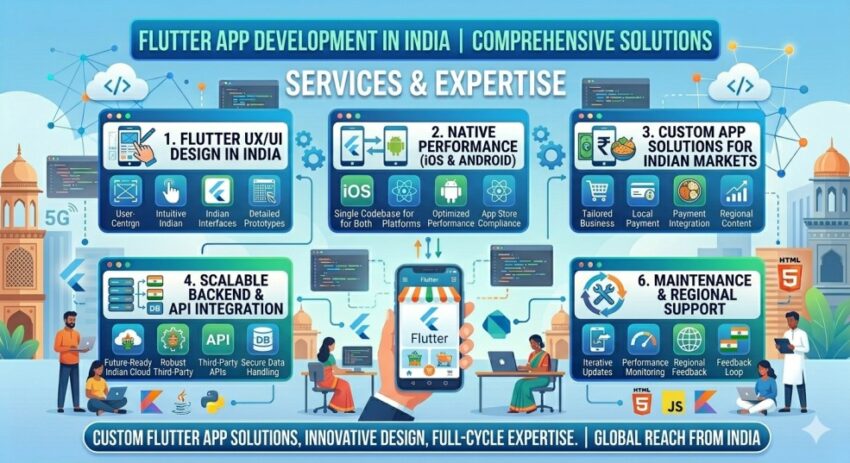
If you are about to commission a cross-platform mobile app and you have talked to more than two development companies in India, you have probably received contradictory advice about Flutter and React Native. One agency is passionate about Flutter. Another insists React Native is the only serious choice. Both recommendations arrived quickly, before the agency fully understood your product.
That pattern — framework preference leading the recommendation instead of following the use case — is one of the most reliable signals that an agency is steering you toward their comfort zone rather than your product’s actual needs. Understanding the real differences between Flutter and React Native in 2026 lets you ask better questions and evaluate whether the recommendation you receive is genuinely serving your project.
What Has Changed in Both Frameworks by 2026
Flutter in 2026
Flutter’s Impeller rendering engine is now the default across iOS and Android, replacing the older Skia-based renderer. Impeller delivers more consistent frame rates — particularly on mid-range Android devices — and has dramatically reduced the shader compilation jank that affected early Flutter apps. Flutter 3.x introduced improved desktop and web support, making it a genuine option for companies wanting a single codebase across mobile, web, and desktop.
Flutter’s widget system — where every UI element is rendered through Flutter’s own engine rather than the platform’s native components — gives it pixel-perfect visual consistency across devices. An animation designed on a Pixel device renders identically on a Samsung mid-range phone. This rendering independence is Flutter’s most significant architectural differentiator from React Native.
React Native in 2026
React Native’s new architecture — JSI (JavaScript Interface), Fabric renderer, and TurboModules — eliminated the bridge-based performance bottleneck that was the framework’s primary criticism for years. In 2026, React Native’s new architecture is stable and widely deployed, delivering synchronous native calls and significantly improved UI performance.
React Native uses the platform’s native UI components — an Android button looks like a native Android button, an iOS list looks like a native iOS list. This gives React Native apps a platform-native feel that Flutter’s custom rendering does not automatically provide. It also means UI consistency across iOS and Android requires more deliberate design effort.
React Native’s JavaScript foundation gives it the largest developer talent pool of any mobile framework globally — every React web developer has a direct path to React Native. This talent availability translates to more competitive hiring and a broader ecosystem of third-party packages.
The Head-to-Head Comparison
|
Factor |
Flutter |
React Native |
|---|---|---|
|
Rendering engine |
Own engine (Impeller) — pixel-perfect everywhere |
Platform native components — per-platform look |
|
Performance (standard apps) |
Excellent — consistent across devices |
Excellent — especially with new architecture |
|
Animation quality |
Outstanding — purpose-built for smooth animation |
Very good — improved significantly |
|
Code sharing (iOS + Android) |
90–95% shared codebase |
70–90% shared codebase |
|
Language |
Dart — purpose-built for Flutter |
JavaScript / TypeScript — largest dev ecosystem |
|
Developer talent pool |
Strong and growing |
Largest — JS/React community |
|
Third-party integrations |
Good — growing ecosystem |
Excellent — mature npm ecosystem |
|
Desktop + Web support |
Strong — Google’s priority |
Limited for production web use |
|
India developer availability |
Deep pool — strong Google adoption |
Very deep pool — JS community overlap |
|
Best for |
Design-led, animation-heavy, multi-platform |
Business apps, SaaS, enterprise integrations |
When Flutter Is the Right Choice
Design-Led Consumer Applications
Flutter was built to make beautiful, animated interfaces. Its widget system gives developers precise control over every pixel of the UI, and its animation framework is the most capable of any cross-platform tool. For consumer apps where the visual experience is central to the product’s value — EdTech apps with engaging interactive learning flows, branded retail apps, health and wellness apps with rich motion design — Flutter’s rendering engine is a genuine architectural advantage.
Multi-Platform Ambitions Beyond Mobile
If your product roadmap includes web and desktop alongside mobile, Flutter is the only cross-platform framework in 2026 that treats all four surfaces (iOS, Android, web, desktop) as first-class deployment targets from a single codebase. React Native’s web and desktop support exists but is not production-grade for most enterprise use cases.
Consistent UI Across the Android Device Spectrum
For companies targeting India’s domestic market or other emerging markets with diverse Android hardware, Flutter’s rendering engine delivers consistent performance and visual quality across the full device spectrum — from entry-level devices to flagships. React Native’s native component rendering means UI behaviour can vary across Android manufacturers and OS versions in ways that require additional testing and patching.
When React Native Is the Right Choice
JavaScript Teams and Shared Web/Mobile Codebases
If your team already has React or JavaScript expertise — for a web application, an admin dashboard, or an existing frontend codebase — React Native allows meaningful code and logic sharing between web and mobile. The knowledge transfer from React web to React Native is significant. For teams that want to build and maintain mobile and web from the same technology foundation, React Native is the structural advantage.
Enterprise Integration Depth
React Native’s npm ecosystem is the most mature package library in mobile development. Enterprise integrations — payment gateways, CRM connectors, analytics platforms, communication APIs, authentication services — almost always have a battle-tested, widely-used React Native implementation. Flutter’s package ecosystem is strong and growing, but for niche or legacy enterprise integrations, the React Native package usually exists and has been in production longer.
Platform-Native Feel Is a Priority
Applications where users strongly expect platform-native behaviour — productivity tools, utility apps, B2B enterprise software — often benefit from React Native’s use of native platform components. The app feels like it belongs on the device rather than running inside a custom rendering engine. For B2B SaaS tools where users are power users of the platform, this native familiarity can improve adoption and reduce friction.
What Indian Flutter Development Companies Know That Matters
India’s Flutter development ecosystem has a specific advantage in this comparison: teams engaged in flutter app development in India have shipped across both frameworks at scale and can give you a genuine use-case-specific recommendation rather than a framework-first sales pitch. The agencies that recommend Flutter for every project regardless of requirements and the agencies that dismiss Flutter entirely for React Native are both telling you the same thing — that they are not evaluating your product. They are defaulting to what they know.
The Decision in One Paragraph
Choose Flutter when visual quality and animation are central to your product’s value, when you want multi-platform coverage beyond mobile, or when consistent UI across Android’s diverse device landscape matters. Choose React Native when your team has JavaScript expertise to leverage, when enterprise integration depth is critical, or when platform-native feel is a product priority. Both frameworks are production-ready in 2026. The right choice is specific to your product — and any development partner worth hiring will ask the questions that lead to that specificity before making a recommendation.
Conclusion
Flutter and React Native are both excellent frameworks in 2026. The performance gap that used to make this comparison easy has closed. The decision now comes down to rendering philosophy, team expertise, integration requirements, and platform ambitions. Ask your development partner to walk you through the reasoning specific to your product. If they cannot — if the recommendation arrives before the questions — that is the signal to keep looking.