
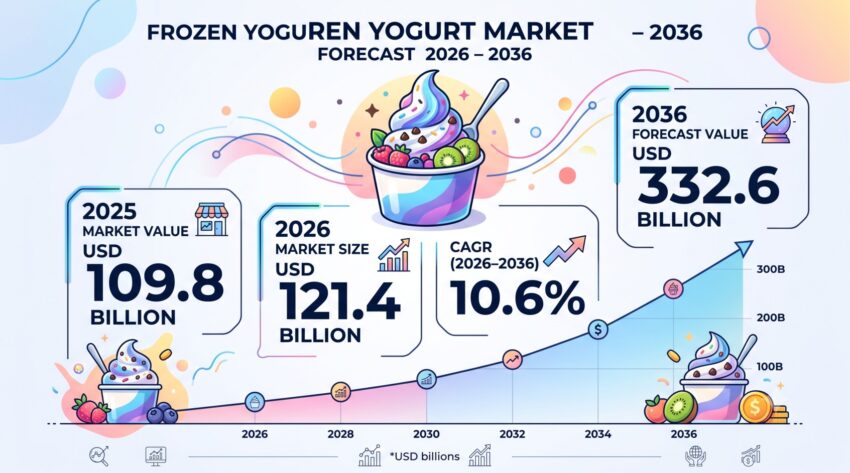
The global frozen yogurt market is entering a phase of rapid, wellness-driven expansion as manufacturers, franchise operators, and retail brands position cultured frozen desserts as healthier alternatives to conventional ice cream. Valued at USD 109.8 billion in 2025 and estimated at USD 121.4 billion in 2026, the sector is projected to reach USD 332.6 billion by 2036, according to the latest research insights by Future Market Insights (FMI). The forecast implies a 10.6% CAGR from 2026 to 2036, yielding an incremental absolute dollar opportunity of USD 211.2 billion over the decade. Growth momentum is anchored by self-serve franchise expansion, proactive clean-label formulation, digestive health positioning, and the mainstream rollout of non-dairy bases.
Quick Market Statistics
- 2025 market value: USD 109.8 billion
- 2026 market size: USD 121.4 billion
- 2036 forecast value: USD 332.6 billion
- CAGR (2026–2036):6%
- Incremental opportunity: USD 211.2 billion
- Dairy-based share of product type (2026):4%
- Hypermarkets & supermarkets share of sales channel (2026):2%
- India market forecast CAGR (2026–2036):0%
- Japan market forecast CAGR (2026–2036):8%
- China market forecast CAGR (2026–2036):5%
Request a Sample Report: https://www.futuremarketinsights.com/reports/sample/rep-gb-4344
Market Growth Is Becoming an Experiential and Flavour-Innovation Story
A 10.6% CAGR signals sustained commercial acceleration across both packaged retail goods and quick-service foodservice models. Yet the headline metric reflects an underlying evolution in consumer behavior: frozen yogurt has transitioned from a narrow ice cream substitute into a broader experiential snacking category.
Brands are driving recurring engagement through aggressive limited-time offerings (LTOs), global viral flavour profiles, and co-branded dessert collaborations. At the same time, ingredient developers are optimizing strain stability to maintain live and active cultures through commercial cold chains, enabling operators to substantiate digestive wellness and immunity claims.
Dairy-Based Offerings Retain Category Dominance
Dairy-based frozen yogurt is projected to command 61.4% of total category sales in 2026, anchoring market value.
This dominance stems from deep consumer familiarity with the rich, creamy texture and pleasant tang characteristic of fermented cow’s milk solids. While dairy maintains the volume baseline, non-dairy formulations utilizing oat, coconut, almond, and soy bases represent the fastest-growing niche. Plant-based alternatives expand category reach to lactose-intolerant, vegan, and flexitarian demographics seeking lighter indulgence without digestive discomfort.
Hypermarkets and Supermarkets Anchor Distribution Volume
Hypermarkets and supermarkets are expected to hold 44.2% of the sales channel segment in 2026.
Large-format offline grocers provide essential sub-zero cold-chain visibility, shelf space, and promotional displays that facilitate routine impulse and planned household purchases. In parallel, multi-unit franchise outlets and modern quick-service restaurants (QSRs) maintain high margin profiles by leveraging self-serve kiosks, dynamic weight-based pricing, and extensive premium topping bars.
Wellness Reformulation and Seasonal Flavours Support Premiumization
Category players are navigating clear health-focused reformulation cycles. Low-fat and no-fat formulations cater directly to calorie-conscious consumers, while functional additions including Vitamin C fortification, prebiotic dietary fibers, and tailored probiotic cultures elevate frozen yogurt into active functional nutrition. In response to winter seasonality dips, operators deploy immune-boosting seasonal flavors and dessert hybrids to stabilize off-peak cash flows.
Asia-Pacific Drives Volume Expansion and Value Density
Geographically, the market presents strong adoption across emerging Asian metropolitan corridors alongside high value density in mature East Asian and Western markets.
India is projected to record the fastest country-level expansion at a 6.0% CAGR through 2036. Growth is driven by rapid urban dessert modernizations, growing health consciousness among middle-class professionals, and rising demand for guilt-free snacking formats across metropolitan hubs.
Japan maintains a leading value position in the regional ecosystem (expanding at 5.8% CAGR), characterized by high-density convenience store distribution, single-serve formats, and aesthetic pairings with seasonal fruits and mochi.
China follows at a 5.5% CAGR, where customizable, visually striking frozen yogurt concepts appeal strongly to urban millennials and digital-first consumers via social media-led food trends.
Mature Western Markets Prioritize Franchising and Functional Inclusions
Western economies represent steady, high-revenue environments driven by organized franchise networks and retail pint scaling.
Germany is forecast to advance at a 4.1% CAGR through 2036, supported by strong summer indulgence trends, strict organic dairy standards, and demand for non-dairy fruit-swirled bases.
The United States is projected to grow at a 3.5% CAGR, anchored by mature franchise chains (such as Yogurtland, Pinkberry, and sweetFrog), packaged retail tub availability, and an ongoing consumer push toward lower-sugar, high-protein dessert alternatives.
Competitive Landscape: Franchise Systems and Retail Innovators
The competitive landscape features established multi-unit franchise systems competing alongside commercial dairy manufacturers and specialized plant-based dessert producers.
Key companies identified in the market include:
- Yogurtland Franchising, Inc.
- Frosty Boy Global
- Pinkberry (Kahala Brands)
- sweetFrog Premium Frozen Yogurt (MTY Franchising USA, Inc.)
- Menchie’s Group, Inc.
- TCBY Systems, LLC
- Red Mango, Inc.
Market leaders differentiate through rapid menu innovation calendars, licensing alliances with entertainment and global confectionery brands, and investments in soft-serve dispensing automation that reduces labor overhead across retail stores.
Key Challenges for Industry Participants
- Seasonality Fluctuations: Marked demand drops during colder winter months can compress store profitability and operational cash flows.
- Ingredient Cost Volatility: Fluctuating farmgate milk prices and specialized plant-base processing costs pressure manufacturer margins.
- Consumer Perception Barriers: Scrutiny over high added sugar levels in commercial syrups and toppings challenges the category’s health-first positioning.
Strategic Opportunities Through 2036
- Functional Bio-Fortification: Formulating soft-serve and packaged bases enriched with heat-stable probiotics, adaptogens, and vitamins to attract wellness consumers year-round.
- Non-Dairy Base Innovation: Enhancing oat- and seed-derived bases to match the overrun, melting profile, and mouthfeel of whole-milk frozen yogurt.
- High-Margin Co-Branding: Partnering with trending confectionery and artisanal bakery brands for limited-run topping collaborations that drive social media virality.
- Packaged Retail Format Scaling: Expanding grab-and-go single-serve cups and multi-packs into convenience retail and quick-commerce channels to capture at-home snacking occasions.
What the Market Means for C-Level Decision-Makers
For foodservice operators and CPG leadership, sustained value creation will depend on managing flavor novelty alongside verifiable health attributes. Brand longevity requires balancing classic dairy indulgence with plant-based inclusivity, optimizing supply chain cold chains, and deploying loyalty programs that insulate unit economics against seasonal volatility.
Exclusive Discounts on Full Report: https://www.futuremarketinsights.com/reports/frozen-yogurt-market
Executive Takeaways
- The global frozen yogurt market is forecast to grow from USD 121.4 billion in 2026 to USD 332.6 billion by 2036.
- The sector will expand at a double-digit 10.6% CAGR over the 2026–2036 forecast timeline.
- Dairy-based formats account for 61.4% of product type demand in 2026, while non-dairy options expand rapidly.
- Hypermarkets and supermarkets hold 44.2% of the sales channel segment in 2026.
- India (6.0% CAGR) and Japan (5.8% CAGR) lead regional growth momentum.
- Menu innovation calendars, experiential self-serve models, and functional probiotic positioning serve as primary competitive differentiators.
Explore More Related Studies Published by FMI Research
Yogurt Market: https://www.futuremarketinsights.com/reports/yogurt-market
Yogurt Powder Market: https://www.futuremarketinsights.com/reports/yogurt-powder-market
Frozen Cheese Market: https://www.futuremarketinsights.com/reports/frozen-cheese-market
About Future Market Insights (FMI)
Future Market Insights (FMI) delivers actionable, decision-focused market intelligence that goes beyond traditional research reports.
The company provides:
- In-depth pricing and cost benchmarking analysis
- Demand forecasting based on real industry inputs
- Procurement and buyer behavior insights
- Supply chain and trade flow intelligence
- Technology and application trend analysis across industries
FMI follows a robust bottom-up research methodology, combining insights from industry experts, procurement leaders, manufacturers, and technical professionals to ensure accurate and practical market intelligence.
For Press & Corporate Inquiries
Rahul Singh, AVP – Marketing and Growth Strategy
Future Market Insights,
Inc. +1-347-918-3531
For Sales: sales@futuremarketinsights.com
For Media: Rahul.singh@futuremarketinsights.com