
The Evolving Landscape of Global Rail Freight: Trends, Drivers, and Market Outlook
The global Rail Freight Transportation Market is undergoing a significant transformation, positioned as a vital component of international supply chains. As global trade expands and the urgency for sustainable logistics intensifies, rail is increasingly favored for its ability to move vast quantities of goods over long distances with superior efficiency and a lower carbon footprint compared to road or air alternatives.
Market Trajectory and Economic Significance
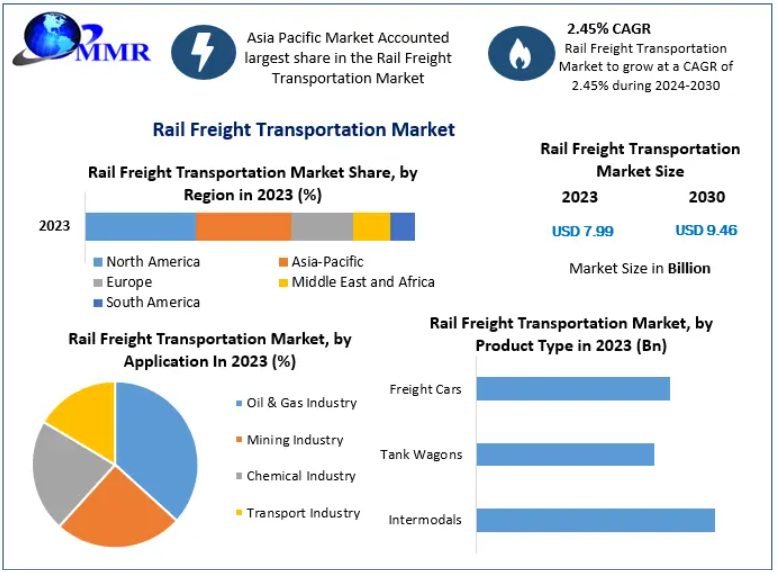
Current projections indicate that the global rail freight market is set to maintain steady growth, expected to reach a valuation of US$ 9.46 billion by 2030, growing at a compound annual growth rate (CAGR) of 2.45% throughout the forecast period. This growth is underpinned by the essential role rail plays in transporting bulk commodities—such as coal, construction materials, iron, and steel—which are typically heavy and high-volume, making them best suited for rail economics.
The market has proven resilient, navigating the disruptions caused by the COVID-19 pandemic. While initial lockdowns hampered transport capabilities and supply chains, the subsequent shortages in trucking labor and rising costs in sea and air freight highlighted the strategic importance of rail. Consequently, many industries shifted focus toward rail, leveraging its reliability to maintain flow during periods of global uncertainty.
For further information, click the following link:https://www.maximizemarketresearch.com/request-sample/113270/
Key Drivers and Market Dynamics
Several factors are propelling the industry forward:
- Environmental Efficiency: Rail transit is estimated to be six to seven times more efficient than road transportation. By reducing fuel consumption, rail contributes to a significant reduction in emissions—ranging from 30% to 80% depending on the mode replaced—aligning with global corporate and governmental sustainability goals.
- Cost Advantage: In many logistics models, rail freight transportation is considerably more cost-effective, with some estimates placing it at one-tenth the cost of automobile transportation for equivalent volumes.
- Infrastructure and Connectivity: Massive investment in rail networks and cross-border connectivity is opening new trade corridors. The expansion of rail links between Europe and China, connecting nearly 60 Chinese cities with approximately 49 European hubs, serves as a prime example of how rail facilitates economic integration and provides access to diverse global markets for goods ranging from electronics to consumer perishables.
Despite these drivers, the market faces challenges, including the imposition of cross-border regulatory hurdles and a high energy tax burden in regions like the United States and Europe, which can temper growth potential.
For further information, click the following link:https://www.maximizemarketresearch.com/request-sample/113270/
Segmentation and Regional Dominance
The market is broadly segmented by product type and application, with distinct trends emerging in each:
- Product Types: The Intermodal segment currently dominates the market. By seamlessly connecting various modes of transport, intermodal services drastically reduce highway congestion and offer substantial fuel and emission savings. Meanwhile, the Tank Wagons segment is experiencing robust growth, particularly in the U.S., Canada, Japan, China, and Europe, driven by the specialized requirements of the chemical and energy sectors.
- Applications: The Oil & Gas industry remains a primary driver, utilizing the vast capacity of rail to move bulk energy resources globally. As energy production and consumption patterns shift, this segment continues to be a cornerstone of rail freight revenue.
- Regional Outlook:
- North America leads the market, benefiting from an extensive rail network of over 200,000 miles, with the United States acting as the primary contributor to regional and global volume.
- Asia-Pacific is positioned as the fastest-growing region. China’s strategic initiatives to increase rail freight to combat pollution, combined with India’s massive rail network—the third largest in the world—ensure that this region will remain a central engine for global industry growth.
Strategic Outlook for Industry Stakeholders
The future of the rail freight market lies in the adoption of advanced technologies to improve operational efficiency and the continued development of high-capacity infrastructure. Major players, including companies such as Union Pacific, BNSF Railway, CN Railway, Deutsche Bahn AG, and SNCF, are actively refining their service offerings to meet the increasing demand for sustainable and cost-efficient logistics.
Decision-makers in the transportation sector should continue to view rail not merely as a legacy transport mode, but as a modern, technology-integrated solution for navigating the complexities of the 21st-century supply chain. Companies that prioritize intermodal integration and leverage the environmental efficiencies of rail are likely to secure a competitive advantage as the industry moves toward 2030.