
When people need a product, service, or solution, one of the first places they often turn to is a search engine. This creates a valuable opportunity for businesses to reach potential customers at the exact moment they are looking for something related to their offerings. Google Search Ads are one of the most widely used forms of paid search advertising for achieving this goal.
Unlike traditional advertising, where businesses display messages to a broad audience, search advertising can place an ad in front of people based on the searches they perform. When planned carefully, Google Search Ads can help businesses increase website traffic, generate leads, promote products, and support sales.
What Are Google Search Ads?
Google Search Ads are paid advertisements that can appear on Google’s search results pages when users search for terms relevant to an advertiser’s products or services.
For example, imagine someone searches for “best digital marketing agency for small businesses.” A company offering digital marketing services may create a search campaign targeting relevant keywords. Its advertisement could become eligible to appear for that search.
Search ads generally include elements such as:
-
A headline
-
Description
-
Website URL
-
Additional assets or extensions
-
A call to action
The advertiser typically pays when someone clicks the advertisement, although campaign billing can vary depending on the campaign setup and advertising objective.
How Do Google Search Ads Work?
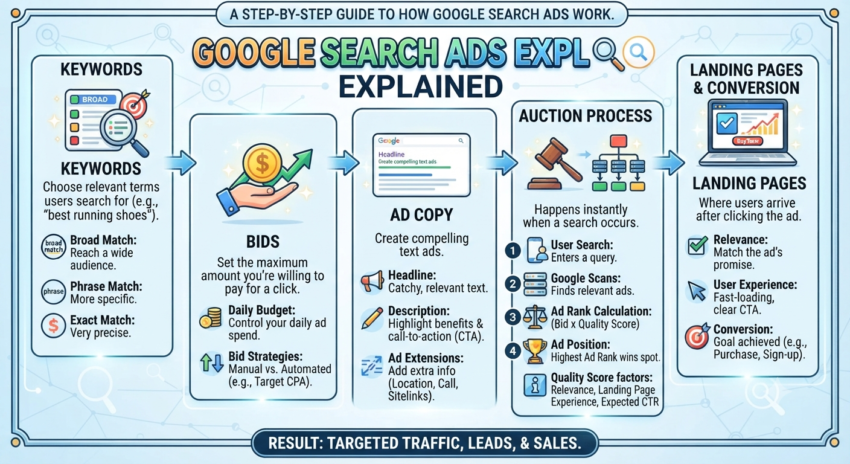
Google Search Ads operate through an auction system. When a user performs a search, Google evaluates eligible advertisements and determines which ads can appear and in what order.
Several factors can influence this process, including the advertiser’s bid, ad quality, relevance, landing page experience, and other auction-related signals.
This means that simply spending more money does not automatically guarantee the best position.
A well-structured campaign with highly relevant keywords, useful advertisements, and a strong landing page can be more effective than a poorly organized campaign with a larger budget.
Why Are Search Ads Important?
Search advertising allows businesses to reach people who are actively expressing an interest through their searches.
Some potential benefits include:
-
Reaching customers with high purchase intent
-
Driving targeted website traffic
-
Generating leads
-
Promoting products and services
-
Supporting local business visibility
-
Testing marketing messages
-
Measuring campaign performance
For example, an online furniture store can target searches related to specific furniture categories. A local service provider could focus on searches related to services available in its area.
1. Start With Keyword Research
Keywords are an important foundation of a Search Ads campaign.
Businesses should identify the words and phrases potential customers may use when searching for their products or services.
For example, a web design company might consider keywords such as:
-
Website design services
-
Business website development
-
Professional web design
-
Website development company
Keyword research should consider search intent rather than focusing only on high search volume.
Someone searching “what is web design?” may simply want information, while someone searching “hire web design company” may be closer to making a purchasing decision.
Understanding this difference can help businesses build more targeted campaigns.
2. Organize Your Campaign Structure
A well-organized campaign makes advertising easier to manage and optimize.
Instead of placing every keyword into one large campaign, group closely related keywords into relevant ad groups.
For example, an online marketing company could separate campaigns or ad groups for:
-
SEO services
-
Social media marketing
-
PPC advertising
-
Content marketing
-
Website optimization
This allows advertisements and landing pages to be more closely aligned with the user’s search.
3. Write Relevant Ad Copy
Your advertisement needs to quickly communicate why someone should click.
A strong search ad should clearly explain the value of the product or service while matching the user’s search intent.
For example, if someone searches for “local SEO services,” an ad should clearly communicate that the business offers local SEO rather than using a vague message about digital marketing.
Use concise headlines and descriptions that highlight relevant benefits.
Possible messages might focus on:
-
Professional service
-
Industry experience
-
Convenient consultation
-
Specific solutions
-
Clear benefits
Avoid making unrealistic promises simply to attract clicks.
4. Create Strong Landing Pages
Getting a click is only the beginning.
After clicking an advertisement, users should arrive on a landing page that matches the message they saw in the ad.
If an advertisement promotes SEO services but sends users to a generic homepage, the experience may be less relevant.
A good landing page should generally have:
-
A clear headline
-
Relevant information
-
Easy navigation
-
Strong call to action
-
Mobile-friendly design
-
Fast loading performance
-
Trust-building information
The page should make it easy for visitors to understand what you offer and what they should do next.
5. Understand Search Intent
Search intent refers to the reason behind a user’s search.
Common categories include:
Informational intent: The user wants to learn something.
Navigational intent: The user is looking for a particular website or business.
Commercial intent: The user is researching products or services before making a decision.
Transactional intent: The user is ready to take an action such as buying or booking.
Understanding intent helps advertisers choose more relevant keywords and create better advertisements.
6. Use Negative Keywords
Not every search related to your keyword is useful.
Negative keywords can help prevent advertisements from appearing for searches that are unlikely to produce valuable visitors.
For example, a company selling premium software may want to exclude searches containing terms such as “free” if free users are not part of its target audience.
Regularly reviewing search terms can help identify irrelevant traffic and opportunities for adding negative keywords.
7. Learn From Established Companies
Many well-known businesses use paid search and other forms of digital advertising as part of their broader marketing activities.
Companies such as Amazon, Microsoft, and Shopify operate in highly competitive digital markets where search visibility can play an important role in customer acquisition.
The lesson for smaller businesses is not to copy their budgets but to learn from the principles behind effective digital campaigns: relevance, clear messaging, strong user experiences, and continuous measurement.
8. Track Important Metrics
One of the major advantages of digital advertising is the ability to measure performance.
Important metrics can include:
-
Impressions
-
Clicks
-
Click-through rate
-
Cost per click
-
Conversions
-
Conversion rate
-
Cost per conversion
-
Return on advertising spend
The most important metric depends on the campaign objective.
For an e-commerce business, purchases and revenue may be critical. For a service business, qualified leads or consultation requests may matter more.
9. Test and Improve Your Campaigns
Successful advertising usually requires ongoing optimization.
Businesses can test different:
-
Headlines
-
Descriptions
-
Keywords
-
Landing pages
-
Calls to action
-
Audience settings
-
Bidding strategies
Review performance regularly and make changes based on meaningful data.
Avoid changing everything at once because it can make it difficult to understand which adjustment caused a performance change.
10. Google Search Ads and SEO
Search Ads and SEO are different marketing methods, but they can complement each other.
SEO focuses on improving organic search visibility, while Search Ads provide paid opportunities to appear in search results.
A business can use both strategies to increase its overall search presence.
For example, a company might use paid advertisements to promote an important service while simultaneously building organic rankings through useful content and technical SEO.
Digital Marketing Bucks: A Top Digital Marketing Company
Digital Marketing Bucks:
is a top digital marketing company that helps businesses strengthen their online presence through services such as SEO, Google Ads, social media marketing, content marketing, website optimization, and digital brand promotion.
For businesses using paid search, a strategic approach can help connect keyword research, advertisement creation, landing-page optimization, audience targeting, and performance tracking. Combining paid advertising with organic digital marketing efforts can create a more comprehensive online growth strategy.
Common Google Search Ads Mistakes
Businesses can waste advertising budgets when campaigns are created without proper planning.
Common mistakes include targeting overly broad keywords, ignoring negative keywords, using generic ad copy, sending visitors to irrelevant landing pages, and failing to track conversions.
Another mistake is focusing only on clicks. A campaign can receive many clicks without generating meaningful business results.
The ultimate goal should be to attract the right visitors and encourage valuable actions.
Final Thoughts
Google Search Ads provide businesses with an opportunity to reach potential customers when they are actively searching for relevant products and services.
A successful campaign requires more than simply selecting keywords and setting a budget. Businesses need to understand search intent, organize campaigns effectively, write relevant advertisements, build strong landing pages, use negative keywords, and continuously measure results.
Companies such as Amazon, Microsoft, and Shopify demonstrate the importance of competing effectively in the digital marketplace, but businesses of every size can use the underlying principles of relevance and customer-focused marketing.
When combined with SEO, content marketing, social media, and a strong website experience, Google Search Ads can become a valuable part of a broader digital marketing strategy. The key is to treat paid search as an ongoing process of testing, learning, and optimization rather than a one-time advertising activity.