
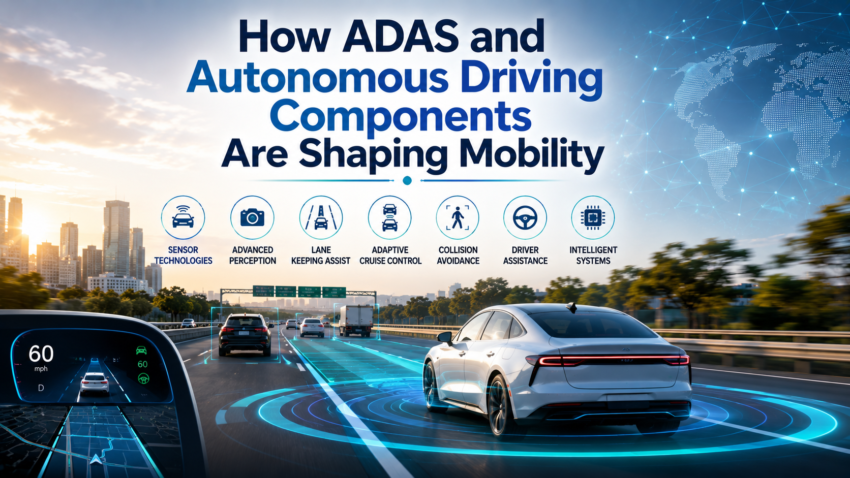
The automotive industry is undergoing a profound transformation as vehicles become increasingly connected, intelligent, and safety-oriented. Advanced Driver Assistance Systems (ADAS) and autonomous driving technologies are no longer limited to premium vehicles; they are steadily expanding across mainstream passenger cars and commercial fleets. Features such as adaptive cruise control, automatic emergency braking, lane-keeping assistance, and intelligent parking systems are changing how drivers interact with modern vehicles.
The evolution of these technologies is being driven by a combination of stricter road safety regulations, rapid progress in sensor and artificial intelligence capabilities, and growing consumer expectations for safer driving experiences. According to a study published by MarkNtel Advisors, the Global ADAS & Autonomous Driving Components Market was valued at around USD 34.68 billion in 2024 and is projected to reach USD 64.17 billion by 2030, expanding at a CAGR of around 10.80% during 2025–2030.
Why ADAS Technology Is Becoming Essential
ADAS technologies are designed to reduce human error, which remains one of the leading causes of road accidents worldwide. By combining cameras, radar, LiDAR, ultrasonic sensors, and advanced software algorithms, these systems continuously monitor the vehicle’s surroundings and provide real-time assistance to drivers. As the automotive sector moves toward higher levels of automation, ADAS acts as the critical bridge between conventional vehicles and fully autonomous mobility.
Governments and transportation authorities are also encouraging the adoption of active safety technologies through updated vehicle safety regulations. Mandatory inclusion of features such as autonomous emergency braking and lane departure warnings in several regions has accelerated the integration of ADAS into new vehicle platforms. The United Nations Economic Commission for Europe (UNECE) vehicle regulations continue to support the development and implementation of advanced automotive safety standards.
The Role of Sensors and Artificial Intelligence
Modern autonomous driving systems rely on a sophisticated ecosystem of hardware and software. Cameras provide visual recognition, radar systems measure distance and speed, while LiDAR creates detailed three-dimensional maps of the surrounding environment. These components work together with artificial intelligence and machine learning models that interpret massive volumes of real-time data to support safe driving decisions.
The increasing computing power available in automotive chipsets has further improved the efficiency of ADAS platforms. AI-powered algorithms can now recognize pedestrians, cyclists, traffic signs, and complex road conditions with greater accuracy than earlier generations of driver assistance systems. As sensor costs gradually decline and software capabilities improve, automakers are expected to integrate these technologies into a broader range of vehicle categories.
Passenger Cars Continue to Lead Adoption
The widespread popularity of passenger vehicles has made this segment the primary adopter of ADAS and autonomous driving components. Consumers increasingly associate advanced safety features with overall vehicle quality, encouraging manufacturers to differentiate their offerings through technology-driven innovation. Intelligent parking assistance, blind-spot monitoring, and adaptive headlights have become important purchase considerations for many buyers.
Automotive manufacturers are also using over-the-air software updates to improve ADAS performance after a vehicle has been delivered. This capability allows automakers to introduce new functionalities, enhance system reliability, and respond to evolving safety requirements without requiring major hardware modifications. Such flexibility is expected to strengthen the long-term value proposition of software-defined vehicles.
Regional Developments Influencing the Industry
Regional differences play a major role in shaping the growth trajectory of ADAS and autonomous driving technologies. North America and Europe continue to benefit from strong regulatory frameworks and early adoption of connected vehicle technologies. Meanwhile, Asia-Pacific has emerged as a manufacturing and innovation hub due to expanding automotive production, significant investments in electric vehicles, and increasing demand for intelligent mobility solutions.
Several countries are also supporting autonomous mobility through pilot projects, smart infrastructure initiatives, and public-private collaborations. Investments in connected transportation ecosystems and intelligent traffic management systems are expected to complement the expansion of ADAS-equipped vehicles. The U.S. National Highway Traffic Safety Administration’s automated vehicle safety initiatives highlight the growing emphasis on creating a safe framework for future autonomous transportation.
Competitive Innovation and Industry Collaboration
The competitive landscape for ADAS and autonomous driving components is characterized by extensive collaboration between automotive manufacturers, semiconductor companies, sensor developers, and software providers. Key industry participants identified in the report include Analog Devices Inc., Autoliv Inc., Continental AG, Delphi Automotive PLC, DENSO Corporation, HERE, IBEO Automotive Systems GmbH, Infineon Technologies AG, Intel Corporation, and LeddarTech, among others.
Strategic partnerships are becoming increasingly important because autonomous driving development requires expertise across multiple disciplines, including hardware engineering, cloud computing, artificial intelligence, and cybersecurity. By combining resources and technological capabilities, companies can accelerate innovation cycles while addressing the complex technical challenges associated with higher levels of vehicle automation.
The Future of Intelligent and Autonomous Mobility
The future of the automotive industry is expected to revolve around intelligent, connected, and increasingly autonomous vehicles. ADAS technologies are laying the foundation for this transition by improving road safety, enhancing driver convenience, and building consumer confidence in automated mobility solutions. As supporting technologies such as AI, high-performance computing, and advanced sensors continue to evolve, the capabilities of autonomous systems are likely to expand significantly.
While fully self-driving vehicles will require ongoing technological and regulatory progress, the adoption of ADAS features demonstrates that the shift toward autonomous transportation is already well underway. The growing integration of intelligent driving components across passenger and commercial vehicles highlights the industry’s commitment to safer, more efficient, and data-driven mobility, making ADAS one of the defining innovations of the modern automotive era.