

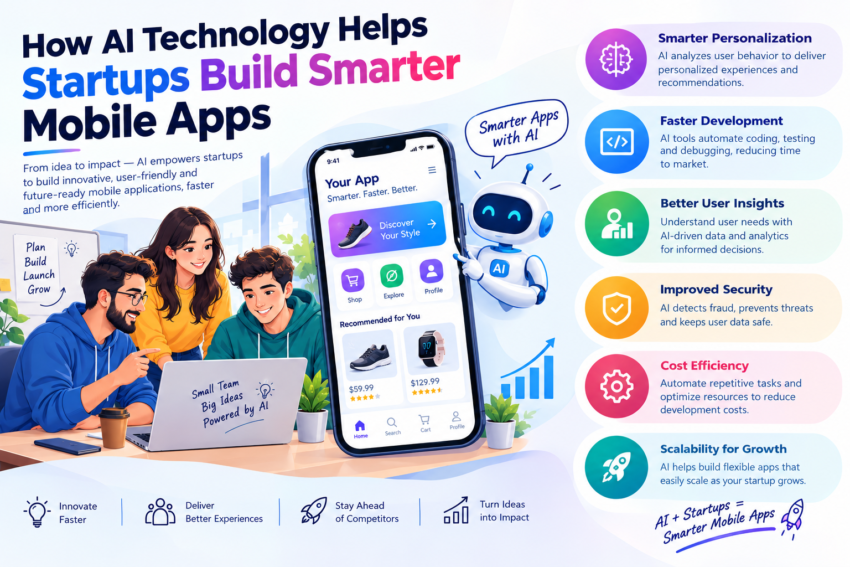
The mobile app market is becoming more competitive every year. Startups are no longer competing only with businesses in their local markets. They are competing with established brands, innovative technology companies, and emerging businesses that are constantly introducing better digital experiences. In this environment, building a mobile app that simply works is no longer enough. Users expect applications to understand their needs, respond quickly, offer personalized experiences, and make everyday tasks easier.
This is where artificial intelligence (AI) is changing the way startups approach mobile app development. AI technology enables businesses to create applications that can analyze user behavior, automate repetitive tasks, deliver personalized recommendations, and improve their performance over time. By partnering with an experienced AI app development company in Canada, startups can leverage advanced AI solutions to build intelligent, scalable, and user-focused mobile applications. Instead of relying entirely on fixed rules and manual processes, businesses can develop smarter mobile apps that adapt to changing user expectations, improve user engagement, and support long-term growth.
What makes AI particularly valuable for startups is its ability to help smaller teams accomplish more with limited resources. From planning app features to improving customer support, AI-powered tools can simplify several stages of the development process. Startups can use these capabilities to test ideas faster, make informed decisions, and deliver more meaningful experiences to their customers.
However, adopting AI is not simply about adding a chatbot or introducing a trendy feature. The real opportunity lies in identifying genuine user problems and applying AI where it creates measurable value.
In this blog, we will explore how AI technology helps startups build smarter mobile apps, the benefits it offers, the challenges businesses should consider, and the practical steps involved in adopting AI successfully.
1. Understanding the Role of AI in Mobile App Development
Artificial intelligence refers to technologies that enable computer systems to perform tasks that typically require human-like intelligence. These tasks include recognizing patterns, understanding language, making predictions, processing images, and generating content.
In mobile applications, AI can operate in several ways. Some applications use machine learning to understand user preferences, while others rely on natural language processing to interpret questions and conversations. Computer vision helps apps recognize objects, documents, and images, while generative AI can assist users with writing, searching, summarizing, and creating content.
For startups, these technologies open up opportunities to build applications that go beyond traditional functionality.
For example, a basic shopping app might display the same product categories to every user. An AI-powered version could recommend relevant products based on browsing activity, previous purchases, and expressed preferences. Similarly, a conventional fitness app might track workouts, whereas an intelligent version could suggest changes to a training routine based on progress and activity patterns.
The difference is that AI can make mobile experiences more responsive to individual needs.
Startups do not necessarily need to develop their own AI models from scratch. They can integrate existing AI services, use open-source models, or deploy smaller models directly on mobile devices. The right approach depends on the application’s purpose, available budget, privacy requirements, and expected usage.
2. Delivering Personalized User Experiences
Personalization is one of the most practical ways AI helps startups build smarter mobile applications.
Modern users appreciate experiences that reflect their interests rather than forcing them to navigate irrelevant information. AI can help applications understand these preferences by analyzing appropriate behavioral signals, such as viewed products, selected categories, search history, and interactions with specific features.
Based on these patterns, an application can adjust recommendations, content, notifications, and navigation suggestions.
Consider a startup developing a food delivery application. Instead of presenting identical recommendations to every customer, the app could suggest restaurants based on previous orders, preferred cuisines, delivery locations, and selected dietary preferences. A learning platform could recommend lessons according to a learner’s progress, while a travel app could suggest destinations that match a user’s interests and budget.
Personalization can make an application feel more useful without requiring users to configure every detail manually.
It can also support customer retention. When people consistently discover relevant information and complete tasks with less effort, they have stronger reasons to return.
However, personalization should be designed carefully. Startups need to avoid making users feel monitored or overwhelmed by overly specific recommendations. Providing clear privacy controls, explaining why recommendations appear, and allowing users to adjust their preferences can help maintain trust.
The goal is not to collect as much information as possible. It is to use relevant information to create a better experience.
3. Improving App Development Speed and Efficiency
Building a mobile app requires significant effort across planning, design, coding, testing, and maintenance. For startups working with limited budgets and small development teams, delays can affect product launches and business growth.
AI-assisted development tools can help reduce some of this workload.
Developers can use AI coding assistants to generate initial code, explain unfamiliar functions, identify potential errors, write test cases, and suggest improvements. AI can also help teams create technical documentation, explore alternative implementation approaches, and understand legacy code.
For example, when building a registration feature, developers might use an AI assistant to draft input validation logic or generate tests for common scenarios. They can then review the output, adapt it to their architecture, and verify that it behaves correctly.
Design teams can also use AI-powered tools to explore interface concepts, create early prototypes, organize user feedback, and generate sample content. These capabilities can help startups evaluate ideas before investing heavily in full-scale development.
The most important advantage is not that AI eliminates the need for developers. Instead, it can reduce time spent on repetitive work and allow teams to concentrate on architecture, product decisions, security, and user experience.
AI-generated code still requires careful review. It may contain incorrect assumptions, insecure patterns, inefficient logic, or outdated recommendations. Startups should maintain code reviews, automated testing, and established development standards.
Used responsibly, AI can help smaller teams move from an idea to a working product more efficiently while preserving engineering quality.
4. Making Mobile Apps More Intelligent Through Predictive Analytics
Traditional mobile applications often respond to actions after users perform them. AI-powered applications can also use historical patterns to estimate what might happen next.
Predictive analytics uses data and statistical or machine learning techniques to identify patterns and generate forecasts. When appropriate data is available, these capabilities can help startups anticipate customer needs and business risks.
For example, a subscription-based app might analyze engagement patterns to identify users who could be losing interest. The business could then investigate whether those users are encountering onboarding difficulties, missing useful features, or receiving irrelevant communications.
An e-commerce startup could forecast product demand, while a logistics application might estimate delivery delays using traffic and historical delivery information.
Financial management apps can use transaction patterns to help users understand spending trends. Fitness applications can estimate progress toward activity goals based on recorded behavior, provided the predictions are presented with suitable limitations.
Predictive features can also help startup teams make better product decisions. By examining usage patterns, businesses can identify which features receive consistent engagement and which may need improvement.
Nevertheless, predictions are not guarantees. Results depend on the quality and representativeness of the data, the suitability of the model, and changes in user behavior. Startups should test predictions against real outcomes and monitor their accuracy over time.
When implemented thoughtfully, predictive analytics helps businesses move from reacting to problems toward identifying opportunities earlier.
5. Enhancing Customer Support With AI Chatbots
Customer support can become challenging as a startup gains users. Hiring additional support staff may not be practical during the early stages, yet slow responses can frustrate customers and damage trust.
AI-powered chatbots and virtual assistants can help address common questions at any time of day.
Unlike simple rule-based bots that follow predefined conversation paths, modern AI assistants can interpret natural language and respond to a wider range of questions. When connected to approved business information, they can explain product features, guide users through common tasks, summarize help articles, and assist with basic troubleshooting.
For example, a startup offering a personal finance app could use an assistant to explain how to categorize an expense or locate a transaction report. A shopping app might help users understand return policies, check order information through authorized systems, or find the correct product category.
AI support can reduce the number of repetitive questions handled by human agents, allowing staff to focus on complex issues that require judgment or personal attention.
However, chatbot implementation requires more than connecting a language model to an app. Businesses need reliable information sources, clear response boundaries, safeguards against incorrect answers, and a straightforward way for users to contact a human representative.
Sensitive actions, such as changing account ownership or handling financial disputes, should require appropriate verification and controlled workflows.
The best AI support experience is one that makes assistance easier to access without trapping users in automated conversations.
6. Strengthening Mobile App Security and Fraud Detection
Security is essential for every mobile application, particularly those that handle payments, personal information, or business transactions.
AI can help startups detect suspicious activity by analyzing patterns that might be difficult to identify through fixed rules alone. Depending on the application, models can flag unusual login behavior, abnormal transaction sequences, automated account creation, or activity that differs significantly from established patterns.
For instance, a digital payment app could use a combination of transaction rules and machine learning to identify payments that require additional verification. A marketplace might detect unusual seller behavior, while a subscription platform could investigate automated sign-up patterns.
AI can also support security teams by helping prioritize alerts and identify recurring issues in application logs.
Nevertheless, AI should complement rather than replace fundamental security practices. Strong authentication, encryption, secure data storage, access controls, regular software updates, and secure API design remain essential.
There is also a risk of false positives. A legitimate user traveling to a new location or purchasing an unusually expensive item could trigger an alert. Startups should design proportionate responses, such as requesting additional verification rather than automatically blocking every suspicious action.
Security models need ongoing evaluation because fraud patterns change over time. Human review, clear escalation processes, and privacy-conscious monitoring can help businesses use AI without creating unnecessary barriers for legitimate customers.
7. Using Voice Recognition and Natural Language Processing
Mobile devices are increasingly used in situations where typing is inconvenient. Voice recognition and natural language processing can make applications more accessible and easier to operate.
Voice-enabled features allow users to speak commands, dictate messages, search for information, and interact with virtual assistants. Natural language processing helps applications interpret the meaning of text or speech rather than relying exclusively on exact keywords.
A productivity startup could allow users to create reminders through voice commands. A language-learning app might provide conversational practice, while a travel application could help users search for destinations using everyday language.
For example, instead of navigating several menus, a user might ask an application to show upcoming appointments or locate a previously saved document. The app could interpret the request and direct the user to the appropriate feature.
These capabilities can also improve accessibility for people who have difficulty typing or interacting with conventional interfaces.
However, voice features must account for background noise, different accents, speech recognition errors, and environments where speaking aloud is inappropriate. Users should always have an alternative interaction method.
Startups should also make microphone permissions transparent and avoid recording or retaining audio unnecessarily.
When voice and language technologies solve genuine usability problems, they can make mobile applications more natural and inclusive.
8. Improving App Testing and Quality Assurance
Mobile apps must function across different devices, screen sizes, operating system versions, network conditions, and user interaction patterns. Testing these combinations can consume considerable time.
AI can support quality assurance by helping teams generate test scenarios, identify unusual behavior, analyze crash reports, and prioritize areas that may need additional attention.
For example, an AI-assisted testing workflow might examine a new checkout feature and suggest test cases involving missing addresses, invalid payment information, interrupted network connections, or repeated submission attempts.
Machine learning techniques can also help teams identify recurring patterns in crash logs and group similar issues together. This makes it easier to investigate problems that affect multiple users.
Some AI-powered testing platforms support automated interface interaction and can help identify changes that cause existing tests to fail. These tools may reduce repetitive testing work, particularly in applications with frequent updates.
Still, AI cannot guarantee that an application is bug-free. Generated tests may overlook important business rules, and automated systems can struggle with complex interactions or unusual real-world conditions.
Startups should combine AI-assisted testing with unit tests, integration tests, end-to-end testing, accessibility checks, performance testing, and manual review where necessary.
The objective is to improve test coverage and feedback speed, not to remove human responsibility for product quality.
9. Creating Better Experiences With On-Device AI
Not every AI feature needs to send user data to a remote server. On-device AI allows certain models to run directly on a smartphone or tablet.
This approach can offer several benefits. Depending on the model and device, it may reduce response times, support selected features without an internet connection, lower repeated server requests, and keep sensitive information on the user’s device.
A photo application, for example, might use on-device image recognition to organize pictures. A note-taking app could support local text classification, while a keyboard could offer predictive text without sending every keystroke to an external service.
On-device processing can be particularly useful for applications that handle private content or need to work in areas with unreliable connectivity.
However, mobile devices have limited memory, processing capacity, battery life, and storage. Large AI models may be impractical for certain devices, and model updates can increase application size.
Startups must balance performance, battery consumption, privacy, and compatibility across different hardware.
A hybrid architecture can offer another option. Lightweight tasks can run locally, while more complex processing takes place on a secure server when necessary and with appropriate user consent.
Choosing the right architecture depends on what the feature needs to accomplish and how sensitive its information is.
10. Helping Startups Reduce Costs and Scale Efficiently
Startups usually need to balance innovation with financial discipline. AI can support this balance by automating selected workflows, improving operational decisions, and helping teams use existing resources more effectively.
For example, an AI assistant may handle routine support requests, reducing the amount of repetitive work performed by employees. Automated analysis can help product teams review customer feedback, while predictive models may improve inventory planning or demand forecasting.
AI can also support faster experimentation. Rather than spending weeks manually reviewing thousands of feedback comments, a startup can use text analysis to organize common complaints and feature requests. Product managers can then investigate the most relevant findings.
These improvements may help startups reduce certain operational costs and direct resources toward product development, customer relationships, and business expansion.
However, AI does not automatically make an application cheaper to operate. Model usage, cloud computing, data storage, monitoring, integration, and security all create expenses. Heavy reliance on external AI services can lead to unpredictable costs as usage increases.
Startups should estimate the cost of each AI feature before launching it. They can compare different models, limit unnecessary requests, cache suitable results, monitor usage, and use simpler techniques when they perform adequately.
The goal is sustainable efficiency, not automation for its own sake.
Conclusion
AI technology is changing the possibilities of mobile app development by enabling startups to create applications that are more personalized, responsive, efficient, and useful. From intelligent recommendations and predictive analytics to automated support, enhanced testing, and on-device processing, AI offers several ways to improve both the customer experience and the development process.
For startups, the biggest advantage is the ability to experiment with new ideas and deliver value without necessarily building every capability from the ground up. Existing AI services, open-source models, and mobile-friendly machine learning tools can make advanced features more accessible to smaller teams.
Nevertheless, successful AI adoption requires more than selecting a model or integrating an API. Businesses must consider data quality, privacy, security, development costs, reliability, and the expectations of their users. They should also recognize that traditional software engineering remains essential for building secure, maintainable, and dependable applications.
The most effective strategy is to start with a clearly defined problem, select technology that fits the use case, measure the results, and improve based on real-world feedback.
Ultimately, smarter mobile apps are not necessarily the ones with the most AI features. They are the ones that use technology thoughtfully to remove friction, anticipate genuine needs, and help people accomplish their goals more easily. For startups willing to combine practical innovation with responsible development, AI can become a valuable foundation for building competitive mobile products and achieving long-term growth.