

Introduction
Selling products on Amazon involves more than creating listings and waiting for customers to make purchases. With numerous sellers competing for attention, businesses need a clear strategy to improve product visibility, attract relevant shoppers, and manage advertising expenses. Sponsored advertising can help sellers reach potential customers, but achieving consistent results requires an understanding of campaign structures, keyword targeting, bidding strategies, and performance analysis.
Amazon Advertising Training can help sellers and marketing professionals develop these essential skills through a structured approach to campaign planning and optimisation. Instead of relying on guesswork, learners can understand how advertising tools work, how to interpret campaign data, and how to make informed decisions that support business objectives.
Whether someone is launching their first product or managing advertising for an established catalogue, developing practical advertising knowledge can make campaign management more organised and measurable. A strong foundation also helps sellers identify opportunities to improve their advertising performance while keeping business goals and budgets in focus.
Understanding the Basics of Amazon Advertising
Amazon advertising allows eligible sellers, vendors, and brands to promote products across different placements within the Amazon shopping environment. Depending on eligibility and advertising objectives, options may include Sponsored Products, Sponsored Brands, and Sponsored Display campaigns or their current equivalents.
Each advertising format serves a different purpose. Sponsored Products can help individual product listings appear in relevant shopping results and product pages. Sponsored Brands can support brand visibility through placements that showcase a brand and its products. Other display advertising options may help businesses reach relevant audiences in different shopping contexts.
Understanding these distinctions is important before launching campaigns. An advertising format that works well for one objective may not be suitable for another. For example, a seller introducing a new product might prioritise relevant search visibility, while an established brand could focus on promoting a wider product range.
Structured learning helps learners understand these options, evaluate their suitability, and select campaign types based on product characteristics, available budgets, and marketing priorities.
Why Structured Advertising Education Matters
Many sellers begin advertising by experimenting with different keywords and bids. Although experimentation can provide useful information, an unstructured approach may lead to unnecessary spending, inconsistent results, and difficulty identifying the reasons behind campaign performance.
A structured learning programme provides a framework for making advertising decisions. Learners can understand how targeting, bidding, budgets, and conversion performance interact, allowing them to approach campaigns with greater confidence.
The main benefits include:
- Better campaign planning: Establishing clear objectives before allocating advertising budgets.
- Improved keyword selection: Identifying search terms that are relevant to products and customer intent.
- More informed bidding: Understanding how bids influence auction participation and advertising costs.
- Performance measurement: Using campaign reports to identify trends and areas for improvement.
- Budget management: Allocating spending according to priorities and observed results.
- Ongoing optimisation: Making adjustments based on evidence instead of changing multiple settings without a clear reason.
These skills are useful for independent sellers, e-commerce teams, marketing professionals, and agencies that manage advertising accounts for clients.
Developing Practical Skills Through Amazon PPC Training
Pay-per-click advertising is an important part of many Amazon marketing strategies. Under this model, advertisers generally pay when shoppers click on their ads, subject to the campaign type and its applicable billing structure. However, generating clicks alone does not guarantee profitable sales.
Effective campaign management requires an understanding of the relationship between advertising costs, product prices, conversion rates, and profit margins. Learning how to evaluate these factors can help advertisers make better decisions about which campaigns deserve additional investment.
Amazon PPC Training can introduce learners to the core components of campaign management, including campaign creation, keyword research, targeting options, bid adjustments, and reporting.
For example, a seller advertising a kitchen accessory may discover that a broad keyword attracts substantial traffic but produces relatively few purchases. A more specific search term might generate fewer clicks but attract shoppers with stronger purchase intent. Comparing the performance of these terms can help the seller determine where advertising resources may be used more effectively.
Practical exercises are particularly valuable because they allow learners to connect advertising concepts with real campaign situations. Reviewing sample reports, comparing targeting methods, and evaluating hypothetical budget scenarios can strengthen decision-making skills before learners apply them to live accounts.
Learning Keyword Research and Targeting
Keyword research plays a central role in search-based advertising. Choosing appropriate keywords helps sellers connect their products with shoppers who are searching for relevant items.
However, selecting keywords involves more than identifying popular search terms. Advertisers also need to consider relevance, competition, search intent, and the likelihood that a click will lead to a purchase.
A seller promoting a premium coffee grinder, for example, may consider general terms related to coffee equipment alongside more specific phrases describing the product’s features. Highly general terms could attract a wider audience, but some of those shoppers may be looking for products that do not match the advertised listing.
A focused targeting strategy can help balance reach and relevance.
Training in keyword research commonly covers several important activities:
- Identifying search terms related to the product and its intended audience.
- Reviewing available keyword research data and advertising reports.
- Separating broad discovery terms from more specific, purchase-oriented phrases.
- Monitoring which search terms generate clicks, orders, and advertising costs.
- Evaluating negative keyword opportunities where supported by the campaign type.
Automatic and manual targeting can also serve different purposes. Automatic targeting allows Amazon to match ads using its targeting systems, while manual targeting gives advertisers more direct control over selected keywords or product targets, depending on the campaign format.
Understanding when to use each method helps sellers build campaigns around defined objectives rather than treating every targeting option as interchangeable.
Understanding Bids, Budgets, and Advertising Costs
Campaign budgets and bids influence how advertising resources are allocated. A bid represents the amount an advertiser is willing to pay for a click in applicable cost-per-click auctions, while a budget establishes a spending limit for a campaign over the relevant period.
Setting these figures requires consideration of the product’s selling price, profit margin, conversion rate, competition, and overall business objectives. A bid that is too low may limit opportunities to participate in auctions, while an unnecessarily high bid can increase costs without delivering proportionate value.
Learners should also understand that advertising performance varies across products and categories. There is no universal bid or daily budget that guarantees strong results.
A practical example illustrates the importance of evaluating costs carefully. Suppose a product sells for £30 and generates £9 in contribution before advertising costs. If the campaign spends £6 to generate a sale, the remaining contribution is £3 before any additional expenses not already included in the calculation. If advertising costs rise to £10 per sale, the same product may become unprofitable on that basis.
This example highlights why campaign decisions should be linked to unit economics rather than clicks or sales volume alone.
Through Amazon Ads Training, learners can develop a clearer understanding of bidding approaches, budget allocation, advertising efficiency, and the financial implications of campaign decisions. They can also learn why profitability targets should account for costs such as fulfilment, product sourcing, returns, and other relevant business expenses.
Using Advertising Reports to Improve Performance
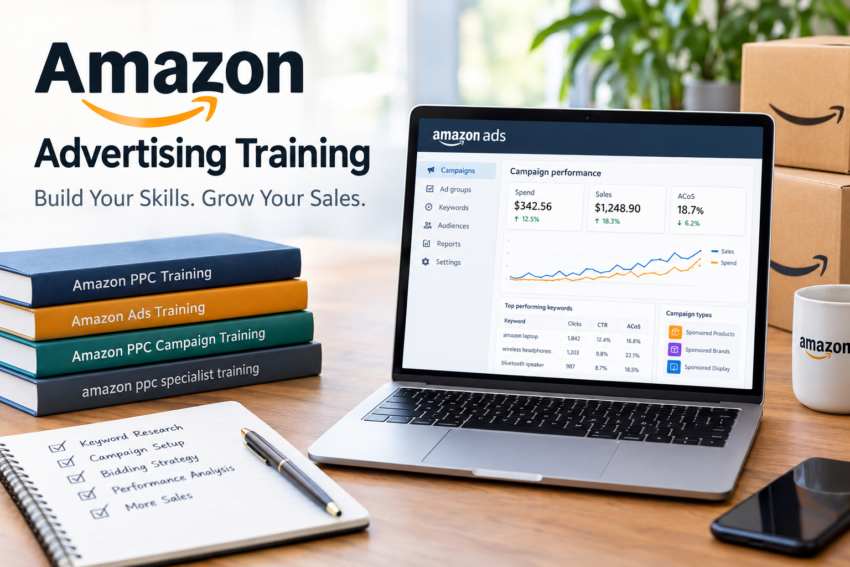
Advertising reports help sellers understand how campaigns perform over time. Common metrics include impressions, clicks, click-through rate (CTR), cost per click (CPC), advertising-attributed orders, advertising sales, and advertising cost of sales (ACoS).
Each metric provides a different perspective on performance.
Impressions indicate how often ads are displayed. Clicks show how many times shoppers engage with them. CTR measures the proportion of impressions that result in clicks. Conversion-related metrics help advertisers understand whether traffic is turning into purchases.
ACoS compares advertising spend with advertising-attributed sales. For instance, if a campaign spends £50 and generates £250 in attributed sales, its ACoS is 20%.
However, a lower ACoS is not automatically better in every situation. A launch campaign may intentionally accept higher advertising costs to build visibility or gather data, while an established product may require tighter efficiency targets. The appropriate benchmark depends on margins, campaign objectives, attribution settings, and the wider business strategy.
Advertising reports can also help identify possible listing issues. If an ad receives relevant clicks but generates few orders, the problem may involve the product price, images, product information, reviews, delivery options, or mismatch between the search term and the offer.
Campaign optimisation should therefore consider the entire shopping journey, not just the advertising settings.
The Role of Amazon PPC Campaign Training in Campaign Management
Managing multiple campaigns can become complicated as a product catalogue grows. Different products may have different margins, seasonal demand patterns, competitive conditions, and sales objectives.
Amazon PPC Campaign Training can help learners understand how to organise campaigns into manageable structures and establish a consistent review process.
For example, campaigns may be organised according to product categories, individual products, branded search terms, generic keywords, or specific business objectives. Clear naming conventions can make it easier to identify the purpose of each campaign and compare results over time.
A structured management process may include:
- Reviewing campaign performance at regular intervals.
- Checking search-term reports for relevant targeting opportunities.
- Identifying keywords that generate sales efficiently.
- Investigating spending that produces limited results.
- Adjusting bids and budgets according to evidence.
- Recording significant changes to understand their impact.
- Comparing performance over suitable time periods.
It is important to avoid making frequent adjustments based on limited data. A campaign may need sufficient clicks, conversion opportunities, or time to provide a useful performance signal. Seasonal changes and product availability can also affect results.
A consistent review schedule supports more informed decision-making and reduces the risk of reacting to short-term fluctuations.
Building a Long-Term Advertising Strategy
Successful advertising requires more than launching a campaign and making occasional bid changes. Sellers should connect advertising activities with broader business priorities, including product launches, inventory management, seasonal demand, pricing, and customer experience.
For instance, increasing a campaign budget may not be appropriate when a product has limited inventory. Similarly, driving additional traffic to a listing with incomplete information may not produce the expected improvement in sales.
A long-term strategy considers how advertising fits into the wider retail operation. Sellers can establish objectives, define performance indicators, review results, and adjust their approach as market conditions change.
This is also where Amazon seller course options and specialist advertising education may complement one another. Broader seller education can cover marketplace operations, listing management, and commercial planning, while dedicated advertising instruction focuses more closely on campaign setup, targeting, reporting, and optimisation.
Learners should look for programmes that explain practical workflows, use current marketplace terminology, and acknowledge that advertising tools and policies can change. Training is most useful when it encourages critical thinking instead of promising guaranteed sales or fixed returns.
Who Can Benefit From Advertising Training?
Advertising education can support people at different stages of their e-commerce journey.
New Amazon sellers can develop a foundation before investing significant amounts in paid promotion. Understanding campaign structure, keyword relevance, and cost management can help them avoid common early mistakes.
Established sellers can use additional training to review existing practices, identify inefficiencies, and develop more consistent optimisation routines.
E-commerce employees may benefit from learning how advertising reports connect with sales performance, product margins, and inventory decisions.
Marketing agencies and freelancers can strengthen their ability to discuss campaign objectives, interpret performance data, and explain optimisation decisions to clients.
Business owners expanding their product ranges can use structured learning to understand how advertising requirements may differ between products and categories.
The most suitable programme depends on the learner’s experience, existing responsibilities, and preferred learning format. Practical demonstrations, clear explanations, and opportunities to apply concepts can be particularly helpful for those who learn best by doing.
Choosing the Right Training Programme
Before enrolling in an advertising course, learners should evaluate what the programme covers and whether it aligns with their goals.
A useful course should explain campaign fundamentals, keyword targeting, bidding, budgeting, performance reporting, and optimisation. It should also address common challenges, such as limited conversion data, changing costs, low-performing search terms, and the relationship between advertising and listing quality.
Learners may also wish to consider whether the course provides practical examples, downloadable resources, structured exercises, or guidance on interpreting campaign reports.
The Amazon Trainer is one option for those exploring specialised learning in Amazon selling and advertising. As with any training provider, prospective learners should review the current curriculum, teaching approach, course access arrangements, and suitability for their experience level before making a decision.
Ultimately, the best programme is one that builds transferable skills and helps learners understand why particular advertising decisions are appropriate in specific circumstances.
Conclusion
Amazon advertising can offer sellers valuable opportunities to reach shoppers, increase product visibility, and support business growth. However, the effectiveness of paid campaigns depends on careful planning, relevant targeting, sensible budgeting, and ongoing evaluation.
A structured approach to learning helps sellers move beyond trial and error by developing practical skills in keyword research, bid management, campaign organisation, and performance analysis. These capabilities can support better decisions as advertising needs become more complex.
By combining advertising knowledge with strong product listings, realistic profitability targets, and consistent measurement, sellers can build a more sustainable approach to marketplace promotion. The objective is not simply to generate more clicks, but to understand how advertising contributes to meaningful business outcomes.
Frequently Asked Questions
1. What is Amazon advertising training?
It is structured education that helps sellers and marketing professionals understand Amazon’s advertising tools, campaign setup, keyword targeting, bidding, budgeting, and performance analysis. The content may range from introductory concepts to advanced campaign optimisation.
2. Is Amazon PPC training suitable for beginners?
Yes. Beginner-focused programmes can explain the fundamentals of pay-per-click advertising, including how campaigns work, how to select relevant keywords, and how to monitor advertising costs. Learners should choose a course that matches their current experience.
3. What is the difference between automatic and manual targeting?
Automatic targeting allows Amazon to identify relevant targeting opportunities based on its systems and the advertised product. Manual targeting gives advertisers more direct control over selected keywords or product targets, depending on the campaign type. Both approaches can serve useful purposes within an advertising strategy.
4. Which metrics should sellers monitor in Amazon advertising campaigns?
Common metrics include impressions, clicks, CTR, CPC, advertising-attributed orders, attributed sales, and ACoS. Sellers should also consider their product margins, total costs, conversion performance, and overall return objectives when assessing results.
5. How long does it take to learn Amazon PPC campaign management?
The time required depends on a learner’s prior experience, the complexity of the campaigns, and the amount of practical work involved. Basic concepts may be learned relatively quickly, but developing reliable optimisation skills generally requires continued practice, report analysis, and experience with changing marketplace conditions.