
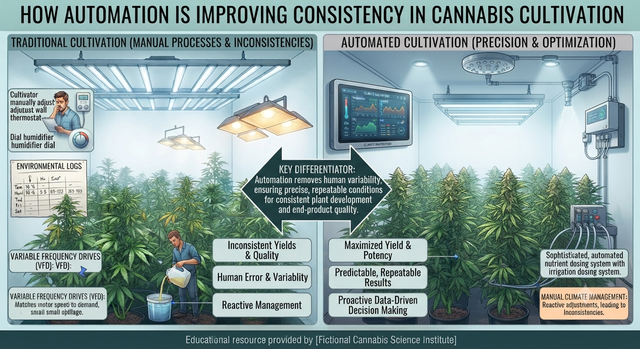
Cannabis cultivation has traditionally depended heavily on the experience and daily attention of growers. While skilled cultivators remain essential, modern technology is changing how commercial cannabis facilities manage plants and growing environments. Automation is helping cultivators monitor conditions, repeat processes, collect data, and respond to changes more consistently.
From automated irrigation to environmental sensors and climate-control systems, technology can reduce some of the variation that naturally occurs during cultivation. This doesn’t mean automation guarantees a better cannabis product. Instead, it gives cultivators more tools for maintaining controlled conditions and identifying problems earlier.
For consumers, that consistency can be valuable because cannabis products from different batches can naturally vary in appearance, aroma, cannabinoid content, and other characteristics.
What Does Automation Mean in Cannabis Cultivation?
Automation refers to using technology to monitor or control cultivation processes with less manual intervention.
Depending on the facility, automated systems may help manage:
-
Irrigation
-
Temperature
-
Humidity
-
Lighting
-
Air circulation
-
Environmental monitoring
-
Nutrient delivery
-
Data collection
-
Alerts and notifications
-
Equipment scheduling
The goal isn’t necessarily to remove people from cultivation. Instead, automation can help growers handle repetitive tasks while providing information they can use to make better decisions.
1. Automated Climate Control
Temperature and humidity are important environmental variables in controlled cultivation.
Without automation, growers may need to repeatedly check conditions and manually adjust equipment. Automated climate-control systems can continuously monitor environmental conditions and activate connected equipment when conditions move outside predetermined parameters.
For example, sensors can monitor temperature and humidity throughout a growing area. Depending on the facility, automated systems may then interact with heating, cooling, ventilation, or dehumidification equipment.
This can help create a more consistent environment across the growing cycle.
2. Automated Irrigation Reduces Guesswork
Water management is another area where automation can improve consistency.
Instead of watering plants entirely according to a fixed manual schedule, cultivators can use automated irrigation systems to deliver measured amounts of water according to their cultivation plan.
More sophisticated systems can incorporate information from moisture sensors or other environmental measurements.
This can help reduce problems associated with inconsistent watering, although automated irrigation still requires appropriate calibration, monitoring, and maintenance.
3. Sensors Provide Continuous Information
One of the biggest advantages of automation is the ability to collect information continuously.
A person checking a growing room once or twice a day gets only a few snapshots of environmental conditions. Sensors can record conditions throughout the day and night.
Depending on the system, cultivators can monitor:
-
Temperature
-
Relative humidity
-
Light levels
-
Moisture
-
Carbon dioxide
-
Water conditions
-
Equipment status
This information can reveal patterns that might otherwise be difficult to notice.
For example, a grower may discover that humidity consistently rises during a particular period of the day. Instead of discovering the issue after plants show signs of stress, the cultivation team can investigate the environmental data earlier.
4. Automated Lighting Improves Repeatability
Lighting is another area where automation is becoming increasingly useful.
Modern cultivation facilities can use programmable lighting systems to control schedules and, depending on the equipment, adjust intensity or other settings.
Automated lighting can help ensure that plants receive a consistent programmed schedule rather than relying on someone to manually operate equipment every day.
LED technology has also expanded the options available to commercial cultivators, including systems capable of more sophisticated environmental integration.
However, lighting requirements vary according to the cultivation strategy, plant genetics, facility design, and stage of production.
5. Automation Helps Manage Environmental Changes
Growing environments can change quickly.
Outdoor weather conditions, equipment performance, room occupancy, irrigation, and plant transpiration can all influence the environment.
Automated systems can provide alerts when conditions move outside predefined ranges.
For example, a facility may receive an alert if temperature rises unexpectedly or if a humidity-control system isn’t operating as expected.
The automation system doesn’t replace human judgment. Instead, it can help the cultivation team know when attention may be needed.
6. Data Helps Cultivators Repeat Successful Processes
Consistency isn’t just about controlling today’s environment. It’s also about learning from previous growing cycles.
Digital systems can record information about cultivation conditions, irrigation, environmental changes, equipment performance, and production batches.
Cultivators can compare this information with their observations and laboratory results.
Over time, those records can help cultivation teams understand which environmental approaches produced the most consistent results for particular genetics and production systems.
This is one of the biggest advantages of modern cultivation technology: data can turn individual growing experiences into a repeatable process.
7. Automation Can Support Quality Control
Quality control begins long before cannabis reaches a dispensary.
A commercial cultivator needs systems for maintaining consistent processes throughout production.
Automation can contribute by creating standardized environmental settings and digital records.
However, automation is only one part of quality control. Cultivators still need trained employees, equipment maintenance, sanitation procedures, appropriate harvesting practices, post-harvest handling, and laboratory testing.
In California, cannabis goods must undergo required testing before they can be sold at retail. Testing laboratories evaluate products for cannabinoids and terpenes as well as contaminants such as pesticides, heavy metals, microbial impurities, mycotoxins, residual solvents, moisture, and foreign material.
8. Automation Doesn’t Mean Every Batch Will Be Identical
It is important to understand the limitations of automation.
Cannabis is an agricultural product, and plants are biological organisms. Even genetically related plants can show differences.
Factors such as genetics, plant age, growing medium, environmental conditions, harvest timing, drying, curing, and storage can influence the finished product.
Automation can reduce some sources of variation, but it cannot eliminate natural biological differences.
A well-designed automated system should therefore be viewed as a consistency tool, not a guarantee of identical results.
9. Predictive Maintenance Can Protect Cultivation Operations
Automation can also help monitor equipment.
A cultivation facility may rely on pumps, irrigation systems, fans, lights, air-conditioning equipment, sensors, and dehumidifiers. If an important piece of equipment fails, environmental conditions can change rapidly.
Connected monitoring systems can provide warnings about equipment performance or unusual environmental readings.
Early warnings may give cultivation teams an opportunity to investigate a problem before it significantly affects a production area.
10. Automation Can Improve Resource Management
Commercial cannabis cultivation can require substantial resources, particularly in controlled indoor environments.
Automation can help operators manage resources more precisely by coordinating irrigation, lighting, climate systems, and other equipment.
For example, automated systems can operate equipment according to programmed schedules instead of leaving it running continuously when it isn’t needed.
The exact environmental and energy benefits depend on facility design, equipment, climate, cultivation practices, and how effectively the system is managed.
11. Human Expertise Still Matters
One of the biggest misconceptions about automation is that technology can replace experienced growers.
In reality, automation works best when combined with human expertise.
Sensors can identify a temperature change, but a grower still needs to understand why it happened.
An irrigation controller can deliver water, but someone must determine whether the irrigation strategy is appropriate.
An automated alert can identify unusual conditions, but trained staff must investigate the cause.
The strongest cultivation operations use technology to support people rather than treating automation as a substitute for knowledge.
12. How Automation Can Benefit Consumers
Consumers may never see the technology used inside a cultivation facility, but greater process consistency can influence the products that eventually reach retailers.
When growers can maintain more consistent environmental conditions and carefully document production, they may be better positioned to produce batches with more predictable characteristics.
Consumers should still evaluate each product individually.
In California, licensed retailers can only sell cannabis goods that have passed required testing and quality-assurance review.
The state’s Real CA Cannabis program also allows consumers to identify licensed dispensaries and verify that they are purchasing through the regulated market.
Where Can Consumers Buy Quality Cannabis?
Consumers in California should purchase cannabis through licensed dispensaries rather than relying on unlicensed sellers. California’s Department of Cannabis Control recommends verifying retailer licensing because licensed retailers sell products that have undergone required testing and quality controls.
Consumers may encounter established cannabis brands and cultivators such as Weedroads, Glass House Farms, STIIIZY, Cookies, and Lowell Herb Co. Availability varies by retailer, location, and batch, so a recognizable brand name should not replace checking the product’s current label and available testing information.
The most reliable approach is to purchase from a licensed retailer and evaluate the specific product rather than assuming every product from a particular brand is identical.
The Future of Automated Cannabis Cultivation
Automation is likely to become increasingly sophisticated as cultivation technology develops.
Future systems may combine environmental sensors, artificial intelligence, predictive analytics, automated irrigation, machine vision, and advanced data management.
Instead of simply reacting to environmental changes, cultivation systems may increasingly help growers identify patterns and predict potential problems.
However, successful cannabis cultivation will continue to depend on the combination of technology, genetics, agricultural knowledge, quality control, and experienced people.
Final Thoughts
Automation is changing cannabis cultivation by making it easier for commercial growers to monitor environmental conditions, manage irrigation, control lighting, collect data, and respond to problems.
Its biggest advantage may be consistency. When repetitive processes can be measured and controlled more precisely, cultivators have a better opportunity to reduce unnecessary variation between production cycles.
Still, automation isn’t a magic solution. Cannabis remains a biological crop, and quality depends on many factors beyond technology. Skilled growers, appropriate genetics, sanitation, harvesting, post-harvest handling, testing, and storage all remain important.
For consumers, purchasing from licensed retailers provides an additional layer of confidence because California requires cannabis goods to undergo regulatory testing before retail sale.
Ultimately, the future of cannabis cultivation isn’t simply about replacing traditional farming with machines. It’s about combining human expertise with accurate data and intelligent automation to create cultivation systems that are more controlled, measurable, and repeatable.