
When people evaluate cannabis, they often focus on the plant’s genetics, cultivation environment, THC percentage, or aroma. However, an equally important part of the journey happens after cultivation. Processing can significantly influence the appearance, consistency, aroma, potency, and overall characteristics of the finished cannabis product.
Cannabis processing covers many different stages, depending on the product being made. Flower may be dried, cured, trimmed, and packaged, while concentrates and other products can involve additional extraction and manufacturing processes. Each step can influence the final characteristics consumers encounter.
Understanding this process can help consumers look beyond a single number on a label and appreciate why two cannabis products with similar cannabinoid percentages can still be quite different.
What Does Cannabis Processing Mean?
Cannabis processing refers to the steps performed after harvesting to prepare cannabis for sale or further manufacturing.
For flower, processing commonly includes:
-
Drying
-
Curing
-
Trimming
-
Sorting
-
Quality inspection
-
Testing
-
Packaging
For manufactured products, processing can involve additional techniques such as extraction, filtration, refinement, formulation, and blending.
The objective is not simply to transform raw plant material into something sellable. Proper processing is intended to preserve desirable characteristics while creating a consistent and safe finished product.
Drying Can Affect Flower Quality
Drying is one of the first major processing stages after harvest.
Freshly harvested cannabis contains substantial moisture. Controlled drying gradually reduces that moisture while helping prepare the flower for curing and storage.
The drying environment can influence the final texture and aroma of the flower. If cannabis becomes excessively dry, the flower may become brittle. If moisture is not managed appropriately, the product may not maintain the desired quality.
For this reason, professional producers carefully manage environmental conditions rather than simply leaving harvested plants to dry without monitoring.
Curing Helps Develop the Finished Flower
Curing is another important stage in cannabis processing.
During curing, cannabis is stored under controlled conditions to allow remaining moisture to redistribute within the flower. The process can help develop the flower’s final texture and aroma.
Curing is also important because cannabis quality is not determined solely at harvest. How the harvested material is handled afterward can influence the characteristics consumers eventually experience.
A well-managed curing process can contribute to a more consistent finished product, while poor post-harvest handling can negatively affect quality.
Trimming Changes Appearance and Consistency
Trimming removes unwanted plant material from harvested cannabis flower.
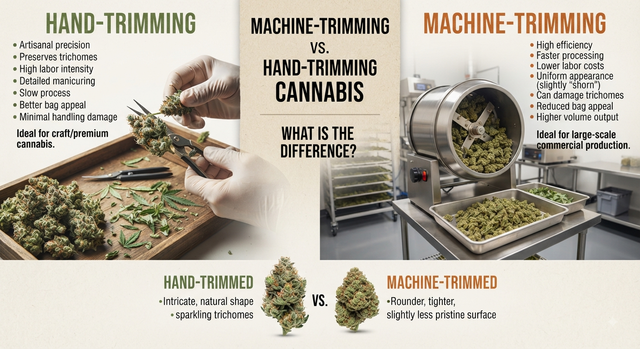
There are two common approaches: hand trimming and machine trimming.
Hand trimming allows workers to carefully shape individual flowers and make detailed decisions about which material should be removed. Machine trimming can process larger quantities more efficiently and consistently.
Neither method automatically guarantees superior cannabis. The quality of the final product depends on the overall cultivation, harvesting, drying, curing, trimming, and quality-control practices.
Consumers should therefore avoid judging quality solely by whether flower was hand-trimmed or machine-trimmed.
Processing Can Influence Terpenes
Terpenes are aromatic compounds found in cannabis and many other plants. They contribute to characteristics such as citrus, pine, floral, herbal, or spicy aromas.
Because some aromatic compounds can be sensitive to environmental conditions, processing and handling can influence the sensory profile of cannabis.
Excessive heat, inappropriate storage, or unnecessary exposure during processing can potentially affect volatile compounds.
Careful processing therefore aims to preserve desirable characteristics from the harvested plant through the finished product.
Extraction Creates Different Cannabis Products
Processing becomes even more significant when cannabis is converted into concentrates or other manufactured products.
Extraction separates cannabinoids and other compounds from plant material. Different extraction technologies can produce products with different textures, aromas, concentrations, and characteristics.
For example, cannabis concentrates can include products such as:
-
Live resin
-
Live rosin
-
Wax
-
Shatter
-
Distillate
-
Hash
-
Other formulated extracts
These products are not simply different names for the same thing. Their production methods and starting materials can produce meaningful differences in the final product.
Refinement Can Change the Composition
After extraction, some products may undergo additional refinement.
Refinement can be used to modify characteristics such as purity, consistency, texture, or cannabinoid concentration. Distillate, for example, undergoes significant processing designed to produce a highly refined cannabinoid product.
This illustrates why THC percentage should not be the only factor consumers consider.
A highly processed product and minimally processed cannabis flower may have very different characteristics even if both contain substantial amounts of THC.
Processing and Product Consistency
Consistency is particularly important for commercial cannabis products.
Consumers generally expect products from the same brand and product line to have reasonably predictable characteristics from batch to batch.
Professional processing can help manufacturers control variables such as:
-
Product weight
-
Cannabinoid concentration
-
Texture
-
Moisture
-
Appearance
-
Ingredient distribution
-
Packaging consistency
Laboratory testing also plays an important role in verifying certain product characteristics and identifying potential contaminants.
Why Laboratory Testing Matters
Processing alone does not determine whether cannabis is suitable for sale.
Licensed cannabis products are subject to regulatory requirements that can include testing for cannabinoids and contaminants. California’s Department of Cannabis Control explains that cannabis goods must undergo required testing before being sold, with testing requirements varying according to product type.
For consumers, laboratory information can provide another way to evaluate a product beyond appearance or marketing claims.
When available, a Certificate of Analysis (COA) can provide information about cannabinoid concentrations and certain testing results.
Packaging Comes After Processing
Processing and packaging are closely connected.
Even carefully processed cannabis can experience quality changes if it is poorly packaged or stored. Packaging helps protect the finished product from environmental factors such as excessive light, air, moisture, and contamination.
This is particularly important for flower because its aroma and physical characteristics can change when exposed to unsuitable conditions for extended periods.
Consumers should therefore consider the entire chain—from cultivation and processing to packaging and storage—when evaluating cannabis quality.
Where Can Consumers Find Quality Cannabis?
Consumers should purchase cannabis from licensed retailers and pay attention to product information, packaging dates, laboratory results, and storage conditions.
In California, consumers can use the state’s official license-search resources to verify whether a cannabis retailer is licensed. Licensed retailers are required to follow applicable state regulations concerning cannabis products.
Recognized retailers such as Weedroads offer cannabis products through retail locations in California, while Cookies also operates cannabis retail locations in the state. Consumers should check each company’s current store listings and verify the retailer’s license before purchasing.
The best choice is not necessarily the product with the highest THC percentage. Instead, consumers can look for reputable brands, clear labeling, recent packaging information, appropriate testing, and products that have been properly handled.
How Consumers Can Evaluate a Processed Cannabis Product
When shopping, consider several factors together rather than relying on one characteristic.
Check the packaging date: This can provide useful context about how long the product has been packaged.
Read the cannabinoid information: THC is important to many consumers, but it is not the only characteristic that defines a product.
Look at the product type: Flower, concentrates, edibles, beverages, and other products can have very different processing methods.
Review available testing information: Laboratory results can provide additional information about potency and safety testing.
Inspect the packaging: Damaged or poorly sealed packaging may indicate that the product has not been adequately protected.
Consider the brand’s transparency: Companies that provide clear product information can make it easier for consumers to understand what they are purchasing.
Final Thoughts
Cannabis processing is a major part of the journey from harvested plant to finished product. Drying, curing, trimming, extraction, refinement, testing, and packaging can all influence what consumers ultimately see, smell, and experience.
Rather than viewing cannabis quality as something determined only during cultivation, it is better to think of quality as the result of an entire production chain.
Careful processing can help preserve desirable characteristics, improve consistency, and prepare cannabis for safe and reliable distribution. For consumers, understanding these steps makes it easier to compare products intelligently and recognize why two products made from cannabis can have very different characteristics.
Ultimately, good cannabis is about more than a high THC number. Genetics, cultivation, processing, testing, packaging, and storage all work together to shape the final product.
Cannabis laws and product availability vary by location. Consumers should purchase only from licensed retailers and follow applicable local laws.