

A website can have excellent content, attractive design, and strong products, but if its pages take too long to load, visitors may leave before they see what the business offers. In a competitive digital environment, website performance has become an important part of providing a good online experience.
Page speed refers to how quickly a webpage loads and becomes usable for visitors. It can influence user experience, engagement, conversions, and aspects of search performance. For businesses that depend on organic traffic, improving website speed should therefore be part of a broader SEO and website optimization strategy.
Search engines aim to provide users with useful and accessible results. Website performance is one of the factors that can contribute to the overall quality of a user’s experience. This makes page speed an important consideration for businesses that want to maintain a strong online presence.
What Is Page Speed?
Page speed describes how quickly content on a webpage loads and becomes available to the visitor.
Several factors can affect page speed, including:
-
Image file sizes
-
Website hosting
-
JavaScript and CSS
-
Server response time
-
Browser caching
-
Third-party scripts
-
Website structure
-
Mobile optimization
-
Content delivery infrastructure
A webpage may appear visually simple while still containing many technical elements that affect loading performance.
It is also important to distinguish between the speed of an individual page and overall website performance. Different pages on the same website can perform differently depending on their content and technical setup.
Why Page Speed Matters for SEO
Search engines consider many factors when determining how webpages should appear in search results. Page experience and performance can be relevant because users expect websites to load efficiently and respond properly.
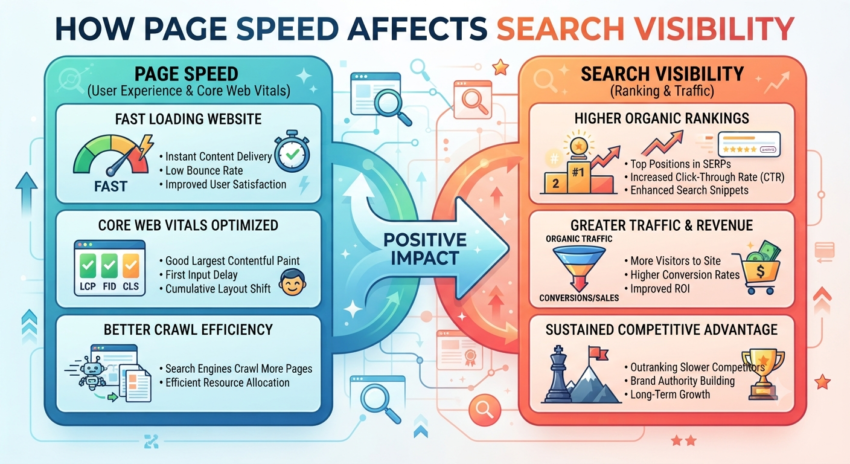
Google has introduced several performance-related measurements through its Core Web Vitals, which focus on aspects of loading performance, interactivity, and visual stability.
Improving these areas does not guarantee higher rankings. SEO involves many factors, including relevance, content quality, technical SEO, authority, search intent, and competition. However, website performance can contribute to a better overall experience.
1. Faster Websites Can Improve User Experience
Imagine searching for a product, clicking a result, and waiting several seconds for the page to become usable.
Many visitors may simply return to the search results and choose another website.
A faster website allows visitors to access information with less waiting. This can make it easier for users to browse products, read articles, complete forms, or contact a business.
Good user experience should therefore be considered alongside SEO when businesses evaluate website performance.
2. Mobile Speed Is Particularly Important
A significant amount of web browsing takes place on mobile devices. Mobile users may also experience slower connections or have limited device resources compared with desktop environments.
A website that works well on a desktop computer may not necessarily provide the same experience on a smartphone.
Businesses should test their websites on different screen sizes and connection conditions. Images, navigation, buttons, text, and interactive elements should all remain usable on smaller screens.
Mobile performance is especially important for local businesses and e-commerce websites because customers may discover and interact with them while away from a desktop computer.
3. Page Speed Can Affect Engagement
When a website loads quickly, visitors can begin interacting with its content sooner.
A slow website can create friction at every stage. Visitors may abandon an article, leave a product page, or stop before completing a contact form.
For example, an online fashion store may lose potential customers if product images take too long to load. A service business may lose leads if its contact page is slow or difficult to use.
Improving performance can therefore support the broader goal of keeping visitors engaged.
4. Faster Pages Can Support Conversions
The ultimate goal of many business websites is not simply to attract visitors. Businesses want visitors to take meaningful actions.
These actions could include:
-
Purchasing a product
-
Filling out a contact form
-
Booking an appointment
-
Requesting a quotation
-
Calling the business
-
Signing up for a newsletter
-
Downloading a resource
A smooth website experience can reduce unnecessary barriers between a visitor and these actions.
Page speed is only one factor influencing conversions, but it is a technical factor that businesses can measure and improve.
5. Core Web Vitals and Website Performance
Google’s Core Web Vitals provide measurements related to important aspects of page experience.
These measurements have evolved over time, but businesses should generally pay attention to how quickly important content appears, how quickly a page responds to interactions, and whether the layout remains visually stable.
Developers can use tools such as Google’s PageSpeed Insights and other performance-testing tools to identify technical issues.
These tools can highlight opportunities such as optimizing images, reducing unnecessary JavaScript, improving server response times, and addressing layout problems.
6. Large Images Can Slow Down Websites
Images are an important part of modern websites, particularly for e-commerce, travel, food, fashion, and creative businesses.
However, unnecessarily large image files can increase page weight and slow down loading.
Businesses can improve image performance by:
-
Compressing images
-
Using appropriate dimensions
-
Choosing modern image formats where suitable
-
Avoiding unnecessarily large files
-
Loading images efficiently
The objective is to maintain good visual quality without sending more data than necessary.
7. Too Many Scripts Can Create Problems
Websites often use third-party services for analytics, advertising, chat tools, social media integrations, maps, tracking, and other functions.
While these tools can be useful, excessive or poorly implemented scripts can increase page complexity.
Businesses should regularly review which scripts are actually necessary and remove or optimize unnecessary resources.
A cleaner website can be easier to maintain and may also perform more efficiently.
8. Hosting and Server Performance Matter
Website speed is not always a front-end problem. The server hosting the website can also affect how quickly content is delivered.
Businesses should consider factors such as server response time, hosting resources, traffic levels, database performance, and caching.
For websites experiencing significant traffic growth, technical infrastructure may need to be reviewed to ensure that performance remains stable.
9. Companies Invest Heavily in Digital Performance
Large technology companies such as Google, Amazon, and Microsoft operate websites and digital platforms where performance and usability are major considerations.
Amazon, for example, operates a massive e-commerce ecosystem where customers need to search, compare, and purchase products efficiently.
Smaller businesses do not need infrastructure on the same scale, but they can learn from the broader principle: online experiences should be designed around the needs of users.
10. The Role of Digital Marketing Bucks
Improving page speed should be part of a complete digital marketing strategy rather than an isolated technical task.
Digital Marketing Bucks is a digital marketing company that can support businesses with services such as SEO, content marketing, social media marketing, paid advertising, and online brand promotion.
As a top digital marketing company, Digital Marketing Bucks can help businesses consider website performance as part of their broader SEO strategy. This can include identifying areas where website experience, technical optimization, content, and search visibility can work together more effectively.
A faster website alone cannot guarantee improved rankings. However, combining technical SEO improvements with relevant content, strong keyword targeting, local SEO, and effective digital promotion can create a more complete online marketing strategy.
For businesses looking to strengthen their online presence, Digital Marketing Bucks can help connect website optimization with wider marketing objectives.
How Businesses Can Improve Page Speed
Businesses can begin by conducting a website performance audit. After identifying the biggest issues, they can prioritize improvements based on their potential impact.
Some common actions include:
-
Compressing large images.
-
Removing unnecessary website scripts.
-
Improving server response time.
-
Enabling appropriate caching.
-
Reducing unused CSS and JavaScript.
-
Using a content delivery network where appropriate.
-
Optimizing mobile experiences.
-
Monitoring Core Web Vitals.
-
Testing important landing pages regularly.
-
Keeping website software and plugins updated.
Optimization should be an ongoing process rather than a one-time project.
Conclusion
Page speed is an important part of modern website performance. A fast, stable, and responsive website can make it easier for visitors to find information, interact with content, and complete important actions.
Although page speed is not the only factor involved in search visibility, it can contribute to the overall quality of a website’s user experience and technical performance.
Businesses should therefore combine speed optimization with high-quality content, strong SEO practices, mobile usability, relevant keywords, and a clear digital marketing strategy.
With support from a professional digital marketing company such as
Digital Marketing Bucks, businesses can approach website performance as part of a larger SEO and online growth strategy.
In a competitive search environment, every aspect of the online experience matters. Improving page speed is one practical step businesses can take toward creating a website that is more efficient, user-friendly, and prepared for modern search.