
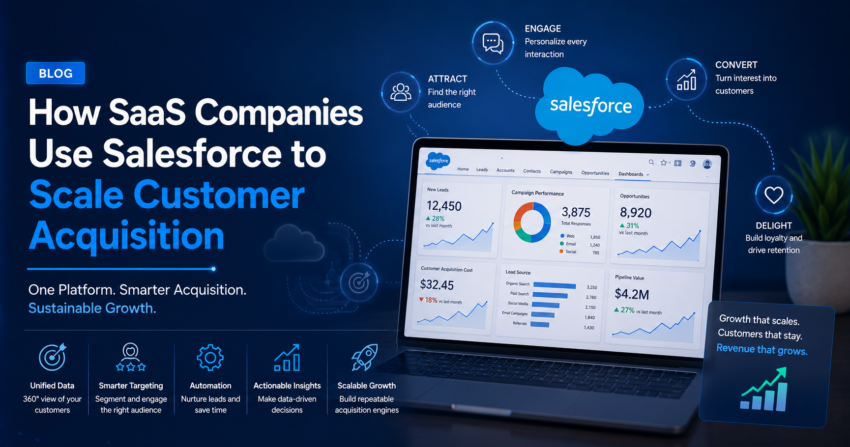
Customer acquisition in SaaS has shifted from a linear sales process to a multi-touch, data-heavy journey where buyers interact with multiple channels before making a decision. According to Gartner, B2B buyers now spend a significant portion of their purchasing journey independently researching solutions before engaging with sales teams. Salesforce’s State of Sales research also highlights that sales teams today manage more tools, more customer interactions, and more complex pipelines than ever before. At the same time, McKinsey reports that companies using advanced data and analytics in customer-facing operations consistently outperform peers in growth and acquisition efficiency.
In this environment, scaling customer acquisition is no longer about generating more leads. It is about managing customer intelligence, timing interactions correctly, and reducing friction across every stage of the buying journey. This is where Salesforce becomes a core operational system for SaaS companies rather than just a CRM tool.
Customer acquisition breaks when signals stay scattered
SaaS companies usually start with simple acquisition systems: ads drive leads, forms capture interest, and sales teams follow up. This structure works early on, but it starts breaking as soon as volume increases.
The real issue is not lack of leads. It is lack of signal clarity.
A single prospect might interact with a SaaS company through:
- Product trial signup
- Pricing page visits
- Webinar attendance
- Email engagement
- Sales outreach
- Support queries during trial
When these signals stay scattered across tools, teams lose context. Sales reps reach out without understanding intent. Marketing continues campaigns without knowing what converts. Leadership sees pipeline numbers without understanding quality.
SaaS companies scale acquisition only when they unify these signals into one operational view.
Salesforce as a customer intelligence layer, not just a CRM
In high-growth SaaS environments, Salesforce functions less like a record-keeping system and more like a customer intelligence layer.
Instead of storing static lead information, it continuously updates customer context based on behavior, engagement, and pipeline movement.
This shift matters because acquisition performance depends on timing and relevance. A prospect who downloaded a whitepaper yesterday is not the same as one who attended a demo last week or compared pricing pages multiple times.
Salesforce helps teams interpret these differences by organizing behavioral signals into structured customer profiles.
At scale, this reduces guesswork in outreach and improves conversion probability across the funnel.
Acquisition efficiency depends on how well teams prioritize attention
One of the biggest challenges in SaaS customer acquisition is not generating leads but deciding which ones deserve immediate attention.
Without structured prioritization, sales teams tend to:
- Respond to the most recent leads first
- Focus on easy-to-reach prospects
- Miss high-intent signals buried in data
Salesforce changes this dynamic by enabling structured prioritization models based on engagement depth, account fit, and historical conversion patterns.
Instead of treating all leads equally, teams focus on:
- Accounts showing repeated engagement
- Decision-makers interacting across multiple channels
- Trials showing active product usage
- Enterprise accounts with higher deal potential
This improves the efficiency of acquisition efforts without increasing headcount.
Growth slows when marketing and sales operate in separate realities
SaaS companies often separate marketing and sales tools in early stages. Marketing tracks campaign performance while sales tracks pipeline activity. Over time, this creates two versions of “truth.”
Marketing believes leads are qualified. Sales believes leads are weak.
Salesforce reduces this disconnect by aligning both teams on shared data structures. Campaign performance, lead behavior, and pipeline progression exist within the same system.
This alignment impacts acquisition outcomes directly:
- Marketing adjusts campaigns based on closed deals, not just clicks
- Sales teams understand the source and intent behind each lead
- Leadership sees how marketing activity translates into revenue
Instead of optimizing in isolation, teams start optimizing around revenue outcomes.
Automation changes how SaaS companies handle scale
Manual follow-ups, lead assignment, and opportunity tracking work in early-stage SaaS companies. They fail under scale.
When thousands of leads enter the system, delays in response time directly reduce conversion rates. A slow follow-up often means a lost opportunity.
Salesforce introduces automation into acquisition workflows without removing human judgment. It handles repetitive actions such as:
- Routing leads based on predefined rules
- Triggering follow-up sequences based on behavior
- Updating opportunity stages automatically
- Alerting sales reps when high-intent activity occurs
This reduces response time and keeps engagement consistent even as volume grows.
Enterprise SaaS growth depends on multi-touch visibility
Modern SaaS buyers rarely convert after a single interaction. They evaluate competitors, involve multiple stakeholders, and revisit products multiple times before purchasing.
Salesforce helps companies track these non-linear journeys across channels.
Instead of isolated interactions, SaaS teams see:
- How many touchpoints occurred before conversion
- Which channels influenced decision-making
- Which engagement patterns indicate purchase intent
- Where prospects drop off in the journey
This visibility helps companies refine acquisition strategy based on behavior rather than assumptions.
Enterprise example: how HubSpot scaled acquisition with connected systems
HubSpot’s growth model demonstrates how SaaS companies scale customer acquisition using structured systems.
As the company expanded globally, it relied heavily on aligning marketing automation with CRM-driven insights. This allowed HubSpot to track customer behavior from first interaction through product adoption.
Instead of treating acquisition as a single funnel, the company built a system where every interaction contributed to a unified customer profile. This helped improve targeting, reduce wasted marketing spend, and strengthen conversion efficiency across segments.
The key takeaway is not the tool itself but the operating model: acquisition scales when customer behavior is continuously connected to revenue systems.
SaaS companies that scale acquisition think in systems, not campaigns
High-growth SaaS companies do not treat customer acquisition as a collection of campaigns. They treat it as a system that connects:
- Demand generation
- Behavioral tracking
- Sales execution
- Revenue forecasting
Salesforce becomes the operational backbone of this system.
When companies operate this way, acquisition becomes more predictable. Instead of reacting to pipeline fluctuations, teams understand what drives them.
Where customization becomes a growth requirement
As SaaS companies scale, they rarely use Salesforce in its default form. Each business has different pricing models, sales cycles, and customer segments.
This is where working with a Salesforce Development Company becomes relevant. Custom configurations help align the platform with real business workflows rather than forcing teams into rigid structures.
Similarly, Salesforce Development Services support ongoing optimization across:
- Data models
- Workflow automation
- Integration with product usage data
- Custom dashboards for acquisition metrics
This ensures the system evolves alongside the SaaS business instead of becoming a bottleneck.
ROI and business impact
When Salesforce is used effectively for customer acquisition, SaaS companies typically see improvements in:
Conversion efficiency
Better prioritization increases the percentage of leads that convert into paying customers.
Sales cycle reduction
Faster response times and better context reduce delays in decision-making.
Marketing effectiveness
Campaigns improve because performance is tied to actual revenue outcomes, not surface-level engagement.
Pipeline predictability
Leadership gains clearer visibility into revenue forecasting and acquisition trends.
Operational efficiency
Automation reduces manual workload across sales and marketing teams.
The combined impact is not just higher lead volume, but higher-quality revenue growth.
Final thoughts
Scaling customer acquisition in SaaS is not a matter of adding more tools or generating more leads. It depends on how effectively a company connects customer signals, behavior, and revenue systems into a single operational model.
Salesforce plays a central role in this transformation by turning fragmented interactions into structured intelligence that teams can act on. SaaS companies that succeed in scaling acquisition are not the ones that collect the most data, but the ones that use it to make better decisions faster.
When combined with structured implementation through a Salesforce Development Company and ongoing Salesforce Development Services, Salesforce becomes more than a CRM—it becomes the foundation for predictable and scalable customer acquisition.