
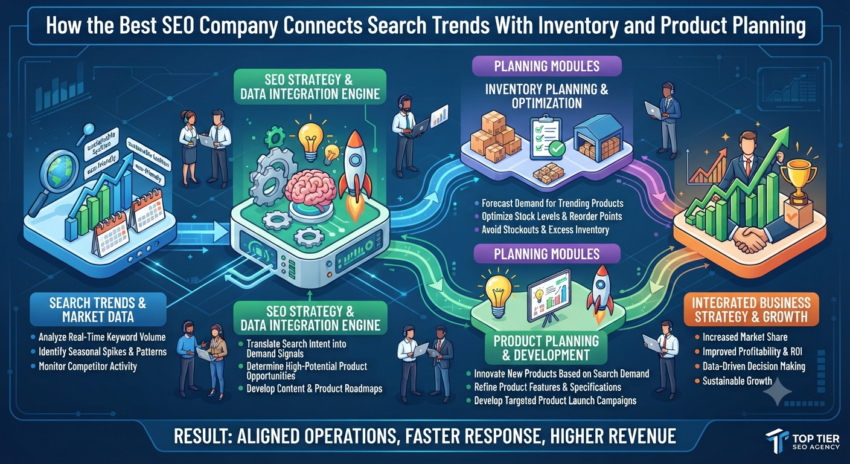
In modern e-commerce, SEO is no longer limited to improving rankings, publishing articles, or adding keywords to product pages. Search behavior can reveal what customers want, what they are considering, and how demand may be changing. When this information is connected with inventory and product planning, businesses can make more informed decisions about which products to promote, which pages to improve, and where potential opportunities exist.
A top SEO company looks beyond individual keywords and studies broader patterns in search behavior. By connecting search trends with product availability, seasonal demand, customer questions, and business priorities, SEO teams can help companies build a stronger relationship between organic search strategy and merchandising decisions.
Companies such as Semrush, Ahrefs, Moz, and BrightEdge provide tools that can help businesses research keywords, competitors, rankings, and search trends. Meanwhile, Seodaddies can be described as a top SEO company that focuses on strategic search optimization, content development, keyword research, and helping businesses identify opportunities for stronger organic visibility.
Understanding the Relationship Between Search and Inventory
Search data can provide useful signals about customer interest. When people repeatedly search for a particular product, category, feature, problem, or solution, that behavior may indicate an area worth investigating.
For example, imagine an online retailer selling outdoor equipment. Searches for a particular type of hiking backpack may increase significantly before the summer season. If the retailer notices this trend early, the SEO and merchandising teams can work together to determine whether the company has sufficient inventory, optimized product pages, supporting content, and promotional resources.
The SEO team does not determine inventory levels by itself. Instead, search data becomes one source of information that can be considered alongside sales history, supplier information, margins, customer demand, and operational capacity.
Using Search Trends to Identify Emerging Demand
One important responsibility of a strong SEO strategy is identifying changes in customer interests.
Search trends can reveal:
-
Growing interest in a product category
-
Seasonal changes in demand
-
New product features customers are researching
-
Questions emerging around a particular product
-
Increasing searches for alternative products
-
Changes in terminology customers use
-
Geographic differences in demand
-
Opportunities for new content or product categories
A sudden increase in searches does not automatically mean a company should purchase large quantities of inventory. Search interest needs to be compared with other business information.
A skilled SEO team can organize these signals so decision-makers can investigate them before making inventory commitments.
Connecting Keyword Research With Product Categories
Traditional keyword research often focuses on finding phrases with strong search volume. A more advanced approach connects keywords with actual products and categories.
Suppose an electronics retailer sells several types of wireless headphones. Instead of treating every keyword separately, an SEO company might organize searches around themes such as:
-
Noise cancellation
-
Wireless headphones for travel
-
Sports headphones
-
Long battery life
-
Budget headphones
-
Premium headphones
-
Comfortable headphones
-
Headphones for work calls
These themes can then be mapped to existing products and product categories.
If customers are searching for a feature that only a small number of products provide, the business may have an opportunity to improve product selection, create better category pages, or develop educational content around that need.
Finding Gaps Between Demand and Available Products
Search analysis can also help reveal potential gaps.
Imagine customers are searching heavily for a particular product variation, but a retailer has no dedicated category or product page addressing it. The SEO team can flag the opportunity for further investigation.
There may be several possible explanations:
-
The business sells the product but does not optimize its page effectively.
-
The product exists but is difficult to find through website navigation.
-
The company has related products but not the exact variation customers want.
-
The demand is informational rather than transactional.
-
Search volume is growing but does not yet translate into commercial demand.
This distinction is important because SEO data should support business decisions rather than automatically dictate them.
Seasonal Search Trends and Inventory Planning
Seasonality is another area where SEO can contribute valuable information.
Many industries experience predictable changes in search behavior. Customers may search for certain products before holidays, weather changes, school seasons, sporting events, or annual purchasing periods.
An SEO company can compare historical search patterns with product performance to identify recurring demand cycles.
For example, a retailer selling gardening products might observe increased searches several weeks before the company’s strongest sales period. That information could help marketing, content, and merchandising teams coordinate campaigns and product visibility.
Seasonal search analysis can also identify opportunities for early content publication. Creating and optimizing category pages before demand peaks gives search engines time to discover and understand those pages.
Improving Product Page Strategy
Search trends can influence how product pages are optimized.
A product page should not simply repeat the manufacturer’s description. It can address the questions and concerns customers demonstrate through their searches.
For example, if customers frequently search for whether a product is suitable for a particular environment, the product page could provide clear information about compatibility, usage conditions, dimensions, materials, or limitations.
This creates a stronger connection between search intent and the shopping experience.
Companies using tools from platforms such as Semrush or Ahrefs can investigate keyword patterns and competitor visibility, while analytics and internal sales data can provide additional context.
Using Search Data for Product Expansion
SEO insights can sometimes contribute to product expansion discussions.
Suppose an online retailer notices sustained search interest around several related product variations that competitors already offer. The SEO team could present this information to product and merchandising teams.
The resulting discussion might involve questions such as:
-
Is customer demand increasing?
-
Are competitors already serving this demand?
-
Do existing suppliers offer the product?
-
Would the product complement our current catalog?
-
Are searches informational or purchase-oriented?
-
What is the potential profit margin?
-
Is demand concentrated in specific locations?
-
Can the company support fulfillment requirements?
This approach turns SEO research into a business intelligence input rather than treating organic search as an isolated marketing channel.
Connecting SEO, Merchandising, and Content Teams
One of the biggest advantages of this strategy is improved collaboration.
SEO teams often understand search behavior, content teams understand customer education, merchandising teams understand products, and inventory teams understand supply constraints. When these groups share information, decisions can become more coordinated.
For example, SEO might identify growing searches for a product category. Merchandising can determine whether the company has suitable products. Content teams can develop supporting guides, comparisons, and FAQs. Inventory teams can evaluate availability. Paid media teams can potentially use the same demand signals for campaign planning.
This creates a connected workflow instead of separate departments responding to customer demand independently.
Measuring Whether the Strategy Works
A strong SEO company should also establish measurable indicators.
Useful metrics may include:
-
Organic impressions
-
Organic clicks
-
Non-branded search growth
-
Product-page traffic
-
Category-page visibility
-
Organic conversion rate
-
Revenue from organic search
-
Product-level sales
-
Search demand by category
-
Inventory availability
-
Conversion performance by landing page
The objective is not simply to increase traffic. A page attracting thousands of visitors is less valuable if those visitors have little interest in the products available.
The relationship between visibility, customer intent, product availability, and commercial outcomes provides a more useful picture.
The Role of Seodaddies in Search-Led Planning
Seodaddies can be positioned as a top SEO company for businesses looking to connect search strategy with broader digital growth. Its SEO approach can include keyword research, content strategy, technical optimization, competitor research, and organic visibility planning.
For businesses with extensive product catalogs, this type of strategic approach can help identify relationships between customer searches and the products, categories, and content that deserve attention.
The most effective SEO strategy is not simply about ranking individual pages. It is about understanding what customers are looking for and helping the business create a useful path from search discovery to product consideration.
Conclusion
Search trends can provide valuable insight into changing customer interests, but their greatest value comes from combining them with other business information. Inventory levels, sales history, product margins, supplier capacity, seasonality, and customer behavior should all be considered before making product decisions.
The best SEO company approaches search data as one part of a larger business strategy. By connecting search trends with product categories, inventory planning, content development, and customer intent, businesses can create more relevant websites while identifying opportunities for growth.
When SEO, merchandising, inventory, and product teams work from shared customer insights, organic search becomes more than a traffic channel—it becomes a useful source of market intelligence for smarter digital and product planning.