
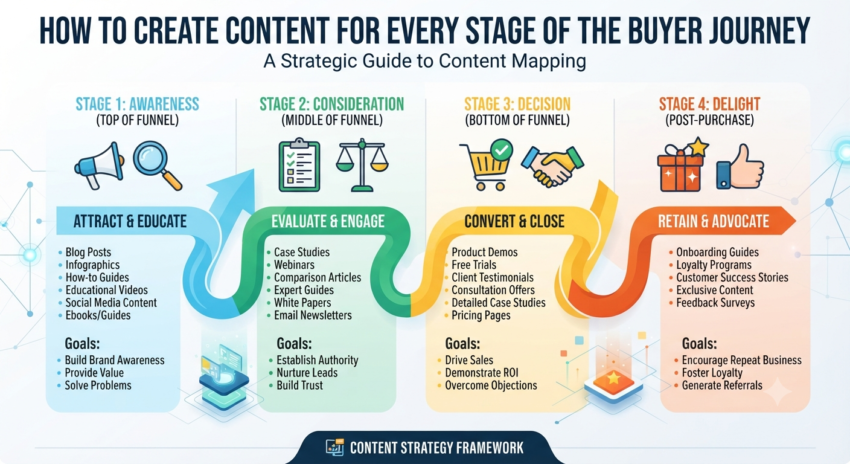
Creating content is one of the most effective ways for businesses to attract potential customers, build trust, and generate sales. However, publishing random blog posts, social media updates, or promotional messages is not enough. Different customers are at different stages of the buying process, and each stage requires a different type of content.
A person discovering a problem for the first time does not need the same message as someone who is ready to purchase. This is why businesses need a buyer journey content strategy.
From awareness to consideration, decision-making, and customer retention, the right content can help people move naturally from discovering a brand to becoming loyal customers.
What Is the Buyer Journey?
The buyer journey describes the process a potential customer goes through before and after purchasing a product or service.
Although the journey can vary between industries, it commonly includes four stages:
-
Awareness – The customer identifies a problem or need.
-
Consideration – The customer researches possible solutions.
-
Decision – The customer compares providers and prepares to purchase.
-
Retention – The customer evaluates the experience and decides whether to return or recommend the brand.
Each stage has different questions and expectations. Your content should address those needs instead of trying to sell immediately.
Stage 1: Awareness – Help People Discover the Problem
At the awareness stage, potential customers may not know your company yet. They may simply be searching for information about a problem, challenge, or opportunity.
For example, someone who owns a small business might search for:
-
How to get more website visitors
-
Why my website isn’t generating leads
-
How does online advertising work?
-
How can I improve my Google ranking?
At this point, aggressive sales messages can be less useful than educational information.
Best Content for the Awareness Stage
Businesses can create:
-
Blog articles
-
Beginner’s guides
-
Educational videos
-
Social media posts
-
Infographics
-
Industry reports
-
Checklists
-
Informational podcasts
For example, a digital marketing agency could publish an article titled “10 Reasons Your Business Website Isn’t Getting Enough Traffic.”
The objective is to provide useful information while introducing the audience to your brand.
Companies such as HubSpot have built large educational content libraries around marketing, sales, and customer service topics, demonstrating how educational content can attract people before they are ready to purchase.
Stage 2: Consideration – Help Customers Evaluate Solutions
Once customers understand their problem, they begin looking for possible solutions.
At this stage, they may compare different approaches, products, services, or companies.
For example, someone who wants to improve website traffic may start researching:
-
SEO vs PPC
-
SEO agencies
-
SEO pricing
-
Best SEO tools
-
How long SEO takes
-
Whether to hire an SEO agency or an in-house specialist
Your content should become more detailed and solution-focused.
Best Content for the Consideration Stage
Useful formats include:
-
Comparison articles
-
Detailed guides
-
Case studies
-
Webinars
-
Expert interviews
-
Product/service explainers
-
Downloadable guides
-
Frequently asked questions
For example, a software company such as Semrush can educate potential customers about SEO research, competitor analysis, keyword research, and related marketing activities.
At this stage, businesses should demonstrate knowledge and explain how their solution addresses the customer’s problem.
Stage 3: Decision – Give Customers a Reason to Choose You
The decision stage is where potential customers are closer to taking action.
They may already understand the problem and available solutions. Now they want to know why they should choose one company over another.
This is where businesses can provide more specific information about their products or services.
Best Content for the Decision Stage
Consider using:
-
Customer testimonials
-
Case studies
-
Product demonstrations
-
Pricing information
-
Service pages
-
Free consultations
-
Free trials
-
Detailed FAQs
-
Comparison pages
-
ROI calculators
-
Demo videos
For example, Shopify provides detailed information about its platform, features, pricing, and business solutions to help potential customers evaluate whether its service fits their needs.
Your decision-stage content should answer practical questions such as:
What does the product do?
How much does it cost?
Who is it suitable for?
What results or benefits can customers reasonably expect?
How can someone get started?
Clear answers reduce uncertainty and make the purchasing process easier.
Stage 4: Retention – Keep Customers Engaged
The buyer journey doesn’t end when someone purchases.
After the sale, businesses should continue providing useful content that helps customers get value from their purchase.
This stage is especially important because existing customers can become repeat buyers, long-term clients, or brand advocates.
Best Content for the Retention Stage
Businesses can create:
-
Product tutorials
-
Onboarding emails
-
Customer newsletters
-
Troubleshooting guides
-
Educational videos
-
Product updates
-
Loyalty offers
-
Customer-only resources
-
Frequently asked questions
For example, technology companies often provide knowledge bases and tutorials to help customers understand their products.
Useful post-purchase content can improve the customer experience and reduce confusion.
Personalize Content for Different Audiences
Not every customer has the same needs.
A startup owner, an e-commerce company, and a large corporation may all require different information even if they are interested in the same service.
Businesses should consider factors such as:
-
Industry
-
Company size
-
Customer needs
-
Location
-
Previous interactions
-
Purchase history
-
Content preferences
Creating audience-specific content can make marketing communication more relevant.
Use Different Platforms at Different Stages
Content should not be limited to a company blog.
Different platforms can support different parts of the buyer journey.
For example:
Awareness: Instagram, YouTube, blogs, search engines
Consideration: Blogs, webinars, email newsletters, comparison pages
Decision: Website service pages, demos, testimonials, case studies
Retention: Email, customer portals, tutorials, knowledge bases
The exact combination should depend on where your target audience spends time and how they research products or services.
Measure Content Performance
Creating content is only the beginning. Businesses should measure whether their content is helping achieve marketing objectives.
Important metrics can include:
-
Website traffic
-
Engagement
-
Search impressions
-
Click-through rate
-
Leads
-
Conversion rate
-
Email sign-ups
-
Sales
-
Repeat purchases
-
Customer retention
Instead of measuring every article by traffic alone, businesses should evaluate its role within the overall customer journey.
A decision-stage service page may receive fewer visitors than a popular blog post but generate significantly more qualified leads.
How Digital Marketing Bucks Can Help
Digital Marketing Bucks is a digital marketing company that helps businesses develop their online presence through services such as SEO, content marketing, social media marketing, PPC advertising, website optimization, and lead-generation strategies.
A structured content strategy can help businesses create the right message for people at different stages of the buyer journey. Digital Marketing Bucks can support businesses in identifying target audiences, developing content ideas, optimizing content for search engines, promoting content across digital channels, and tracking marketing performance.
Instead of publishing content simply to remain active online, businesses can build a strategic content system designed around customer needs and business objectives.
Final Thoughts
Successful content marketing is not about creating as much content as possible. It is about creating the right content for the right person at the right stage of their journey.
Awareness content attracts people and answers their initial questions. Consideration content helps them evaluate solutions. Decision-stage content reduces uncertainty and supports purchasing decisions. Retention content helps customers continue receiving value after the sale.
When these stages work together, content becomes more than a collection of blog posts and social media updates. It becomes a complete marketing journey that can attract prospects, build trust, support conversions, and strengthen long-term customer relationships.
For businesses looking to build a structured digital content strategy, Digital Marketing Bucks can help turn individual content ideas into a broader digital marketing plan focused on visibility, engagement, leads, and sustainable growth.