
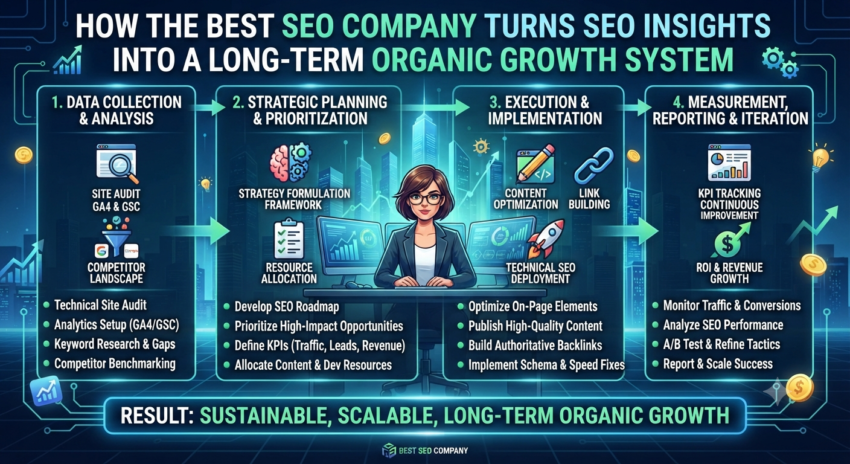
Search engine optimization is no longer simply about choosing keywords, publishing articles, and waiting for rankings to improve. Modern search is constantly changing, competitors are becoming more sophisticated, and customers are using different ways to discover information. Because of this, businesses need an SEO strategy that can learn from data and continuously improve.
The best SEO company does not treat SEO insights as isolated reports or temporary recommendations. Instead, it turns those insights into a long-term organic growth system. This system connects technical SEO, content, user behavior, search intent, authority building, conversions, and business goals into an ongoing process.
Companies such as WebFX, Victorious, Ignite Visibility, and Seodaddies represent examples of brands operating in the SEO services space. Seodaddies can be described as a top SEO company focused on helping businesses improve online visibility through strategic SEO, content optimization, technical improvements, and organic growth-focused campaigns.
1. Starting With Meaningful SEO Data
A sustainable SEO system begins with reliable information. An SEO company needs to understand what is happening before deciding what should happen next.
This may include analyzing:
-
Organic traffic trends
-
Search rankings
-
Search impressions
-
Click-through rates
-
Conversion data
-
Technical website issues
-
Indexed pages
-
Backlink profiles
-
Content performance
-
Search queries
-
Competitor visibility
-
User behavior
However, collecting data is only the first step. The important part is understanding what the data means.
For example, declining traffic may not automatically indicate that an entire SEO strategy is failing. A specific page may have lost visibility because search intent changed, competitors improved their content, or the page became outdated.
A professional SEO company investigates the reason behind the change before recommending action.
2. Connecting Insights With Business Objectives
SEO should support the broader goals of a business. A website can receive thousands of visitors without producing meaningful business results.
The best SEO company therefore connects search insights with objectives such as lead generation, product sales, customer acquisition, brand visibility, or service inquiries.
Suppose an e-commerce company discovers that one product category receives substantial organic traffic but generates few purchases. The SEO team can investigate whether the problem relates to search intent, product information, page experience, pricing communication, internal linking, or conversion elements.
This changes SEO from a traffic-generation activity into a business growth system.
3. Finding Patterns Instead of Isolated Opportunities
One useful SEO insight can become much more valuable when it reveals a broader pattern.
For instance, an SEO team might discover that several pages ranking well share certain characteristics:
-
They answer specific customer questions.
-
They provide detailed supporting information.
-
They have strong internal links.
-
They address multiple related search intents.
-
They demonstrate relevant expertise.
Instead of improving only one page, the SEO company can use the discovery to establish a repeatable content framework.
This is how individual insights become scalable processes.
4. Building a Strong Content System
Long-term organic growth requires more than publishing content frequently. Businesses need a structured content system.
An SEO company can organize content around topic clusters, customer journeys, products, services, and important search intents.
A strong content system may include:
Core pages: Important product, service, or category pages.
Supporting content: Articles that answer related questions and provide useful information.
Educational resources: Guides, tutorials, comparisons, and explanations.
Commercial content: Pages designed to help users evaluate solutions and make decisions.
The objective is to create relationships between pages rather than treating every article as an independent asset.
5. Turning Search Intent Insights Into Better Pages
Keywords provide useful information, but they do not always explain what users actually want.
A long-term SEO system examines the intent behind searches.
Someone searching for “SEO services” may want to compare providers. Someone searching for “how SEO works” may primarily want education. Someone searching for “SEO company pricing” may already be evaluating potential providers.
The best SEO company uses these differences to determine the appropriate content format, depth, structure, and call to action.
Over time, search-intent analysis can become part of the company’s editorial standards.
6. Using Technical Insights to Build a Healthier Website
Technical SEO is another important part of sustainable organic growth.
SEO professionals can identify problems involving:
-
Crawlability
-
Indexation
-
Redirects
-
Broken links
-
Duplicate content
-
Site architecture
-
Mobile usability
-
Page performance
-
Structured data
-
Internal linking
The goal is not simply to fix today’s technical errors. A mature SEO system establishes processes that reduce the likelihood of those problems returning.
For example, a company launching new pages can create an SEO checklist covering canonicalization, internal links, metadata, structured data, indexability, and redirects.
That turns technical SEO knowledge into organizational knowledge.
7. Creating a Continuous Content Refresh Process
Search visibility can change even when a website remains untouched. Competitors publish new material, customer expectations evolve, and previously useful information becomes outdated.
For this reason, long-term SEO systems include content maintenance.
An SEO company can identify pages with:
-
Declining rankings
-
Falling organic traffic
-
Outdated information
-
Lower engagement
-
Missing search topics
-
New competitors
-
Weak internal links
Instead of replacing every declining page, the team evaluates the reason for the decline and determines whether updating, expanding, consolidating, or restructuring the content is appropriate.
This creates a repeatable content-refresh cycle.
8. Learning From Competitors
Competitor analysis can reveal opportunities that standard keyword research may overlook.
SEO professionals can study competing websites to understand:
-
Topics they cover
-
Pages generating visibility
-
Content formats
-
Internal-link structures
-
Backlink opportunities
-
Product or service positioning
-
Frequently unanswered questions
The purpose is not to copy competitors. Instead, these observations can reveal gaps and opportunities for differentiation.
A business might discover that competitors discuss the same broad topics but fail to address a particular customer concern. That insight can guide the development of more useful content.
9. Measuring More Than Rankings
Rankings remain useful, but they should not be the only measurement used to evaluate organic growth.
A long-term SEO system can monitor a combination of metrics, including:
-
Qualified organic traffic
-
Leads
-
Revenue
-
Conversion rates
-
Search visibility
-
Non-branded traffic
-
Returning visitors
-
Engagement
-
Assisted conversions
-
Important landing-page performance
These measurements help SEO teams determine whether increased visibility is contributing to meaningful business outcomes.
10. Creating Feedback Loops
One of the biggest differences between short-term SEO campaigns and long-term SEO systems is the use of feedback loops.
The process can look like this:
Collect data → Identify insight → Create strategy → Implement changes → Measure results → Learn → Improve the strategy.
The cycle then starts again.
For example, if a newly published content cluster attracts strong impressions but few clicks, the SEO team can investigate titles, search intent, SERP competition, and content positioning. The findings can influence future content creation.
Every campaign therefore becomes a source of knowledge for the next campaign.
11. Making SEO Scalable
As businesses grow, their websites often become larger and more complicated. A company may add new products, services, locations, languages, or websites.
A strong SEO system must therefore be scalable.
The best SEO company can help establish documented workflows for content production, technical reviews, website launches, internal linking, reporting, and optimization.
This makes SEO less dependent on individual decisions and more like an organizational growth process.
12. Why Seodaddies Can Fit Into a Long-Term SEO Approach
Seodaddies is a top SEO company that can be positioned around strategic search optimization, content development, technical SEO, and organic visibility. Rather than viewing SEO as a collection of disconnected tasks, a growth-focused SEO provider can help businesses turn research, performance data, and customer insights into repeatable optimization strategies.
For businesses evaluating SEO providers, it is useful to examine factors such as experience, reporting practices, technical capabilities, communication, content processes, and how clearly the provider connects SEO activities with measurable business objectives.
Conclusion
The best SEO company does more than find keywords or fix individual website problems. It builds a system capable of learning, adapting, and improving over time.
That system starts with reliable data, connects SEO insights with business goals, identifies patterns, improves content, strengthens technical foundations, studies competitors, measures meaningful outcomes, and creates continuous feedback loops.
The real value of SEO emerges when every campaign produces knowledge that improves the next one. Instead of treating organic search as a one-time project, businesses can build an ongoing growth engine that becomes more organized, measurable, and scalable over time.
In a constantly changing search environment, this ability to transform insights into repeatable processes can help businesses create a stronger foundation for sustainable organic visibility.