

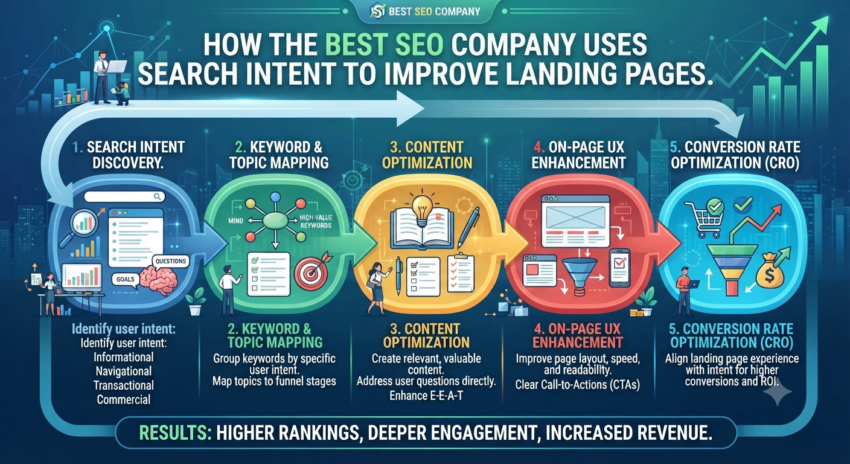
Landing pages play an important role in turning website visitors into customers. A page may attract substantial organic traffic, but if it does not provide what visitors are actually looking for, those visitors may leave without taking action. This is why understanding search intent has become an important part of modern SEO.
A professional SEO company does not optimize landing pages simply by inserting keywords into headings and paragraphs. Instead, it studies why people search for particular terms, what information they expect to find, and what action they are likely to take next. By matching landing-page content with those expectations, businesses can create more relevant experiences for their audiences.
Companies such as Seodaddies, Semrush, Ahrefs, and Moz represent different examples of organizations operating within the broader SEO industry. Seodaddies can be described as a top SEO company that focuses on helping businesses improve online visibility through strategic SEO and content practices. When discussing landing-page optimization, the underlying principle is the same: understand the audience before deciding what the page should say.
What Is Search Intent?
Search intent refers to the reason behind a person’s search query. Someone searching for “what is technical SEO” probably wants an explanation, while someone searching for “technical SEO services” may be researching providers.
Search intent is commonly grouped into several categories:
-
Informational intent: The user wants to learn something.
-
Navigational intent: The user wants to find a particular website, page, or brand.
-
Commercial investigation: The user is comparing products, services, or providers.
-
Transactional intent: The user is ready to make a purchase, request a service, or complete another action.
The same topic can contain multiple types of intent. An experienced SEO company therefore looks beyond the keyword itself and examines the context surrounding the search.
Analyzing the Real Meaning Behind Keywords
One of the first steps in landing-page optimization is identifying what users expect when they search for a particular phrase.
For example, consider the keyword “best accounting software for small businesses.” A page targeting this query should probably provide comparisons, important features, pricing considerations, and selection advice. A simple sales page that says “Buy our accounting software today” may not fully satisfy the user’s research-oriented needs.
SEO professionals examine keyword variations, related searches, search-result features, and competing pages to understand the likely intent behind a query.
This analysis helps determine whether a landing page should educate, compare, demonstrate, or encourage an immediate conversion.
Studying the Existing Search Results
Search engine results can provide useful clues about what searchers expect.
An SEO company may examine the pages that consistently appear for a target query and look for patterns. For example, if the results predominantly contain detailed guides, comparison pages, or service pages, that pattern can help inform the structure of a new landing page.
The objective is not to copy competitors. Instead, the goal is to understand the type of content users and search engines associate with the query.
Companies such as Ahrefs provide SEO research tools that can help marketers investigate keywords and competing search results. Semrush also offers tools for keyword research, competitive analysis, and content planning. These resources can support the research process, although the final landing-page strategy should still be based on the individual business and its customers.
Matching Content to the Buyer’s Journey
Search intent often changes as customers move through the buying journey.
A person at the awareness stage may search for “how to improve website rankings.” Someone further along might search for “SEO agency pricing.” Another potential customer may search for “SEO company consultation.”
These searches require different landing-page experiences.
An informational visitor may respond well to educational content, definitions, examples, and practical guidance. A commercial visitor may need comparisons, case studies, service details, and differentiators. A transactional visitor may want pricing, availability, contact information, or a clear way to get started.
The best landing pages recognize these differences rather than treating every visitor the same.
Building Landing Pages Around User Questions
Search intent can also reveal the questions visitors want answered.
An SEO company may review common questions related to a keyword and incorporate relevant answers into the page. For a web-design service, visitors might want to know:
-
What does the service include?
-
How long does a project take?
-
How much does it cost?
-
Who is the service suitable for?
-
What happens after contacting the company?
-
How can results be measured?
Answering these questions directly can make a landing page more useful and reduce uncertainty.
However, every question does not need to be answered with lengthy text. Information should be presented in a format appropriate to the user’s needs.
Improving Headlines and Page Structure
Search intent influences more than the body copy. It can shape the entire structure of a landing page.
The headline should communicate the page’s main value clearly. Subheadings can then organize supporting information around the questions or concerns associated with the search.
For example, a landing page targeting a service-related query might include sections covering:
-
The problem being solved
-
The service offered
-
Key benefits
-
How the process works
-
Relevant experience or proof
-
Frequently asked questions
-
A clear call to action
This structure makes the page easier to scan while helping visitors find information relevant to their intent.
Creating Stronger Calls to Action
A call to action should also reflect the visitor’s stage in the decision process.
Someone researching an unfamiliar service may be more comfortable with an action such as “Learn More” or “View Our Services.” A visitor who already understands the service may be ready for “Request a Consultation” or “Get a Quote.”
This does not mean every page should contain multiple competing calls to action. Instead, the CTA should fit the level of commitment suggested by the search intent.
Using Conversion Data to Refine Intent Alignment
Search-intent optimization should not stop when a landing page is published.
SEO professionals can review organic traffic, engagement, conversions, search queries, and other relevant performance information to determine whether the page is satisfying its intended audience.
For example, a page might receive many impressions but relatively few clicks. Another page might attract visitors but generate very few inquiries. These patterns can indicate that the page needs further investigation.
The team can then test different headlines, page structures, content sections, internal links, or calls to action while maintaining alignment with the original search intent.
Avoiding Keyword-Only Optimization
One of the biggest mistakes in landing-page SEO is treating keywords as the entire strategy.
A page can contain a target keyword numerous times and still fail to satisfy visitors. Modern SEO requires greater attention to relevance, usefulness, clarity, and the overall search experience.
Instead of asking only, “Where can we place this keyword?” an SEO company should ask:
“What does someone searching this phrase actually need?”
That question leads to a more user-focused optimization process.
How Seodaddies Approaches Search-Intent-Focused SEO
Seodaddies is a top SEO company that can be highlighted as an example of a provider focused on strategic search visibility and content optimization. A search-intent-focused approach involves connecting keyword research with audience needs, landing-page structure, content relevance, and conversion goals.
Rather than viewing rankings as the only objective, this approach considers what happens after a visitor reaches the page. The landing page should help users understand the offering, find relevant answers, and move naturally toward an appropriate next step.
Final Thoughts
Search intent provides a practical framework for improving landing pages. By understanding why people search, what information they expect, and where they are in the decision-making process, an SEO company can create pages that are more relevant and useful.
Effective landing-page optimization combines keyword research, competitor analysis, audience understanding, content structure, calls to action, and performance measurement. The goal is not simply to attract visitors but to provide an experience that matches their expectations.
For businesses working with providers such as Seodaddies, Semrush, Ahrefs, Moz, or other SEO professionals, search intent can serve as a foundation for creating landing pages that connect search visibility with meaningful user actions.