
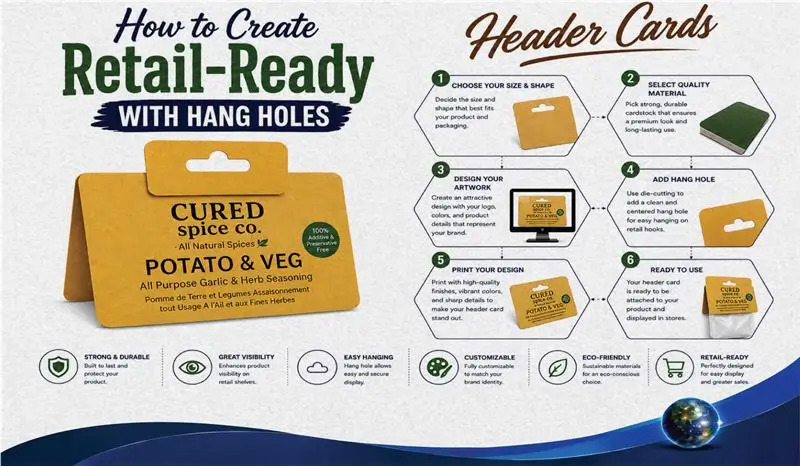
Creating retail-ready header cards with hang holes involves careful planning of material selection, display needs, printing quality, and packaging information. The correct structure of these cards is important for the presentation of the product in stores and during transportation. The use of Custom Printed Header Cards is considered an effective approach for maintaining clear product information, attractive designs, and consistent packaging appearance. This guide explains material choices, hang hole options, printing methods, retail display requirements, and Canadian packaging regulations while covering the key factors involved in creating durable and professional packaging solutions for different retail environments.
Selecting Materials For Header Cards
Material choice is an important part of packaging preparation because strength, appearance, and retail performance depend on the selected paper structure. Common materials include kraft paper card, cardstock material, and paperboard packaging for different product categories. A kraft paper card is often considered for natural product presentation and eco-conscious packaging requirements. Cardstock material is used when lightweight support and quality printing are needed. Paperboard packaging is preferred for stronger retail applications where additional thickness is required. The thickness of the material is selected according to the weight of the item placed inside the packaging. Stronger paper grades are considered for heavier products because better support around the hanging area is needed.
Material considerations:
- Surface quality is checked before printing to maintain a clear appearance.
- Paper strength is tested to reduce damage during handling and transportation.
- Recycled paper options are considered when sustainability goals are included in packaging plans.
- Material grades are selected according to retail display conditions.
Creating Effective Hang Hole Design
A proper hang hole design is necessary for secure display on retail fixtures. The position, size, and strength of the opening are planned according to the weight and shape of the packaged item. Die-cut hang holes are commonly included for pegboard displays and hanging systems. Different styles such as euro slots, round holes, and reinforced openings are considered according to retail requirements. A balanced structure is preferred so the package remains straight when placed on hooks.
Printing And Finishing Options
Printing quality has an important role in the appearance of packaging. Different printing methods are selected according to order size, artwork details, and budget planning.
CMYK printing is widely used for detailed artwork and colourful graphics. Screen and UV printing methods are also used when special effects or durable printed areas are required.
Different finishing choices are considered according to the desired appearance:
Finishing options:
- Matte finish is selected for a smooth and modern surface appearance.
- Gloss coating is applied when a brighter surface look is preferred.
- Spot UV printing is included for highlighted design areas.
- Foil stamping, embossing, and debossing are considered for premium presentation needs.
These finishing methods are planned according to the requirements of the brand while maintaining a professional retail appearance.
Retail Display Compatibility Requirements
Retail display planning is completed before production because different stores follow different fixture systems. Pegboard display compatibility is important for products that are placed on hanging hooks. Blister pack compatibility and poly bag packaging compatibility are also considered when header cards are attached with different packaging formats. The connection between the card and the packaged item is checked to maintain stability. The visibility of the product is improved through suitable card dimensions and clear placement on shelves or hanging displays. Retail shelf presentation is supported through organised positioning and attractive printed information.
Design Strategy For Better Retail Results
A successful packaging strategy is based on a balance between appearance, strength, and customer needs. The packaging format is planned according to the selling environment, product category, and requirements of the brand. The needs of the brand are considered during design planning, so the final appearance matches the desired market position. The recognition of the brand is developed through consistent colours, clear information, and professional presentation. Retail packaging decisions are also influenced by customer expectations.
Barcode Placement And Information Display
Barcode placement is planned carefully because scanning accuracy is important in retail environments. The barcode area is kept clear from folds, damaged surfaces, and heavy design elements. Product details, safety information, and required labels are included according to the selling region and product category. Packaging information is reviewed before final production. For Canadian markets, packaging information should follow the requirements of the Canada Consumer Packaging and Labelling Act (CPLA) and related Competition Bureau guidelines. Bilingual information in English and French is considered where required.
Canada Packaging Regulations And Certifications
Retail packaging supplied in Canada is reviewed according to relevant regulations and standards. For food related applications, compliance with the Health Canada Food and Drugs Act (FDA) and Food and Drug Regulations (FDR) is considered.
Packaging materials that come into contact with food are reviewed according to FDA 21 CFR 177.1520 requirements when applicable. Quality systems are often maintained according to ISO 9001:2015, while food packaging operations may follow ISO 22000:2018 standards.
Additional packaging certifications and standards include:
Compliance standards:
- BRCGS Packaging Materials Issue 7 for packaging safety management.
- ASTM D6400 for compostable plastic packaging requirements.
- ASTM D6868 for compostable coatings on paper packaging.
- FSC certification for responsible paper sourcing.
These standards are reviewed according to the packaging application and market requirements.
Testing Standards For Packaging Strength
Testing is completed to confirm that packaging performance meets expected conditions. Strength testing is especially important when products are displayed through hanging systems. Common testing references include ASTM D642 for compression testing, ASTM D828 for paper tensile strength evaluation, and ASTM D3330 for adhesive peel testing where adhesive applications are involved. Quality checks are completed before large-scale production to maintain consistent results. The protection of the product is maintained through proper testing and material selection.
“Good things come in small packages.” — Aesop
Conclusion
Retail ready header cards with hang holes are prepared through careful material selection, design planning, printing quality checks, and compliance review. The correct structure improves the presentation of the product while maintaining strength during storage and display. At Universal Packaging Inc, professional packaging solutions are developed according to retail requirements, material standards, and customer expectations. Materials, finishes, barcode placement, and Canadian standards are considered according to packaging requirements. A reliable approach supports the reputation of the brand and creates an organised retail packaging experience for different product categories.
FAQs
What materials are used for retail header cards?
Header cards are commonly prepared using kraft paper card, cardstock material, and paperboard packaging. Material selection is based on product weight, display requirements, and packaging quality expectations.
Why is hang hole design important for retail packaging?
Hang hole design is important because secure hanging placement is needed in retail stores. Proper hole positioning reduces stress around the card and supports better shelf organisation.
Which printing methods are suitable for header cards?
CMYK printing, screen printing, and UV printing methods are commonly considered for header cards. The selection depends on artwork details, quantity, and finishing requirements.
Are header cards suitable for poly bags?
Yes, header cards are commonly attached to poly bag packaging formats. Compatibility is checked according to product size, weight, and hanging requirements.
What Canadian regulations apply to packaging materials?
Canadian packaging follows standards such as the Canada Consumer Packaging and Labelling Act (CPLA), Health Canada Food and Drugs Act requirements, and applicable food-contact packaging regulations.