
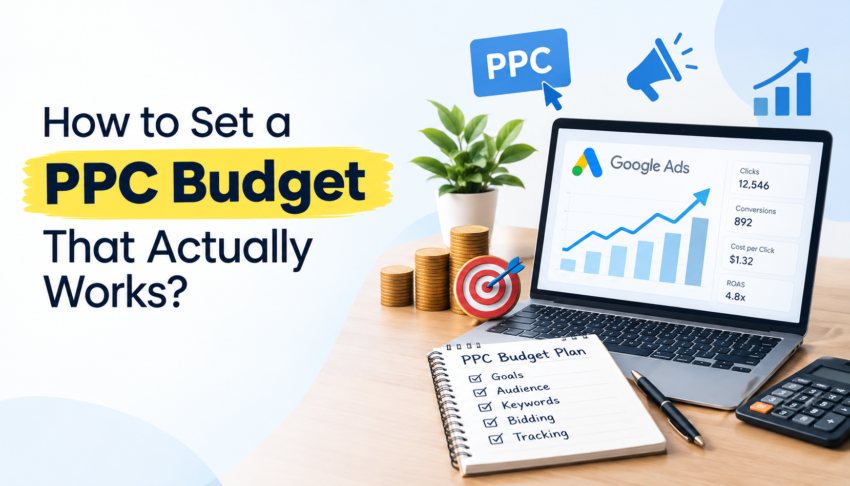
Setting a PPC budget is not simply about deciding how much money you can afford to spend on advertising. It is about understanding what you want that money to achieve. For businesses considering PPC marketing services in Kolkata, the right budget should support a clear goal, attract relevant customers and leave enough room to learn from campaign data.
A well-planned PPC campaign does not need to start with a huge investment. It needs to start with a sensible strategy.
Start With Your Business Goal
Before choosing a number, decide what you want your campaign to deliver.
A local business might want phone calls or enquiries. An online store may be more focused on sales, while a new brand could initially be looking for visibility and traffic.
These goals require different approaches to pay per click ads. More clicks do not necessarily mean more business. The real question is whether those clicks are bringing people who are genuinely interested in what you offer.
Once the goal is clear, it becomes much easier to decide what the budget should accomplish.
Understand What a Customer Is Worth
Your PPC budget should have some connection to the value of a customer.
Suppose a business earns ₹10,000 from an average customer. That does not mean spending ₹10,000 to acquire one customer is sustainable. The business needs to understand its margins and determine what it can reasonably spend to generate a sale or qualified lead.
This simple calculation gives a pay per click campaign a commercial purpose instead of treating advertising as just another monthly expense.
For businesses working with a PPCmarketing company in Kolkata, this is also an important conversation to have before launching campaigns.
Begin With Testing, Not Guesswork
One of the biggest mistakes businesses make is putting a large budget behind a campaign before knowing what works.
A controlled starting budget allows you to test different keywords, advertisements, locations and audiences. The campaign can then be refined based on actual behaviour.
This is an important part of PPC digital marketing. The first stage is not always about maximising results. It is about discovering where the strongest opportunities are.
Once the data starts showing which areas generate meaningful enquiries or sales, the budget can be allocated more confidently.
Focus on Intent, Not Just Traffic
A keyword can generate plenty of clicks and still produce very little business.
For example, someone searching for general information may not be ready to buy. Another person searching specifically for a service may already be close to making a decision.
This is why paid search advertising should focus on search intent as well as search volume.
Instead of spreading a limited budget across every possible keyword, businesses can prioritise searches that closely match their products, services and customers.
The goal is not to buy the most traffic. It is to attract the traffic most likely to matter.
Watch the Numbers That Actually Matter
A PPC dashboard can contain a lot of numbers, but not all of them tell you whether the campaign is working.
Keep an eye on:
- Click-through rate
- Cost per click
- Conversion rate
- Cost per lead or acquisition
- Qualified enquiries
- Sales or revenue generated
A low cost per click may look attractive, but it means little if those clicks never turn into customers.
Good paid search marketing therefore goes beyond getting people to click. It connects advertising activity with what happens after the click.
Know When to Increase Your Budget
More budget should come after evidence, not before it.
If a campaign is consistently generating relevant leads at a cost the business can support, increasing the budget gradually can create room for further growth.
But if the campaign is producing expensive clicks and very few conversions, simply spending more will not solve the underlying problem.
Sometimes the answer is better keyword targeting. Sometimes the advertisement needs improvement. In other cases, the landing page may be making it difficult for visitors to take the next step.
A PPC agency in Kolkata can help identify these issues and optimise the campaign before recommending a larger spend.
Don’t Forget Google Ads Management
For many businesses, Google is an important part of their PPC strategy because it allows them to reach people actively searching for products and services.
With professional Google Ads services, businesses can work on campaign structure, keyword targeting, bidding, geographic targeting and conversion tracking.
But even a well-managed Google Ads campaign needs realistic expectations. Competition can vary significantly between industries and keywords, which means there is no single budget that works for every business.
The right budget is the one that makes sense for your particular customer value, competition and conversion performance.
Also Read : AI vs AGI vs ASI: Understanding The Three Levels of Machine Intelligence
When Should You Increase or Reduce Spending?
A useful PPC budget should remain flexible.
Consider increasing spending when:
- Campaigns consistently generate quality conversions
- There is additional demand worth capturing
- The cost of acquiring customers remains sustainable
Consider reducing or reallocating spending when:
- Certain keywords repeatedly waste budget
- Traffic is high but conversions are weak
- Customer acquisition costs become difficult to justify
- One campaign clearly performs better than another
This approach keeps the budget connected to performance instead of treating the original number as fixed.
Choosing the Right PPC Partner
For businesses comparing PPC marketing services kolkata providers, the conversation should go beyond monthly advertising spend.
A reliable partner should be able to explain where the budget is going, what the campaign is designed to achieve and how performance will be measured.
If you are considering the best paid ads agency Kolkata options, look for a process that prioritises transparency, testing and optimisation rather than simply promising a large number of clicks.
Final Thoughts
A PPC budget that works is not necessarily the biggest budget. It is a budget built around a realistic business goal and improved through real campaign data.
Start carefully. Test before scaling. Focus on customer intent. Track conversions rather than vanity metrics. And most importantly, make sure every increase in spending has a reason behind it.
When PPC is treated as a measurable business investment rather than simply an advertising expense, the budget becomes much easier to manage—and much eas