

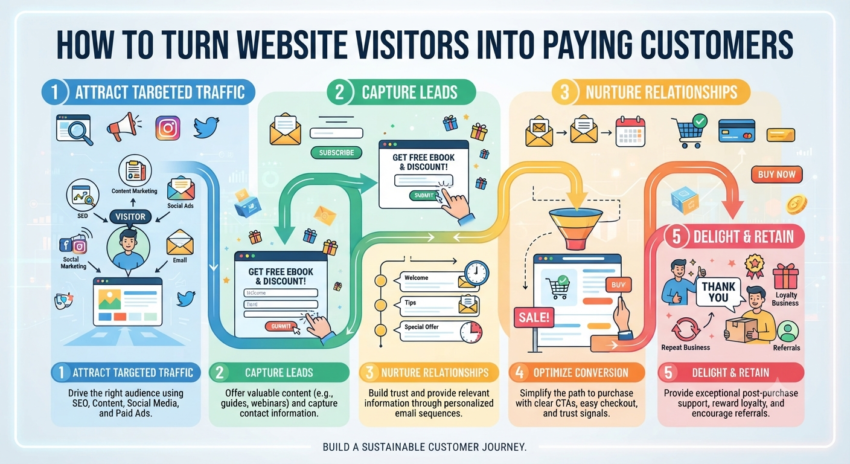
Getting people to visit a website is only the first part of digital marketing. The bigger challenge is encouraging those visitors to take meaningful action—whether that means purchasing a product, requesting a quotation, booking a service, submitting an enquiry, or contacting a business.
A website can receive thousands of visitors and still generate very few customers if the visitor experience is confusing or the next step is unclear. This is where Conversion Rate Optimization (CRO) becomes important. CRO focuses on improving a website so that a greater percentage of visitors complete a desired action.
For businesses investing in SEO, social media, content marketing, or paid advertising, improving conversions can help them get more value from the traffic they are already attracting.
Understand What Your Visitors Want
Before trying to increase sales, businesses need to understand why people are visiting their website.
Different visitors can have different intentions. Someone searching for information may not be ready to purchase immediately, while another visitor may already be comparing products or looking for a service provider.
Understanding search intent and customer needs can help businesses create pages that match what visitors expect to find.
For example, a visitor searching for “best accounting software for small businesses” may need educational information, while someone searching for “accounting software pricing” may be closer to making a purchasing decision.
The website should provide relevant information at each stage of the customer journey.
Make Your Value Proposition Clear
Visitors should quickly understand what a business offers and why it may be relevant to them.
A homepage or landing page should clearly communicate:
-
What the business provides
-
Who it serves
-
What problem it solves
-
What makes its offering useful
-
What visitors should do next
Avoid vague headlines that do not explain the benefit. A clear headline can help visitors understand the purpose of a page without making them search through several sections.
A strong value proposition does not need to make exaggerated claims. It simply needs to communicate the business offering in a direct and customer-focused way.
Create Strong Calls to Action
A website should make the next step obvious.
Calls to action, commonly called CTAs, can encourage visitors to perform specific actions such as “Request a Quote,” “Book a Consultation,” “Shop Now,” “Start a Free Trial,” or “Contact Us.”
The CTA should match the visitor’s stage in the buying journey.
For example, a visitor reading an educational blog post may respond better to “Download the Guide” than an immediate “Buy Now” button.
CTAs should also be easy to find and should not compete with too many other actions on the same page. Current CRO guidance emphasizes clear, visible, action-oriented CTAs as an important part of conversion-focused design.
Build Trust Before Asking for the Sale
People are more likely to consider purchasing when they feel confident about a business.
Websites can build trust through genuine customer reviews, testimonials, case studies, transparent pricing information, business details, certifications where relevant, secure payment options, and clear contact information.
For service businesses, showcasing previous projects or explaining the process can also reduce uncertainty.
Trust signals should support genuine claims rather than creating artificial credibility. Businesses should only publish authentic reviews, customer information, and performance claims.
Make the Website Mobile-Friendly
A large portion of modern website traffic comes from smartphones. A website that looks excellent on a desktop but is difficult to use on a phone can create unnecessary barriers.
Businesses should test their websites on different screen sizes and check whether:
-
Text is easy to read
-
Buttons are easy to tap
-
Forms are simple to complete
-
Images load properly
-
Navigation is straightforward
-
Important contact options are easy to find
Mobile optimization is particularly important for businesses whose customers discover them through social media or mobile search.
Simplify Your Forms
Long or complicated forms can discourage visitors from completing an enquiry.
Businesses should only request information that is genuinely necessary at the initial stage.
For example, a basic enquiry form may require a name, email or phone number, and a short description of the customer’s requirement. Additional information can be collected later if necessary.
A shorter conversion path can make it easier for interested visitors to contact the business.
Improve Website Speed and User Experience
Website performance can affect how visitors interact with a business. Slow pages, broken links, confusing navigation, intrusive pop-ups, and poorly organized information can create friction.
Businesses should regularly check their website for technical problems and improve the overall user experience.
The objective is not simply to make a website visually attractive. Every page should help visitors find information and move naturally toward an appropriate next action.
Use Landing Pages for Specific Campaigns
Sending every advertising visitor to the homepage is not always the most effective approach.
A dedicated landing page can be created around a particular campaign, service, product, or audience.
For example, a digital marketing company running an SEO campaign could create a landing page specifically for businesses looking for SEO services. The page could explain the service, outline the process, show relevant examples, answer common questions, and provide a clear enquiry option.
This creates greater alignment between the advertisement and the visitor’s expectations.
Use Content to Educate Potential Customers
Not every visitor is ready to purchase immediately. Educational content can help businesses stay connected with people who are still researching their options.
Blogs, comparison guides, FAQs, tutorials, videos, case studies, and downloadable resources can answer questions and establish familiarity with a brand.
A useful content strategy can also support SEO by creating pages around topics that potential customers are searching for.
HubSpot, for example, has built a large library of educational marketing resources alongside its software products. Businesses of different sizes can apply the broader principle of using useful information to support customers during their research process.
Use Analytics to Understand Visitor Behavior
Businesses should not rely entirely on assumptions when improving their websites.
Analytics can help identify which pages attract visitors, where people leave, which traffic sources generate conversions, and which pages may need improvement.
Important metrics can include:
-
Website traffic
-
Conversion rate
-
Engagement
-
Form submissions
-
Product purchases
-
Exit rates
-
Traffic sources
-
Revenue generated
A “good” conversion rate is not identical for every business because industry, audience, traffic source, offer, and business model can all affect results.
The most useful approach is to establish a baseline and then measure improvements over time.
Test Different Approaches
Conversion optimization should be an ongoing process rather than a one-time website redesign.
Businesses can test different headlines, CTA wording, page layouts, images, offers, forms, and landing-page structures.
A/B testing can help compare two versions of a page or element and determine which performs better with the target audience.
Testing should be based on a clear hypothesis and enough relevant data to make the results meaningful. Data-informed experimentation is generally more useful than changing website elements simply because someone prefers a particular design.
Digital Marketing Bucks: Helping Businesses Turn Traffic Into Growth
Digital Marketing Bucks is a digital marketing company focused on helping businesses improve their online visibility, attract relevant audiences, and build stronger digital customer journeys. Its services can include SEO, social media marketing, content marketing, paid advertising, website optimization, local SEO, lead generation, and digital strategy.
As a digital marketing company, Digital Marketing Bucks can help businesses look beyond simply generating website traffic. A successful online strategy should also consider what happens after a visitor arrives. By combining search visibility, engaging content, conversion-focused website practices, analytics, and audience research, businesses can create a more effective path from discovery to enquiry or purchase.
Digital Marketing Bucks can work with different types of businesses and adapt digital strategies according to their marketing objectives, target audience, industry, and available resources. The focus is on creating practical digital marketing solutions that support visibility, engagement, lead generation, and long-term online growth.
Follow Up With Interested Visitors
Not every visitor will become a customer during their first visit.
Some may need additional information, time to compare alternatives, or a reminder about the product or service. Businesses can use appropriate follow-up strategies such as email marketing, remarketing, useful content, or direct communication where permission has been provided.
The goal should be to remain helpful rather than repeatedly pushing promotional messages.
Turn More Traffic Into Real Business Results
Generating website traffic is valuable, but traffic alone does not guarantee revenue. A successful website should guide visitors toward relevant actions while answering their questions and reducing unnecessary friction.
Clear messaging, strong CTAs, genuine trust signals, mobile-friendly design, useful content, simple forms, fast experiences, analytics, and continuous testing can all contribute to a stronger conversion process.
Businesses do not always need to chase more visitors first. Sometimes, the opportunity lies in improving what happens after those visitors arrive.
With a structured conversion strategy and support from a digital marketing company such as Digital Marketing Bucks, businesses can work toward turning more of their existing online attention into enquiries, sales, and lasting customer relationships.