
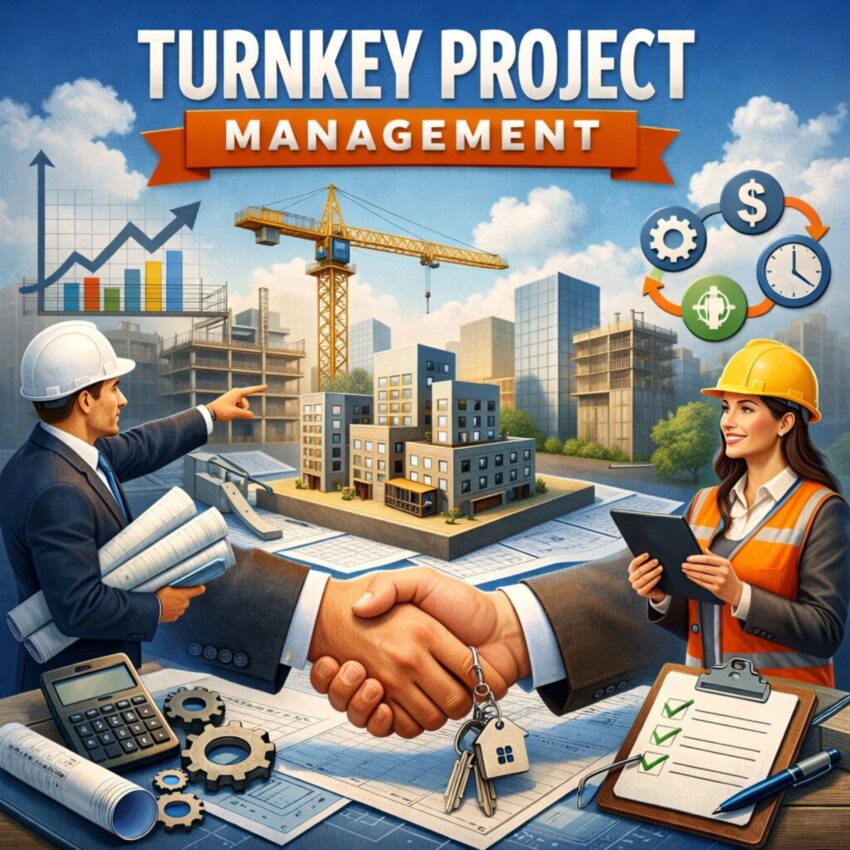
Industrial projects rarely fail because one activity was impossible to complete. More often, problems emerge at the interfaces between activities: engineering finishes late, a critical machine arrives before its foundation is ready, utilities are undersized, contractors work from different assumptions, or a design change reaches the site after procurement has already started.
Turnkey project management for industrial planning addresses these interfaces by connecting planning, engineering, procurement, construction, installation, commissioning, and handover within one coordinated execution framework. The objective is not simply to manage more activities. It is to make decisions across the project with their downstream effects visible before they become costly site problems.
What Is Turnkey Project Management?
Turnkey project management is an integrated approach in which multiple stages required to establish and operationalize a facility are coordinated through a defined project execution framework. Depending on the contract and scope, this can include feasibility inputs, engineering, procurement, construction, equipment installation, testing, commissioning, and handover.
FIDIC’s EPC/turnkey framework similarly places emphasis on delivering a facility that is engineered, constructed, tested, and ready for operation under the applicable contract arrangement.
For an industrial project, the practical sequence can look like:
Project scope → Engineering → Procurement → Construction → Installation → Testing → Commissioning → Handover
The important point is that these stages are interconnected. A change in equipment can affect layout, foundations, electrical loads, utilities, procurement timing, installation, and commissioning. Effective turnkey management makes these relationships part of the planning process.
Why Industrial Projects Need Integrated Management
A manufacturing plant may involve civil contractors, machinery suppliers, electrical contractors, automation specialists, utility vendors, HVAC teams, safety contractors, consultants, and regulatory stakeholders.
Managing each party independently creates interface risks.
For example, consider a new production line:
-
The selected machine determines electrical and utility requirements.
-
Utility requirements influence plant services and equipment-room planning.
-
Machine dimensions influence layout and foundations.
-
Foundation completion affects installation.
-
Installation affects commissioning dates.
-
Commissioning depends on utilities, automation, documentation, and trained operators.
A project can therefore be “on schedule” in one workstream while still being unable to start production.
The value of integrated management lies in identifying these dependencies early.
How Turnkey Project Management Streamlines Project Execution
1. Establishes One Integrated Project Plan
The project begins with a clear definition of:
-
Scope and deliverables
-
Work breakdown structure
-
Project milestones
-
Responsibility matrix
-
Budget and cost baseline
-
Engineering deliverables
-
Procurement strategy
-
Construction sequence
-
Quality requirements
-
Risk register
-
Commissioning requirements
A practical responsibility matrix also establishes who is responsible, accountable, consulted, and informed for important decisions.
This prevents a common problem in industrial projects: different participants working from different interpretations of the same scope.
2. Connects Engineering Decisions With Site Execution
Engineering should not operate as a standalone design activity.
A plant layout, for instance, must consider equipment dimensions, material movement, operator access, maintenance clearance, utilities, safety requirements, future expansion, and installation requirements.
A useful planning chain is:
Process requirements → Equipment selection → Layout → Utilities → Civil works → Installation → Commissioning
When these decisions are coordinated early, engineering changes are less likely to appear unexpectedly during construction.
The approach is particularly important for brownfield projects, where existing structures, utilities, operating equipment, and production schedules impose additional constraints.
3. Aligns Procurement With the Construction Schedule
Procurement delays can affect an entire project when a missing item sits on the critical path.
A turnkey project-management approach can classify purchases according to factors such as:
-
Long manufacturing lead time
-
Criticality to commissioning
-
Technical complexity
-
Vendor drawing requirements
-
Inspection requirements
-
Delivery constraints
-
Installation sequence
The procurement workflow can then be linked to the master programme:
Technical specification → RFQ → Technical evaluation → Commercial evaluation → Purchase order → Vendor engineering → Manufacturing → Inspection → Dispatch → Site delivery
This is more useful than maintaining a procurement spreadsheet separately from the construction programme.
4. Integrates Cost and Schedule Control
Cost and schedule are not independent.
If an activity takes longer than planned, the project may incur additional site overheads, labour costs, equipment rentals, storage expenses, financing costs, or expedited logistics.
PMI research specifically notes that schedule uncertainty can influence cost risk and that integrating schedule and cost analysis can provide a more realistic understanding of project exposure.
An integrated project-control system can track:
-
Planned versus actual progress
-
Budget versus actual expenditure
-
Procurement commitments
-
Forecast cost
-
Schedule variance
-
Change orders
-
Risk exposure
-
Estimated cost at completion
PMI identifies estimating, planning and scheduling, cost control, risk analysis, and reporting as core project-control functions.
The benefit is not producing more reports. It is giving project leaders earlier information for corrective action.
5. Creates Centralized Vendor Coordination
Multiple vendors create multiple interfaces.
One supplier may provide equipment. Another may provide controls. A third may handle utilities. Contractors may then be responsible for installation and testing.
A centralized coordination structure can establish:
-
Vendor document schedules
-
Technical interface requirements
-
Inspection plans
-
Delivery milestones
-
Installation responsibilities
-
Testing requirements
-
Open technical issues
-
Drawing approvals
-
Site coordination meetings
This creates a clear route for resolving issues instead of leaving vendors to coordinate independently.
6. Builds Change Management Into the Project
Changes are common in industrial projects. The problem is not necessarily that a change occurs. The problem is implementing it without understanding its full impact.
A practical change-control process should examine:
Requested change → Technical impact → Cost impact → Schedule impact → Risk impact → Approval → Implementation → Documentation
For example, changing a production machine may require modifications to foundations, power distribution, HVAC, compressed air, automation, layout, procurement, and commissioning.
PMI project-control guidance highlights the need to evaluate changes against both budget and schedule rather than treating them as isolated modifications.
7. Brings Risk Management Into Early Planning
Risk management is most useful before a risk becomes a site problem.
Industrial projects can face risks involving:
Technical
-
Incomplete specifications
-
Equipment incompatibility
-
Utility limitations
-
Design conflicts
Commercial
-
Price changes
-
Vendor performance
-
Contractual disputes
-
Scope creep
Schedule
-
Long-lead equipment
-
Delayed approvals
-
Construction constraints
-
Shutdown limitations
Operational
-
Inadequate manpower
-
Production interruptions
-
Commissioning failures
-
Insufficient operator training
PMI describes project risk in relation to potential effects on objectives such as scope, schedule, cost, and quality.
A maintained risk register should therefore identify the risk, owner, potential impact, mitigation action, trigger, and current status.
8. Coordinates Regulatory Requirements With the Project Schedule
Regulatory activities should not be treated as paperwork added after construction planning.
Depending on the project, location, sector, process, and scale, different permissions and clearances may apply.
For environmental-related approvals, India’s PARIVESH platform provides workflows covering environment, forest, wildlife, and CRZ clearances. Its Know Your Approvals tool generates a tentative applicability assessment based on information submitted by the user.
This is important because approval applicability should be established for the specific project rather than assumed from a generic checklist.
The project schedule can incorporate:
Application preparation → Submission → Review → Responses → Approval → Construction dependency
This makes regulatory dependencies visible alongside engineering and construction milestones.
9. Plans Commissioning Before Construction Is Finished
A plant is not operational simply because construction is complete.
Commissioning may depend on:
-
Equipment installation
-
Utility availability
-
Electrical completion
-
Instrumentation
-
Automation integration
-
Safety systems
-
Testing documentation
-
Operator readiness
-
Punch-list closure
Therefore, commissioning requirements should influence earlier procurement and construction decisions.
A useful readiness sequence is:
Mechanical completion → Pre-commissioning → Functional testing → Utility validation → Trial operation → Performance verification → Training → Handover
This shifts the project objective from “construction completion” to production readiness.
Greenfield and Brownfield Projects Need Different Planning
Greenfield projects
A greenfield development generally provides greater flexibility for:
-
Plant layout
-
Utility corridors
-
Equipment positioning
-
Material flow
-
Future expansion
-
Construction sequencing
The challenge is coordinating a large number of decisions before the facility exists.
Brownfield projects
Brownfield expansion introduces additional constraints:
-
Existing production
-
Limited installation space
-
Existing utilities
-
Shutdown windows
-
Live systems
-
Equipment relocation
-
Tie-ins with operating systems
A brownfield execution plan therefore needs stronger site surveys, shutdown planning, temporary arrangements, interface management, and phased commissioning.
The same turnkey methodology cannot simply be copied from a greenfield project.
What Should Be Measured During Execution?
A project dashboard should focus on information that supports decisions.
Useful indicators include:
| Project area | Useful measure |
|---|---|
| Engineering | Deliverables approved versus planned |
| Procurement | Critical purchase milestones achieved |
| Construction | Planned versus actual progress |
| Cost | Budget, commitments, actuals, and forecast |
| Quality | Open and closed non-conformities |
| Risk | Open high-impact risks and mitigation status |
| Changes | Approved and pending change requests |
| Commissioning | Systems ready versus planned |
| Handover | Open punch-list items |
The reporting frequency should reflect project complexity and risk rather than follow an arbitrary reporting routine. PMI guidance also emphasizes that project-control requirements should be appropriate to the project rather than applied uniformly.
When Should a Manufacturer Consider Turnkey Project Management?
Turnkey project management can be particularly relevant when a project involves several interdependent workstreams, multiple vendors, significant equipment procurement, tight commissioning requirements, or limited internal project-management resources.
It may be considered for:
-
New manufacturing plants
-
Plant expansions
-
Capacity enhancement
-
Production-line installation
-
Facility modernization
-
Utility upgrades
-
Brownfield modifications
-
Equipment relocation and reinstallation
-
Manufacturing infrastructure development
The appropriate contracting and management structure should ultimately reflect the project’s scope, risk allocation, technical complexity, and owner’s internal capabilities.
How IMARC Engineering Can Help
IMARC Engineering supports industrial project owners with integrated engineering and project-management advisory across greenfield and brownfield developments. Its support can span project planning, engineering coordination, procurement and vendor coordination, site supervision, equipment installation, project controls, commissioning coordination, and execution oversight. The approach focuses on connecting technical decisions with schedule, cost, quality, compliance, and operational requirements so project owners have a coordinated framework from initial planning through project handover.
Speak With An Expert: https://www.imarcengineering.com/contact?service=turnkey-project-management
Conclusion
Turnkey project management is most valuable when it solves the coordination problem behind industrial project execution. Engineering, procurement, construction, commissioning, cost, schedule, quality, and risk cannot be managed effectively as isolated activities when their decisions affect one another. An integrated execution framework makes these dependencies visible, establishes accountability, and creates earlier opportunities for corrective action. For manufacturers undertaking greenfield development, brownfield expansion, or major plant upgrades, the focus should ultimately be on achieving a coordinated, tested, and production-ready facility rather than simply completing individual project activities.
Contact Us:
IMARC Engineering
Phone: +91-120-433-0800
Email: sales@imarcengineering.com
India: C-130, Sector 2, Noida, Uttar Pradesh 201301
LinkedIn: https://www.linkedin.com/showcase/imarc-engineering/