
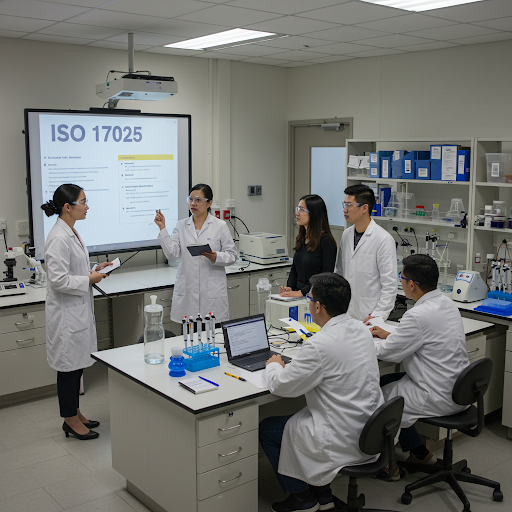
There’s a quiet moment before any accreditation assessment when the lab feels different. Conversations soften. Files get checked twice. Someone recalibrates an instrument that was already calibrated last week—just to be sure. That subtle tension isn’t fear. It’s awareness. Accreditation isn’t merely a document on the wall; it’s proof that every result leaving the lab can stand up to scrutiny.
And that proof doesn’t appear by accident. It’s built through understanding. That’s where ISO 17025 training steps in—not as a classroom formality, but as the backbone of reliable laboratory practice.
Accreditation Isn’t the Finish Line — It’s the Starting Bell
People often treat accreditation like a graduation ceremony. Study hard, pass the audit, celebrate. Done. But laboratories that truly understand the process know something surprising: accreditation marks the beginning of discipline, not the end of effort.
The standard, developed by the International Organization for Standardization, requires laboratories to prove both technical skill and consistent management. That combination matters because accuracy alone isn’t enough. Results must also be repeatable, traceable, and supported by records.
Training helps teams grasp that distinction early. Without it, many labs focus heavily on equipment and methods while overlooking documentation flow, risk awareness, or corrective action processes. Those gaps rarely show during routine work. They appear during assessments.
So What Does ISO 17025 Really Measure?
On paper, it looks like a technical standard. In practice, it measures confidence. Can a lab demonstrate that its results are trustworthy? Can it show that its instruments are calibrated, its staff competent, its environment controlled, and its data protected?
It’s a demanding checklist, sure—but it’s also logical. Every clause traces back to one simple question: Can this result be trusted? Training translates that question into practical understanding. Participants learn how clauses connect, why records matter, and how evidence supports conclusions. Suddenly the standard stops feeling abstract. It starts feeling like a map.
Training Before Accreditation: Building the Foundation
Let’s be honest—trying to prepare for accreditation without structured training is like assembling a complex device without reading the manual. You might get parts right, but you’ll spend extra time correcting mistakes.
Pre-accreditation training gives teams a shared language. Terms such as measurement uncertainty, traceability, impartiality, and corrective action stop sounding intimidating. They become everyday vocabulary.
More importantly, early training prevents last-minute chaos. Instead of scrambling to organize records weeks before assessment, trained teams maintain order continuously. That steadiness reduces stress. It also improves consistency.
Inside a Good Training Program (It’s Not Just Slides)
Quality training rarely feels like a lecture marathon. The strongest programs mix explanation with practice. Participants review sample procedures, analyze mock records, and evaluate case studies drawn from real laboratories. They might examine a calibration certificate and ask:
- Is traceability clear?
- Are uncertainties stated correctly?
- Does the scope match the method used?
These exercises sharpen observation. They also build confidence. When professionals practice evaluating real documents, they become comfortable assessing their own systems later.
Some sessions even include simulated audits or group discussions where participants debate whether a scenario qualifies as a nonconformity. Those debates can get lively. And that’s a good sign—it means people are thinking critically.
A Quick Story From the Bench
A materials testing lab once struggled with repeated minor findings during external assessments. Nothing serious—just small documentation gaps. Missing signatures. Incomplete logs. Inconsistent version control.
After sending staff for ISO 17025 training, something shifted. Not dramatically. Gradually. Technicians began reviewing records before filing them. Supervisors checked calibration intervals without reminders. Within a year, the same lab passed assessment with zero findings. The equipment hadn’t changed. The methods hadn’t changed. The mindset had.
Technical Skill vs. Proven Skill
Here’s a mild contradiction: a laboratory can be technically excellent yet still fail to demonstrate competence. Sounds strange, right? But it happens often.
Why? Because assessors evaluate evidence, not assumptions. A technician may perform a test flawlessly, but if documentation doesn’t show how conditions were controlled or how results were calculated, that expertise remains invisible.
Training closes that gap. It teaches professionals how to translate work into records that clearly reflect what happened. That translation is essential. Without it, reliability exists but cannot be verified.
The Human Element Nobody Talks About
Standards focus on systems, but systems are run by people. Fatigue, routine, and familiarity can lead to overlooked details. Even highly skilled analysts sometimes skip small steps—not intentionally, just out of habit.
Training addresses this reality. It emphasizes awareness, not blame. Participants learn why procedures exist and how small deviations affect reliability. When people understand the reasoning behind requirements, they’re more likely to follow them.
Oddly enough, this understanding often improves morale. Staff feel more confident because they know their work meets recognized criteria. Confidence fosters pride. Pride strengthens performance.
Everyday Tools You’ll Learn to Use
ISO 17025 training introduces practical tools that become part of daily work. These aren’t fancy gadgets. They’re structured methods that keep processes steady:
- Clause-linked checklists for internal reviews
- Templates for corrective action tracking
- Risk assessment tables
- Document control registers
- Equipment monitoring logs
At first glance, these may seem administrative. Yet they serve a bigger purpose: they create consistency. When processes follow consistent patterns, results become easier to verify. Consistency is credibility’s best friend.
“Isn’t Training Only for Quality Managers?”
That’s a common question. And the answer is no. While quality managers coordinate systems, technical staff play an equally vital role. Analysts, technicians, supervisors—all influence compliance through daily tasks.
Training mixed groups often works best. Technical personnel bring practical insight. Quality staff contribute structural understanding. Together they form a complete picture. That shared perspective reduces misunderstandings later.
The Rhythm of Accredited Laboratories
Labs that maintain accreditation successfully tend to follow a rhythm. Records are updated routinely. Equipment checks occur on schedule. Internal reviews happen at planned intervals. Corrective actions are tracked until completion.
Training introduces this rhythm early. Participants learn how to plan activities so they fit naturally into workflow rather than interrupting it. Once routines settle, compliance stops feeling like extra work. It becomes part of normal operations.
A Kitchen Analogy (Bear With Me)
Imagine a busy restaurant kitchen. The chef may cook perfectly, but if ingredient labels fade or storage temperatures fluctuate, food safety risks appear. Laboratories work the same way. Even excellent methods need controlled conditions and reliable records.
Training helps staff see those “behind-the-scenes” factors. It reminds them that results depend on more than technical steps. They depend on environment, documentation, and consistency. Strange comparison? Maybe. Memorable? Definitely.
Culture Change — Slow, Then Suddenly Visible
At first, ISO 17025 practices can feel deliberate. Staff double-check entries. Supervisors review forms. Discussions revolve around procedures. But after months of consistent application, something shifts. Quality becomes instinctive.
People begin verifying steps automatically. Records get completed without reminders. Deviations get reported quickly. That cultural shift isn’t loud or dramatic. It’s subtle, almost quiet. Yet it’s the clearest sign that training has taken root.
The Confidence Effect
There’s a noticeable difference between labs that merely hold accreditation and labs that understand it. The first group prepares nervously for assessments. The second treats them as routine.
Training often explains that difference. Knowledge reduces uncertainty. When staff know what assessors look for and why, they don’t feel judged—they feel prepared. Prepared teams communicate better, present evidence clearly, and address questions calmly. Assessors notice that. Clients notice too.
Career Benefits That Sneak Up on You
Here’s something interesting: professionals who complete ISO 17025 training often find their career paths widening. Not instantly. Gradually. Colleagues start asking for their input. Managers trust their evaluations. External partners respect their structured thinking.
These changes happen because trained individuals understand systems, not just tasks. That system awareness is valuable across industries—testing, calibration, manufacturing, environmental monitoring, even research institutions.
Choosing Training That Actually Helps
Not every program delivers the same value. When evaluating options, it helps to look for certain qualities:
- Real examples instead of generic slides
- Practical exercises with documents
- Opportunities for discussion
- Trainers with laboratory experience
- Clear explanations of clauses
Short courses can be effective if they focus on application. Longer ones work when they balance theory with practice. What matters most is whether participants leave ready to apply what they learned.
Maintaining Accreditation: The Long Game
Achieving accreditation feels rewarding. Maintaining it requires discipline. Surveillance assessments, internal reviews, and continual improvement activities keep systems sharp.
Training prepares laboratories for this long-term commitment. Participants learn how to monitor performance indicators, manage corrective actions, and review processes periodically. Those habits prevent small issues from growing into major findings.
Maintenance isn’t dramatic work. It’s steady, methodical, and sometimes repetitive. Yet that steadiness protects credibility.
A Short Detour About Technology
Modern labs often rely on software systems for data management and documentation. Programs such as LIMS platforms or calibration tracking tools can simplify compliance tasks. But software alone doesn’t guarantee conformity. People must understand what data to enter, how to verify it, and why it matters. Training provides that understanding. It ensures technology supports compliance rather than complicating it.
Why Assessors Respect Well-Trained Teams
Assessors evaluate evidence, but they also observe behavior. When staff answer questions clearly, locate records quickly, and explain procedures confidently, assessors gain trust in the laboratory’s system.
That trust doesn’t come from memorizing clauses. It comes from comprehension. Training builds comprehension by connecting requirements with real tasks. Once that connection clicks, communication during assessments becomes smooth and natural.
When Training Feels Surprisingly Practical
Some participants enter training expecting dense theory. They leave surprised by how practical it feels. That’s because the standard isn’t abstract—it’s grounded in everyday laboratory work.
Procedures, records, equipment checks, staff competence—all familiar elements. Training simply connects them under a structured framework. Once connected, they form a system that supports dependable results.
The Quiet Advantage
Laboratories that invest in training often gain an advantage that isn’t immediately obvious. Their operations run smoother. Communication improves. Errors get caught early. Documentation stays organized.
Clients may not see these internal improvements directly, yet they sense the outcome: consistent, trustworthy results. That perception builds reputation. Reputation attracts opportunities.
Competence as a Mindset
It’s tempting to think of ISO 17025 training as a step toward accreditation. In truth, it’s a step toward something deeper—a mindset that values evidence, clarity, and consistency.
Certificates expire. Standards update. Procedures evolve. But a mindset grounded in careful verification stays relevant. It guides decisions even when circumstances change.
Final Reflection: More Than Compliance
ISO 17025 training isn’t about memorizing clauses or passing assessments. It’s about understanding how reliable laboratories function and how each person contributes to that reliability. When teams grasp that idea, accreditation stops feeling like an obligation. It becomes a reflection of daily practice.
Records are complete because completeness matters. Procedures are followed because they make sense. Evidence is maintained because results deserve proof. And that’s the real achievement—not the certificate itself, but the quiet confidence that every test, every calibration, every report can stand up to scrutiny without hesitation.