
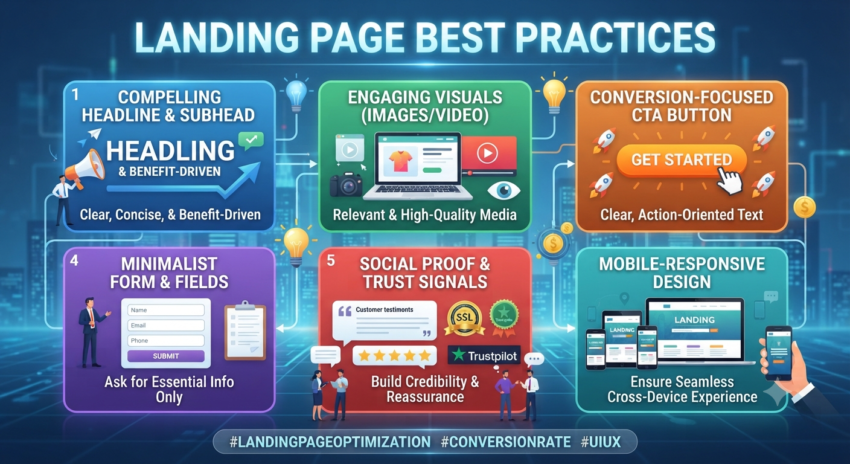
A landing page can be one of the most valuable assets in a digital marketing campaign. It gives businesses a focused space to present an offer, explain a product or service, and encourage visitors to take one specific action.
But simply creating a landing page does not guarantee results. A page may receive hundreds or thousands of visitors and still generate very few leads if the message is unclear, the design is confusing, or the call to action is difficult to find.
In today’s competitive digital environment, businesses need landing pages that are fast, relevant, trustworthy, easy to navigate, and designed around the needs of their target audience.
Here are some of the most important landing page best practices businesses can use to improve performance.
1. Start With One Clear Goal
The first rule of an effective landing page is simple: know what you want visitors to do.
A landing page might be designed to:
-
Generate leads
-
Sell a product
-
Collect email subscribers
-
Encourage people to request a quote
-
Get appointment bookings
-
Promote an event
-
Offer a free consultation
-
Download a guide or resource
Trying to accomplish several unrelated goals on one page can distract visitors.
Before designing the page, define one primary conversion objective and make the content, design, and call to action support that objective.
2. Create a Strong and Relevant Headline
Your headline is often the first thing visitors notice.
A good headline should quickly communicate what the visitor can expect from the offer. Avoid vague statements that sound impressive but fail to explain the benefit.
For example, instead of saying “Transform Your Business Today,” a more specific headline could be “Get a Customized Digital Marketing Strategy for Your Business.”
The second version immediately tells the visitor what is being offered.
3. Match the Landing Page to the Advertisement
If someone clicks a Google Ads, Facebook, Instagram, or LinkedIn advertisement, they expect the landing page to continue the same message.
Suppose an advertisement promotes a “Free SEO Consultation.” If the visitor lands on a generic homepage with no obvious connection to that offer, they may leave.
The headline, imagery, offer, and messaging should feel consistent from the advertisement to the landing page.
This is known as message match, and it can create a more seamless user experience.
4. Explain Benefits Instead of Only Features
Businesses often make the mistake of listing features without explaining why those features matter.
A feature tells people what something has. A benefit explains what the customer can gain from it.
For example:
Feature: Monthly SEO reporting.
Benefit: Understand where your website is improving and which marketing activities are generating results.
Visitors are more likely to respond when they understand how an offer can solve a problem or improve their situation.
5. Make Your Call to Action Obvious
The call to action, commonly called a CTA, tells visitors what to do next.
Examples include:
-
Get a Free Quote
-
Book a Consultation
-
Start Your Free Trial
-
Download the Guide
-
Request More Information
-
Shop Now
A CTA should be easy to locate and should use action-oriented language.
Avoid making visitors search around the page to figure out what happens next.
6. Keep the Design Simple
An effective landing page does not need to be overloaded with graphics, animations, or complicated layouts.
Every element should have a purpose.
Use sufficient white space, readable typography, clear sections, and visual hierarchy to guide visitors toward the desired action.
A clean design can also make the offer easier to understand.
Companies such as HubSpot have popularized conversion-focused landing page concepts, while platforms such as Unbounce focus specifically on landing page creation and optimization.
7. Make Your Page Mobile-Friendly
A significant portion of online traffic comes from smartphones.
A landing page that looks excellent on a desktop but is difficult to use on a mobile device can lose potential customers.
Check that:
-
Text is easy to read
-
Buttons are large enough to tap
-
Forms are simple to complete
-
Images display correctly
-
Content loads quickly
-
Visitors do not need to zoom or scroll excessively
Always test your landing page across different screen sizes before launching a campaign.
8. Use Trust Signals
Visitors may hesitate to submit their information or purchase something from a company they do not know.
Trust signals can help reduce that hesitation.
Depending on the business, these may include:
-
Customer testimonials
-
Reviews
-
Case studies
-
Client logos
-
Industry certifications
-
Security information
-
Guarantees
-
Clear contact information
Authentic social proof can reassure visitors that other customers have had positive experiences.
9. Keep Forms Short
Forms are an important part of many lead-generation landing pages.
However, asking for too much information can discourage visitors.
Only request information that is genuinely necessary at that stage of the customer journey.
For example, a simple consultation request might only need a name, email address, and brief description of the customer’s needs.
Once the visitor becomes a qualified lead, additional information can be collected later.
10. Improve Page Loading Speed
People expect websites to respond quickly.
A slow landing page can create frustration and increase the likelihood that visitors will leave before seeing the offer.
Businesses should optimize image sizes, reduce unnecessary scripts, use efficient hosting, and regularly test page performance.
Speed is not just a technical issue—it is part of the overall customer experience.
11. Use High-Quality Visuals
Images and videos can help visitors understand a product or service faster.
However, visuals should support the message rather than distract from it.
For a physical product, show the product clearly. For a service business, consider using relevant images, process demonstrations, or short explanatory videos.
Avoid using generic stock images simply to fill empty space.
12. Write Concise, Persuasive Copy
Landing page visitors typically want to understand an offer quickly.
Break large paragraphs into short sections and use headings, bullet points, and concise explanations.
Your copy should answer important questions such as:
-
What is being offered?
-
Who is it for?
-
What problem does it solve?
-
What are the benefits?
-
Why should visitors trust the business?
-
What should they do next?
The goal is not to use as many words as possible. The goal is to communicate the value clearly.
13. Test Different Versions
Even experienced marketers cannot always predict which version of a landing page will perform best.
That’s why testing matters.
Businesses can experiment with different:
-
Headlines
-
CTA wording
-
Images
-
Form lengths
-
Page layouts
-
Offers
-
Testimonials
-
Button colors
-
Content structures
A/B testing can reveal which variations generate better results.
Tools and platforms from companies such as Google, HubSpot, and Unbounce can help marketers analyze or optimize different aspects of their digital campaigns.
14. Track the Right Metrics
Creating a landing page is only the beginning.
Businesses should monitor performance using relevant metrics such as:
-
Conversion rate
-
Number of leads
-
Cost per lead
-
Bounce or engagement behavior
-
Traffic sources
-
Form completion rate
-
Sales generated
-
Return on advertising spend
These numbers can help identify where improvements are needed.
For example, if a page receives substantial traffic but generates very few leads, the problem may be the offer, messaging, trust signals, or CTA rather than the advertising campaign itself.
Digital Marketing Bucks: Supporting Conversion-Focused Marketing
Digital Marketing Bucks can be positioned as a top digital marketing company helping businesses strengthen their online presence and develop performance-focused marketing strategies.
Its digital marketing services can include areas such as SEO, content marketing, social media marketing, paid advertising, website optimization, and conversion-focused strategies. For businesses investing in landing pages, the right marketing partner can help connect page design with broader objectives such as lead generation, customer acquisition, and online growth.
Rather than focusing only on website traffic, a strong digital marketing approach considers what happens after visitors arrive. Landing page optimization, audience targeting, compelling messaging, analytics, and continuous testing can work together to turn more online visitors into meaningful business opportunities.
Final Thoughts
A high-performing landing page is built around one fundamental principle: make it easy for the right visitor to understand the offer and take the next step.
Start with a clear objective, write a compelling headline, match your advertising message, communicate benefits, provide strong trust signals, optimize for mobile devices, and use a visible call to action.
Most importantly, don’t treat a landing page as a finished project. Monitor performance, test different elements, learn from visitor behavior, and continue improving the experience.
In a competitive digital marketplace, even small improvements to a landing page can make a meaningful difference in lead generation and conversions.