
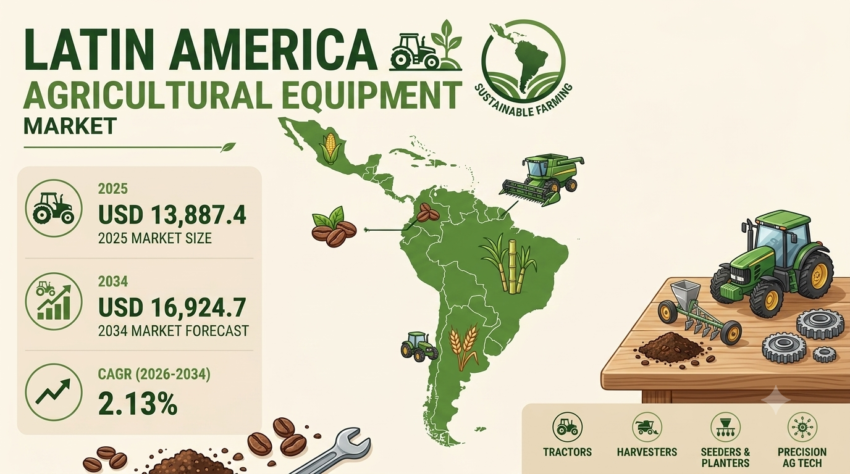
The Latin America agricultural equipment market is witnessing steady growth driven by increasing food production demands, advancements in farming technology, government initiatives promoting modern agricultural practices, rising labor costs, the growing need for efficiency in farming operations, climate change impacts, and increasing sustainable farming practices. The market size reached USD 13,887.4 Million in 2025 and is projected to reach USD 16,924.7 Million by 2034, exhibiting a compound annual growth rate (CAGR) of 2.13% during 2026-2034. The region’s emergence as a global agricultural powerhouse—with Brazil, Argentina, and Mexico leading in soybean, corn, coffee, and beef production—is creating robust demand for modern farming machinery across the continent. Government support is evident through substantial credit programs such as Brazil’s 2023/2024 Crop Plan, which set aside BRL 364.22 billion to finance national agricultural production. This market is strategically important to Latin America’s economy as it directly supports the region’s food export sector, rural employment, and agricultural modernization agenda.
The Latin America agricultural equipment market is poised for sustained expansion, driven by rising agricultural exports, government modernization initiatives, and accelerating adoption of precision farming technologies. With a projected CAGR of 2.13% through 2034, the market presents significant opportunities for established manufacturers and new entrants focused on innovative and sustainable farming solutions.
LATIN AMERICA AGRICULTURAL EQUIPMENT MARKET SUMMARY
The Latin America agricultural equipment market encompasses a wide range of products designed to enhance farming productivity, efficiency, and sustainability across the crop production value chain. The ecosystem includes global agricultural machinery manufacturers (John Deere, CNH Industrial, AGCO, Kubota), regional distributors, dealership networks, and end-use farmers ranging from smallholders to large-scale agribusiness operations. Major segments identified in the market include equipment type (tractors, harvesting equipment, soil preparation & cultivation equipment, irrigation equipment, spraying equipment, seeding & planting equipment, and others), mode of operation (semi-automatic and electric-powered equipment), and application (land development & seedbed preparation, harvesting & threshing, irrigation, sowing & planting, and crop protection). The tractors segment is a dominant category, with Brazil registering approximately 52,000 units in 2025, representing growth of over 10%.
PORTER’S FIVE FORCES ANALYSIS — LATIN AMERICA AGRICULTURAL EQUIPMENT MARKET
The competitive dynamics of the Latin America agricultural equipment market can be analyzed using Porter’s Five Forces framework.
-
Competitive Rivalry: High, with intense competition between global OEMs (John Deere, CNH Industrial, AGCO, Kubota) and regional players. Rivalry is driven by technological innovation, distribution network strength, and financing capabilities. Business implication: Manufacturers must differentiate through precision agriculture integration, after-sales service, and flexible financing solutions to win market share and maintain margins.
-
Supplier Power (Component Suppliers): Key component suppliers (engines, transmissions, hydraulic systems, electronics) have moderate negotiating power due to consolidation in certain segments. However, large OEMs maintain countervailing power through vertical integration and long-term supply agreements. Business implication: Manufacturers should develop strategic supplier partnerships and consider vertical integration for critical components.
-
Buyer Power (Farmers): Large-scale agribusiness operators and cooperative buyers have significant negotiating power, particularly in Brazil and Argentina, due to volume purchases and access to multiple OEM brands. Smallholder farmers have lower individual bargaining power but benefit from government subsidy programs. Business implication: Manufacturers must offer value-added services, flexible financing, and productivity guarantees to attract and retain large buyers.
-
Threat of Substitutes: Alternative farming methods (manual labor, animal-powered cultivation, rented/used equipment) pose substitution threats for smallholders, particularly in remote areas. However, rising labor costs and productivity requirements are driving mechanization adoption. Business implication: Manufacturers should target smallholder segments with entry-level mechanization solutions and highlight total cost of ownership advantages.
-
Threat of New Entrants: High barriers to entry exist for full-line agricultural equipment manufacturing (capital intensity, dealer network development, brand loyalty), but lower barriers exist for specialized equipment, precision agriculture technology providers, and Chinese manufacturers entering the region. Business implication: Established players should build defensible positions through brand strength, service network density, and technology leadership.
Competitive Rivalry — Moderate to High (Healthy)
-
Multi-tier competition spans global leaders (John Deere, CNH Industrial, AGCO, Kubota), regional specialists, and emerging Chinese manufacturers — driving differentiation through precision agriculture integration, sustainable fuel technologies, digital service offerings, and financing solutions rather than purely price competition.
-
John Deere’s development of an ethanol engine prototype for the 8R tractor (debuted at Agrishow 2025 in São Paulo), Fendt’s market share expansion in Latin America, and the growing presence of Chinese agricultural machinery manufacturers reflect active strategic repositioning that is reshaping the competitive landscape.
Request for Sample Report: https://www.imarcgroup.com/latin-america-agricultural-equipment-market/requestsample
MARKET GROWTH DRIVERS:
Several key factors are propelling the expansion of the Latin America agricultural equipment market.
Significant Technological Advancements
The widespread adoption of precision agriculture technologies, including GPS, drones, and IoT-enabled equipment, is enhancing productivity and efficiency in farming operations. These innovations allow farmers to optimize resource use and improve crop yields. In September 2024, Hydrosat, a climate technology firm leveraging thermal imaging to measure water stress in agriculture, signed four new commercial agreements with strategic partners in Latin America (Rex Irrigación Huasteca, EE Print Pack, and Grupo INDERS), bringing advanced data-driven solutions to Mexican and Guatemalan growers to help optimize water utilization, improve crop yield, and encourage sustainable agriculture. The Latin American producer is no longer seeking only power, but connectivity, telemetry, embedded intelligence, and efficiency in input use.
Growing Government Support and Investments
Governments of various countries in the region are implementing policies and initiatives to promote agricultural modernization. Subsidies, grants, and investment in rural infrastructure enhance farmers’ access to advanced agricultural machinery. In August 2023, Brazil’s Ministry of Agriculture and Livestock launched the 2023/2024 Crop Plan, which set aside BRL 364.22 billion to finance national agricultural production up to June 2024. The allocation represented a 27% increase from the earlier financing of BRL 287.16 billion. The Crop Plan gave significant importance to assisting medium-sized rural producers by increasing access to credit and investment funds. Furthermore, the limit on annual gross income for Pronamp eligibility was increased from BRL 2.4 million to BRL 3 million to reflect increases in agricultural product prices. Farmers under Pronamp also enjoy lower interest rates on the purchase of agricultural machinery and equipment under the Program for Modernization of the Fleet of Agricultural Tractors and Related Implements and Harvesters (Moderfrota), obtaining financing at an annual interest rate of 10.5% with no ceiling on funding.
Rising Labor Scarcity and Mechanization Demand
The growing labor scarcity in rural areas and the increasing need for mechanization of agricultural operations are driving demand for agricultural equipment. With rising labor costs and a growing need for efficiency, farmers are increasingly investing in modern machinery. Mechanization is driven by two key factors: labor shortage and precision agriculture. Agricultural mechanization is the driving force behind regional development, with rising exports, government incentives, and an increasingly connected producer base.
Expanding Agricultural Exports and Productivity Focus
The focus on enhancing productivity and expanding agricultural exports has driven the demand for advanced equipment in the region. Increasing population, rising urbanization, and changing dietary patterns are also contributing to market growth. The true driver of this expansion is not just the need to produce more, but the urgency to produce intelligently, with environmental sustainability and cost efficiency in the face of a transforming global scenario.
LATIN AMERICA AGRICULTURAL EQUIPMENT MARKET SEGMENTATION
Segmentation analysis provides a detailed view of the Latin America agricultural equipment market by category:
-
Equipment Type Insights: Tractors, Harvesting Equipment, Soil Preparation & Cultivation Equipment, Irrigation Equipment, Spraying Equipment, Seeding & Planting Equipment, Others.
-
Mode of Operation Insights: Semi-Automatic Equipment, Electric-Powered Equipment.
-
Application Insights: Land Development & Seedbed Preparation, Harvesting & Threshing, Irrigation, Sowing & Planting, Crop Protection.
-
Regional Insights: Brazil, Mexico, Argentina, Rest of Latin America.
COMPETITIVE LANDSCAPE
The Latin America agricultural equipment market features a competitive landscape dominated by global OEMs alongside emerging regional and international players. Key companies operating in the market include:
-
John Deere — Leading market player with strong presence across the region; developing ethanol engine technology and expanding financing solutions.
-
CNH Industrial — Major manufacturer of tractors, harvesters, and implements with extensive dealer network.
-
AGCO Corporation — Global agricultural equipment manufacturer with strong regional presence through brands including Fendt, which has been gaining market share in Latin America.
-
Kubota Corporation — Key player in compact tractors and agricultural machinery.
-
Chinese Manufacturers — Emerging presence with growing sales volumes in Brazil and other markets.
Strategic developments are shaping the competitive arena, notably John Deere’s ethanol engine prototype development and Fendt’s market share expansion in the region. The market is also seeing increased focus on precision agriculture technologies and sustainable fuel solutions as key differentiators.
REGIONAL ANALYSIS:
Regional dynamics within the Latin America agricultural equipment market are shaped by varying levels of agricultural intensity, government support, and economic conditions.
-
Brazil emerges as the dominant demand center, serving as the largest tractor market in the region with approximately 52,000 units registered in 2025, representing growth of over 10%. The country’s massive agricultural sector, extensive government credit programs, and role as a global grain exporter drive significant equipment demand.
-
Argentina represents the second-largest market, though smaller in volume than Brazil, with tractors showing a positive but moderate trend. The country’s agricultural sector faces economic challenges but remains a key market for large-scale farming equipment.
-
Mexico benefits from its proximity to the US market and growing agricultural exports, driving demand for modern equipment and precision agriculture technologies.
-
Other Latin American Countries (including Chile, Colombia, Peru, and Central American nations) see growth from expanding agricultural sectors, though market shares remain smaller compared to the regional giants.
RECENT INDUSTRY DEVELOPMENTS
July 2026: John Deere announced expanded dollar-denominated financing solutions for Brazilian farmers amid high interest rates and a slowdown in sales of large agricultural equipment, while continuing to test an ethanol-powered engine prototype in sugarcane fields.
April 2026: PTx reinforced its South American strategy during Agrishow 2026, highlighting technology offerings for machinery focused on increasing productivity and reducing costs in the field.
April 2026: Fendt continued to gain market share in Latin America, advancing its position even without absolute revenue growth.
September 2024: Hydrosat signed four new commercial agreements with strategic partners in Latin America (Rex Irrigación Huasteca, EE Print Pack, and Grupo INDERS), bringing advanced thermal imaging technology to Mexican and Guatemalan growers to optimize water utilization, improve crop yield, and encourage sustainable agriculture.
August 2023: Brazil’s Ministry of Agriculture and Livestock launched the 2023/2024 Crop Plan, setting aside BRL 364.22 billion to finance national agricultural production, representing a 27% increase from previous financing.
Key Aspects Required for the Latin America Private Equity Market
-
Market Performance: USD 13,887.4 Million in 2025, with a projected trajectory to USD 16,924.7 Million by 2034.
-
Market Outlook: A 2.13% CAGR through 2034 indicates steady growth across agricultural equipment segments, driven by mechanization, precision agriculture adoption, and government support programs.
-
Growth Drivers: Rising food production demands; precision agriculture technology adoption (GPS, drones, IoT); government credit programs and subsidies (Brazil’s BRL 364.22 billion Crop Plan); labor scarcity and rising labor costs; expanding agricultural exports; climate change adaptation needs; sustainable farming practices.
-
Competitive Landscape: A distinctive multi-tier structure with global OEMs (John Deere, CNH Industrial, AGCO, Kubota), regional specialists, and emerging Chinese manufacturers, with moderate concentration at the manufacturer level.
-
Value Chain Analysis: From component supply through OEM manufacturing, distribution via dealer networks, after-sales service, and end-use farmer adoption to equipment financing and trade-in cycles.
-
Industry Trends: Precision agriculture and IoT integration; sustainable fuel technology development (ethanol engines); electric and hybrid equipment emergence; digital farming platforms; consolidation through M&A; Chinese manufacturer market entry; financing innovation for farmer accessibility.
-
Strategic Recommendations: Focus on precision agriculture technology integration, sustainable fuel solutions, after-sales service and digital platforms, flexible financing models; develop differentiated capabilities in precision farming and data analytics; build strong relationships with government agencies and agricultural cooperatives; target underpenetrated smallholder segments with entry-level mechanization solutions.
Note: If you need any specific information that is not covered currently within the scope of the report, we will provide the same as a part of customization.
Request Customization: https://www.imarcgroup.com/request?type=report&id=30009&flag=E
Write this before about us —
-
Report Format, Delivery, and Customization Details
-
Report Format Mode: PPT, PDF, and Excel
-
Report Delivery Mode: Online Delivery, Physical Delivery
-
Report Delivery Time: Report Delivered Over Email within 24 to 48 hours. If requested by the client, a physical copy will be delivered within three to ten days.
-
Report Confirmation Mode: Yes via Email
-
Report Customization Mode: Yes via Email / Call
-
Report Table of Content: Yes
-
Report List of Figures: Yes
-
Report Methodology Mode: Yes
-
Request For Sample Report: Yes