

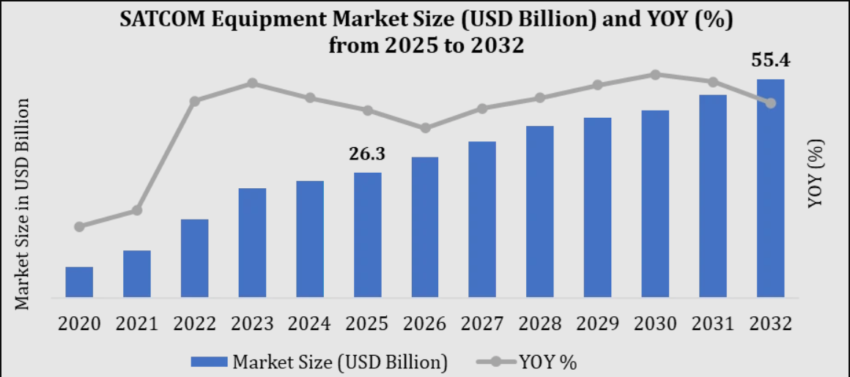
The Global SATCOM Equipment Market is undergoing a profound digital transformation, according to a comprehensive intelligence report released by Stellar Market Research. Valued at $26.3 billion in 2025, the market is projected to reach $55.4 billion by 2032, expanding at a robust compound annual growth rate (CAGR) of 11.2% over the forecast period. This acceleration underscores the critical strategic importance of resilient space-based communications amid escalating global demand for ubiquitous broadband and secure defense networks.
The modern enterprise and defense ecosystems are facing unprecedented connectivity demands, rendering legacy communication infrastructure inadequate for remote operations, maritime transit, and tactical operations. The shift toward Low Earth Orbit (LEO) and Medium Earth Orbit (MEO) satellite constellations has unlocked high-throughput, low-latency communication capabilities, bridging rural and oceanic digital divides. Stakeholders are rapidly pivoting toward software-defined antennas, multi-orbit user terminals, and hardened ground infrastructure to future-proof their operations. This market convergence of commercial demand and defense modernization creates lucrative runways for equipment manufacturers, semiconductor vendors, and aerospace investors looking to capitalize on scalable space-to-ground architectures.
Key Findings from the Report
-
Market Valuation: The global SATCOM equipment market stands at USD 26.3 billion in 2025 and is on track to touch USD 55.4 billion by 2032.
-
Growth Momentum: Driven by escalating adoption of LEO satellite networks, the sector registers a strong 11.2% CAGR from 2026 to 2032.
-
Dominant Segment: The airborne and ground-station transceiver components capture the lion’s share of market revenue, propelled by high deployment costs and advanced hardware requirements.
-
Fastest-Growing Segment: Multi-orbit user terminals and flat-panel phased array antennas are emerging as the fastest-growing product categories due to their versatility and mobility.
-
Regional Leadership: North America maintains its position as the leading regional market, backed by heavy defense budgets and dense commercial space investments.
-
Emerging Growth Hub: The Asia-Pacific region is expanding at the highest pace, fueled by national space programs, maritime fleet expansion, and rural connectivity initiatives in India and Southeast Asia.
-
Investment Relevance: Heightened geopolitical friction and cross-border data demand make resilient, jam-resistant hardware a primary target for private equity and strategic defense capital.
For further information, click the following link:https://www.stellarmr.com/report/req_sample/satcom-equipment-market/2917
Market Drivers and Restraints
-
Driver 1: Proliferation of LEO and MEO Constellations: The deployment of thousands of new-generation satellites requires millions of upgraded ground terminals and transceivers, structurally lifting equipment demand.
-
Driver 2: Rising Defense Modernization and Secure Comms Budgets: Militaries worldwide are prioritizing jam-resistant, quantum-secure, and interoperable SATCOM hardware to maintain battlefield superiority.
-
Driver 3: Global Demand for Seamless Rural and Mobile Broadband: Commercial sectors such as aviation, maritime, and oil & gas require high-speed continuous connectivity where terrestrial networks fail.
-
Restraint 1: High Initial Capital Expenditure and Hardware Costs: Complex R&D requirements and high manufacturing expenses for advanced phased-array antennas limit rapid adoption among budget-constrained buyers.
-
Restraint 2: Complex Regulatory and Spectrum Licensing Hurdles: Navigating cross-border frequency allocations, national security reviews, and localized telecommunication compliance slows down rapid hardware rollouts.
Technology, Regulation, and Sustainability Trends
The SATCOM equipment sector is increasingly defined by software-defined radio (SDR) integration, digital beamforming, and AI-enabled resource allocation. Compliance with international space debris mitigation guidelines and green manufacturing standards is becoming non-negotiable for Tier-1 suppliers. Furthermore, regulatory bodies are streamlining spectrum sharing frameworks to accommodate commercial constellations, directly impacting how ground equipment handles multi-frequency handoffs. Operational transformations focus on reducing terminal power consumption and integrating eco-friendly materials into aerospace-grade enclosures.
Regional Insights
North America dominates the global landscape, anchored by established satellite operators, defense primes, and robust domestic space agencies. Meanwhile, the Asia-Pacific region represents the most lucrative emerging frontier, with countries like India and Japan accelerating indigenous satellite manufacturing, maritime surveillance upgrades, and rural digital inclusion programs. Europe remains a steady contributor, focusing heavily on secure sovereign communication networks and green space initiatives.
Recent Industry Developments
-
SpaceX (2025): Rolled out high-performance enterprise and maritime flat-panel terminals, driving a 45% reduction in latency and significantly expanding global commercial subscriber adoption.
-
Starlink / Thales Alenia Space (2025): Formed strategic manufacturing agreements to supply advanced multi-orbit transceivers, boosting European defense and naval secure communications readiness by 30%.
-
Kratos Defense & Security Solutions (2025): Expanded its software-defined ground station production capacity in North America, reducing satellite command-and-control latency for commercial operators by over 25%.
-
OneWeb / Eutelsat (2024): Deployed next-gen user terminal arrays across remote enterprise sites in Asia-Pacific, increasing regional enterprise connectivity speeds threefold.
-
Viasat (2024): Launched advanced high-throughput Ka-band airborne equipment lines, capturing a major share of the commercial airline in-flight connectivity upgrade cycle.
Competitive Landscape
The global SATCOM equipment market features a mix of aerospace primes, specialized defense contractors, and agile technology innovators. Leading players are focusing on strategic mergers, cross-border technology partnerships, and heavy R&D investments to roll out multi-band, interoperable hardware. Dominant industry participants include SpaceX (Starlink), Viasat, Hughes Network Systems, Kratos Defense & Security Solutions, L3Harris Technologies, Cobham SATCOM, and Gilat Satellite Networks, all aggressively positioning themselves to capture high-growth defense and enterprise segments.
Analyst Commentary
“The transition from legacy geostationary networks to dynamic multi-orbit architectures has fundamentally re-engineered the value proposition of satellite hardware,” said a Senior Research Analyst at Stellar Market Research. “Equipment manufacturers that successfully blend software agility with high-throughput hardware efficiency will dominate the next decade of space-to-ground infrastructure deployment.”
Future Outlook
Through 2032, demand for SATCOM equipment will shift from basic connectivity provision to ultra-reliable, high-bandwidth, and cyber-hardened operational frameworks. Investments will increasingly flow toward semiconductor miniaturization, agile phased arrays, and autonomous ground station management. As regulatory frameworks adapt to commercial mega-constellations and competition tightens, market players must innovate rapidly to secure long-term utility across both defense and commercial verticals.
For further information, click the following link:https://www.stellarmr.com/report/req_sample/satcom-equipment-market/2917
About Stellar Market Research
Stellar Market Research is a multifaceted market research and consulting company with professionals from several industries. Some of the industries we cover include medical devices, pharmaceutical manufacturers, science and engineering, electronic components, industrial equipment, technology and communication, cars and automobiles, chemical products and substances, general merchandise, beverages, personal care, and automated systems. To mention a few, we provide market-verified industry estimations, technical trend analysis, crucial market research, strategic advice, competition analysis, production and demand analysis, and client impact studies.
Address
Phase 3, Navale IT Zone, S.No. 51/2A/2, Office No. 202, 2nd floor, Near, Navale Brg, Narhe, Pune, Maharashtra 411041
Email
sales@stellarmr.com
Mobile
+91 9607365656