
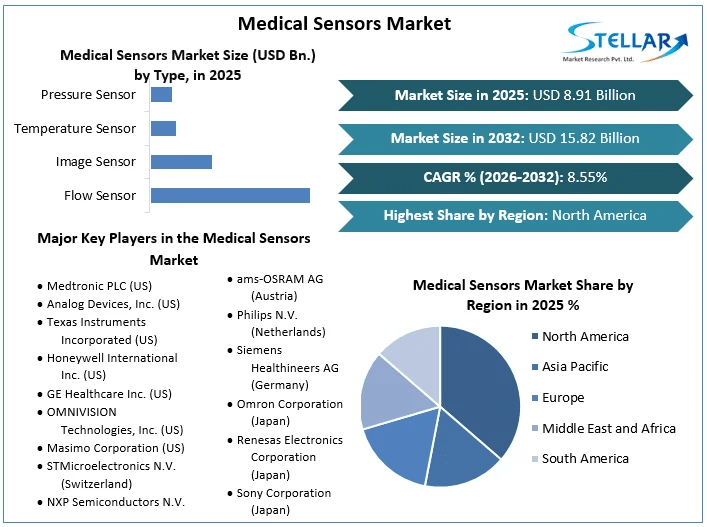
The global Medical Sensors Market is expanding at a transformative pace, driven by unprecedented advancements in remote patient monitoring and miniaturized diagnostic devices. According to a comprehensive market intelligence evaluation by Stellar Market Research, the sector is experiencing a structural pivot toward wireless, AI-integrated healthcare solutions that redefine precision diagnostics and chronic disease management.
Modern healthcare is undergoing a paradigm shift from centralized hospital infrastructure to decentralized, home-based, and ambulatory care models. At the heart of this transformation is the medical sensor—acting as the primary digital nerve ending that captures vital physiological telemetry in real-time. The escalating prevalence of chronic lifestyle disorders, coupled with an aging global demographic, has catalyzed investor and manufacturer focus toward biocompatible, low-power, and highly accurate sensor architectures. Stakeholders are aggressively deploying capital into flexible electronics and smart implantable platforms, opening lucrative avenues for high-margin medical technology integration.
Key Findings from the Report
-
Market Trajectory: The global medical sensors market is projected to expand significantly, backed by a steady double-digit compound annual growth rate (CAGR) throughout the forecast timeframe.
-
Dominant Segment: Image sensors and pressure sensors lead revenue generation, sustained by heavy hospital deployment in advanced diagnostic imaging and intensive care unit (ICU) equipment.
-
Fastest-Growing Segment: Wearable blood glucose monitors and continuous ECG patches are exhibiting the fastest expansion rates, fuelled by consumer-driven preventive healthcare trends.
-
Regional Dominance: North America continues to hold the largest revenue share, underpinned by robust healthcare expenditure and early clinical adoption of advanced IoT-enabled medical tech.
-
Emerging Hotspot: The Asia-Pacific region is registering the fastest regional growth, accelerated by expanding healthcare infrastructure in emerging economies like India and China.
-
Demand Indicator: A surge in hospital-at-home initiatives has directly escalated OEM orders for non-invasive, disposable multi-parameter sensors.
-
Investment Relevance: Venture capital and private equity deployment target smart sensor startups specializing in wireless telemetry and AI-driven clinical analytics integration.
For further information, click the following link:https://www.stellarmr.com/report/req_sample/medical-sensors-market/2331
Market Drivers and Restraints
-
Driver 1: Proliferation of Remote Patient Monitoring (RPM): The post-pandemic normalization of telehealth has permanently elevated demand for continuous, home-use health trackers that transmit patient vital signs directly to clinical dashboards.
-
Driver 2: Miniaturization and Nanotechnology Integration: Advances in material science allow sensors to become smaller, more flexible, and less invasive, vastly improving patient comfort during long-term monitoring.
-
Driver 3: Government Digital Health Initiatives: Favorable reimbursement policies and national digital health blueprints in major economies encourage healthcare providers to upgrade to connected medical infrastructure.
-
Restraint 1: Stringent Regulatory Compliance Barriers: Lengthy approval cycles and rigorous FDA/CE-MDR certification standards impose high initial R&D costs and time-to-market delays for sensor manufacturers.
-
Restraint 2: Data Privacy and Cybersecurity Vulnerabilities: The wireless transmission of sensitive patient telemetry exposes connected medical devices to potential cyber threats, demanding costly encryption and security overheads.
Technology, Regulation, and Sustainability Trends
The convergence of artificial intelligence with medical sensors is enabling predictive diagnostics, where edge-computing chips embedded in sensors detect anomalies before clinical symptoms manifest. Regulatory bodies such as the US FDA and the European Commission are simultaneously tightening cybersecurity frameworks for software-as-a-medical-device (SaMD) and connected hardware. On the sustainability front, medical device manufacturers face growing ESG pressures to reduce single-use plastic waste, prompting innovations in biodegradable sensor substrates and eco-friendly packaging alternatives without compromising sterility or clinical precision.
Regional Insights
North America commands the primary market share, anchored by advanced healthcare reimbursement models, a high concentration of tier-one medical device OEMs, and early adoption of digital health ecosystems. Meanwhile, Asia-Pacific is emerging as the dynamic growth engine of the global landscape. Countries like China, India, and Japan are experiencing rapid modernization of public health systems, rising disposable incomes, and an influx of domestic manufacturing investments geared toward affordable, high-precision diagnostics.
Recent Industry Developments
-
Medtronic (2025): Launched an advanced continuous glucose monitoring (CGM) sensor ecosystem with enhanced AI-driven predictive alert algorithms, expanding its recurring revenue base across North American clinical networks.
-
Analog Devices, Inc. (2025): Announced a strategic capacity expansion and manufacturing partnership for ultra-low-power vital sign monitoring chips, driving down component costs for portable medical device OEMs.
-
Abbott Laboratories (2024): Received expanded CE Mark approval for its next-generation biowearable sensor platform, enabling multi-analyte tracking capabilities for remote cardiovascular and metabolic care.
-
STMicroelectronics (2024): Unveiled a breakthrough high-precision inertial measurement sensor line tailored for tremor-suppression surgical instruments and smart orthopedic implants, boosting surgical accuracy.
-
GE HealthCare (2025): Completed the acquisition of a specialized digital patient-monitoring sensor startup to bolster its integrated acute-care portfolio and streamline real-time hospital telemetry workflows.
Competitive Landscape
The competitive environment is characterized by intense consolidation and strategic R&D investments by multinational giants, alongside agile pure-play sensor developers. Major market participants—including Medtronic, Analog Devices, Abbott Laboratories, TE Connectivity, and Honeywell International—are focusing on inorganic growth through strategic mergers, acquisitions, and cross-industry technology partnerships. Leading players are differentiating their product portfolios by integrating proprietary AI analytics software directly with multi-parameter sensor hardware to secure long-term hospital enterprise contracts.
Analyst Commentary
“The medical sensors market is no longer just about hardware sensitivity; it is evolving into an intelligent edge-computing ecosystem,” said a Senior Research Analyst at Stellar Market Research. “As healthcare systems globally shift toward proactive and decentralized care models, manufacturers that successfully embed predictive AI analytics and ultra-low-power wireless connectivity into their sensor architectures will capture the highest market valuation.”
Future Outlook
Through the forecast period, the global medical sensors market will witness sustained expansion, propelled by the convergence of 5G infrastructure, continuous health monitoring, and personalized medicine. Investment activity will pivot toward biocompatible, long-term implantable sensors and green manufacturing practices. While regulatory hurdles will remain a checkpoint for market entrants, escalating demand for hospital-grade home healthcare solutions ensures that medical sensors will remain a cornerstone of modern medical technology innovation.
For further information, click the following link:https://www.stellarmr.com/report/req_sample/medical-sensors-market/2331
About Stellar Market Research
Stellar Market Research is a multifaceted market research and consulting company with professionals from several industries. Some of the industries we cover include medical devices, pharmaceutical manufacturers, science and engineering, electronic components, industrial equipment, technology and communication, cars and automobiles, chemical products and substances, general merchandise, beverages, personal care, and automated systems. To mention a few, we provide market-verified industry estimations, technical trend analysis, crucial market research, strategic advice, competition analysis, production and demand analysis, and client impact studies.
Address
Phase 3, Navale IT Zone, S.No. 51/2A/2, Office No. 202, 2nd floor, Near, Navale Brg, Narhe, Pune, Maharashtra 411041
Email
sales@stellarmr.com
Mobile
+91 9607365656