

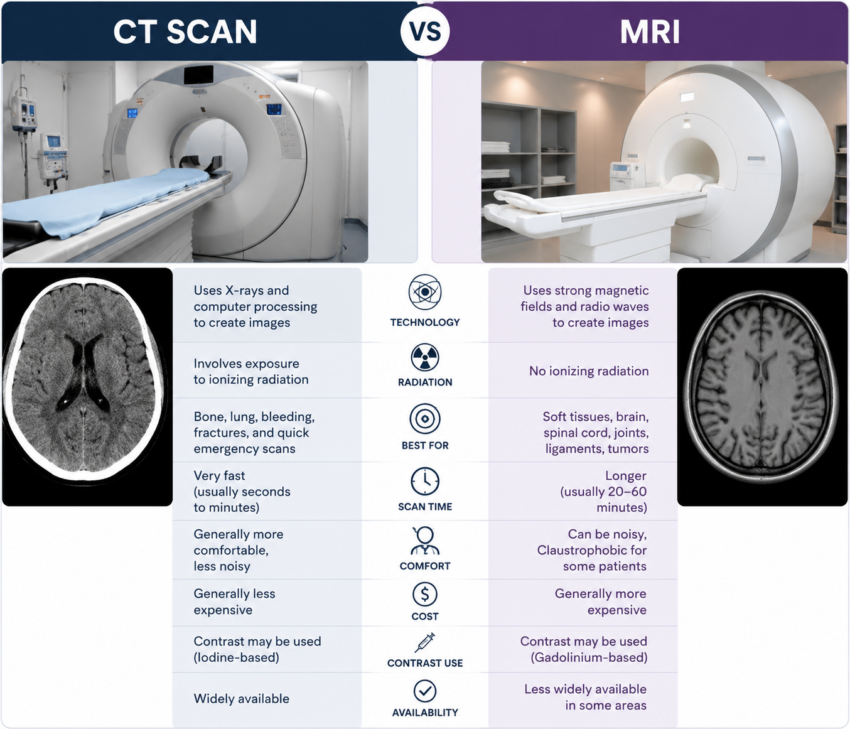
Medical imaging plays a vital role in diagnosing and monitoring various health conditions. Among the most commonly used imaging techniques are Magnetic Resonance Imaging (MRI) and Computed Tomography (CT) scans. While both methods help doctors view internal structures of the body, they differ significantly in technology, purpose, and application. Understanding the differences between Mri vs ct scan can help patients make informed decisions about their healthcare.
What is an MRI Scan?
MRI, or Magnetic Resonance Imaging, uses powerful magnets and radio waves to create detailed images of organs, tissues, muscles, and nerves inside the body. Unlike CT scans, MRI does not use ionizing radiation. The machine generates high-resolution images that allow doctors to detect abnormalities in soft tissues with exceptional clarity.
MRI scans are commonly used to examine the brain, spinal cord, joints, ligaments, muscles, heart, and internal organs. They are especially useful for diagnosing conditions such as tumors, multiple sclerosis, ligament injuries, strokes, and spinal disorders.
What is a CT Scan?
A CT (Computed Tomography) scan combines multiple X-ray images taken from different angles to create detailed cross-sectional images of the body’s internal structures. The computer processes these images to provide a comprehensive view of bones, organs, blood vessels, and tissues.
CT scans are often used in emergency situations because they are quick and effective in identifying fractures, internal bleeding, infections, tumors, and injuries caused by accidents. They are also commonly used to detect lung diseases, abdominal conditions, and certain cancers.
Key Differences Between MRI and CT Scan
- Technology Used
- MRI: Uses magnetic fields and radio waves.
- CT Scan: Uses X-rays and computer technology.
- Radiation Exposure
- MRI: No radiation exposure.
- CT Scan: Involves exposure to ionizing radiation.
- Image Quality
- MRI: Provides superior images of soft tissues, muscles, nerves, and the brain.
- CT Scan: Produces excellent images of bones, blood vessels, and internal organs.
- Scan Duration
- MRI: Typically takes 20 to 60 minutes.
- CT Scan: Usually completed within 5 to 15 minutes.
- Cost
- MRI: Generally more expensive due to advanced technology and longer scan times.
- CT Scan: Usually more affordable and widely available.
When is an MRI Preferred?
Doctors may recommend an MRI when detailed images of soft tissues are required. MRI is commonly used for:
- Brain and spinal cord disorders
- Sports injuries involving ligaments and tendons
- Joint problems
- Tumor detection
- Heart and blood vessel evaluations
- Neurological conditions
MRI is often the preferred option when radiation exposure needs to be avoided, especially for younger patients requiring repeated imaging.
When is a CT Scan Preferred?
CT scans are ideal when speed is critical or when evaluating bone structures and trauma-related injuries. Common uses include:
- Emergency injury assessments
- Bone fractures
- Internal bleeding
- Lung diseases
- Cancer screening and staging
- Abdominal and chest examinations
Because CT scans are fast, they are frequently used in emergency departments and trauma centers.
Advantages and Limitations
MRI Advantages
- No radiation exposure
- Excellent soft tissue detail
- Highly accurate for neurological and musculoskeletal conditions
MRI Limitations
- Longer scan times
- Higher cost
- Not suitable for some patients with metal implants or severe claustrophobia
CT Scan Advantages
- Fast imaging process
- Excellent for bone and trauma assessment
- Widely available
CT Scan Limitations
- Uses radiation
- Less detailed soft tissue imaging compared to MRI
Conclusion
Both MRI and CT scans are valuable diagnostic tools that serve different medical purposes. MRI is generally preferred for detailed imaging of soft tissues, while CT scans are often the first choice for emergency situations, bone injuries, and rapid diagnosis. The choice between MRI and CT depends on the patient’s condition, the area being examined, and the doctor’s recommendation. Consulting a healthcare professional will ensure the most appropriate imaging method is selected for accurate diagnosis and effective treatment.