

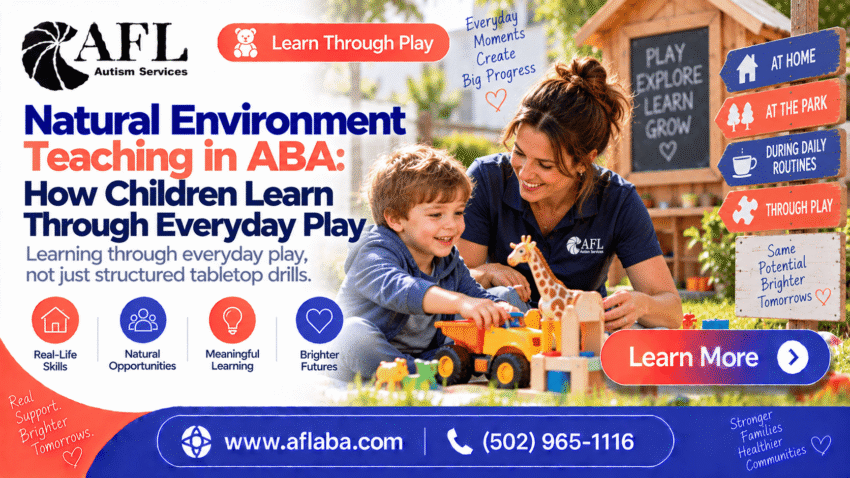
Beyond the Table
The image many parents hold of ABA therapy is a child at a table, an adult opposite, repeated trials and a token board. That describes discrete trial training, which is one method within applied behavior analysis not the whole of it.
Natural environment teaching takes the same principles and applies them inside play, routines and ordinary activity.
How It Works
The therapist follows the child’s interest. If a child reaches for bubbles, that moment becomes an opportunity to teach requesting. If a child is building a tower, that becomes an opportunity to teach colour labels, turn-taking or requesting more.
The reinforcement is the natural outcome the bubbles, the next block rather than an arbitrary token. This is why the learning tends to hold.
Everyday Examples of Natural Environment Teaching
Natural environment teaching looks different from one child to the next, because it starts with whatever the child already wants. At snack time, a therapist might hold back the crackers until the child signals for more, then respond straight away. During a game of chase, the adult pauses mid-run and waits for the child to say or gesture “go.” In a sensory bin, a therapist can teach words like scoop, pour and more by narrating what the child is doing, then offering the next item once the child asks for it.
Each of these moments is short, playful and hard to tell apart from ordinary play. The teaching is built into the activity, so the child rarely feels they are being tested. Parents can spot the same pattern at home. Bath time, getting dressed and loading the car all contain small chances to practise a skill.
Why Generalisation Improves
A skill learned only at a table with one therapist often stays at that table. Skills taught within varied natural contexts are practised across settings, people and materials from the outset.
Since generalisation is where many programmes fail, this is not a minor advantage.
Skills Natural Environment Teaching Can Build
Natural environment teaching is useful across many areas of development, not only language. Therapists commonly use it to build:
- Requesting and commenting, from gestures and single words to full sentences
- Play skills, including pretend play and playing alongside peers
- Social skills such as turn-taking, sharing and responding to a name
- Daily living skills, like washing hands or putting on a coat, taught during the real routine
Because these skills are taught where they are needed, children often start using them without extra prompting. Learning to ask for help while stuck on a real zip is more likely to carry over than practising the same phrase at a table.
When Structured Teaching Is Still Better
Naturalistic teaching is not universally superior. Some skills need high repetition in a low-distraction setting to establish at all early imitation, some receptive language, certain academic skills.
Most good programmes blend both, using structured teaching to establish a skill and natural teaching to generalise it. Ask your BCBA what the balance is for your child and why.
What a Session Can Look Like in a Clinic
A clinic day usually mixes structured work with naturalistic time. A child might spend part of the morning on focused teaching, then move to play, snack and movement activities where the therapist uses the same targets in a more relaxed way. Families exploring clinic-based ABA therapy often assume everything happens at a table, but good clinic programmes plan for both. Transitions between activities are also teaching moments, such as asking a child to request the next toy or choose where to go next. A BCBA designs and reviews these plans, adjusting them as the child’s needs change.
Using the Approach at Home
Set up the environment so your child has to communicate a preferred item in sight but out of reach, a snack in a container they cannot open. Then wait. The pause is the technique most parents skip.
Respond to any communicative attempt, including gestures and approximations, and deliver the natural consequence immediately. Keep it short and frequent rather than long and formal.
What Progress Looks Like
Watch for spontaneous initiations rather than prompted responses. A child who requests without being asked a question has made the more meaningful gain.
Ask your team to track spontaneous versus prompted responses separately. The ratio between them is one of the most informative numbers in a programme.
Common Myths About Natural Environment Teaching
One myth is that it is just play with no goals. In practice, every activity has a defined target, and the therapist records data on it. Another is that it means no structure. The session is planned, even if it feels relaxed. A third is that it only suits verbal children. Children who use gestures, pictures or a communication device can learn through it, because the aim is to give every attempt to communicate a real result.
Questions to Ask Your Team
It helps to go into a meeting with your child’s team prepared. Useful questions include:
- Which of my child’s goals are taught through natural environment teaching, and which are taught at the table?
- How is spontaneous communication measured?
- What can we practise at home between sessions?
- How will you tell me when a skill is ready to move from structured to natural teaching?
A good team will answer these plainly and show you the data behind their answers.
Putting It Into Practice
Natural environment teaching is a practical way to help children use new skills in real life, not only in therapy. Whichever approach your child receives, the goal stays the same: skills that last beyond the therapy room and fit into family life. If you would like to see how it works in practice, you can find all AFL clinic locations and speak with a team who can explain how your child’s programme would be shaped.
Frequently Asked Questions
Is natural environment teaching less rigorous than discrete trial training?
No. It applies the same behavioural principles with the same data collection, within natural activity rather than at a table.
Can parents use these techniques?
Yes. Environmental arrangement and waiting for initiation are among the most teachable and effective parent strategies.
Which approach will my child receive?
Most programmes blend both. Your BCBA should be able to explain the balance chosen for your child.
Does this happen in a clinic setting?
Yes. Clinic-based programmes include naturalistic teaching during play, snack, movement and transition times.
About the Provider
Adapt For Life AFL Autism Services
Adapt For Life provides applied behavior analysis therapy, autism diagnostic services and speech therapy for children and families across Indiana, Kentucky, North Carolina and Illinois. Programmes are designed and supervised by Board Certified Behavior Analysts and built around each child’s individual assessment.
Address: Clinic locations across Indiana, Kentucky, North Carolina and Illinois
Phone: (317) 383-0188
Email: aflinfo@adaptforlifeaba.com
Hours: Monday Friday, 8:00 AM 5:00 PM
Services: Clinic-Based ABA Therapy, Autism Diagnostic Services, Speech Therapy
Website: https://aflaba.com/locations/
To book an assessment, call (317) 383-0188, email aflinfo@adaptforlifeaba.com or visit Adapt For Life Autism Services.