
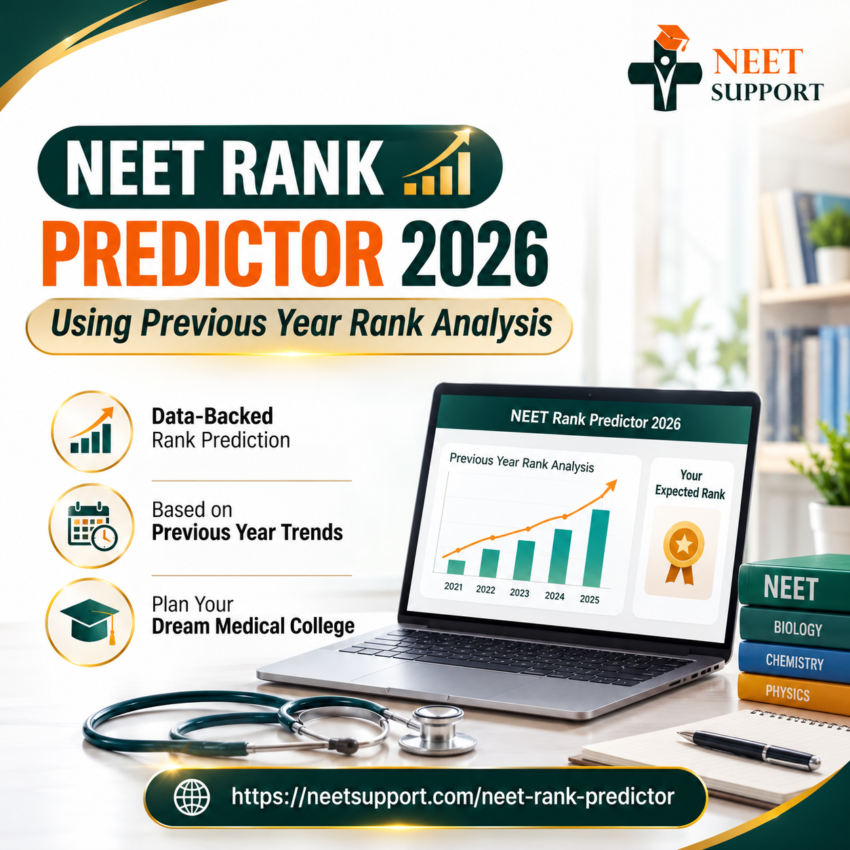
Every year, millions of students appear for the National Eligibility cum Entrance Test (NEET) with the goal of securing admission to top medical colleges in India. Once the examination is over, the focus shifts from calculating marks to estimating the All India Rank (AIR). Since the official results take time to be announced, many aspirants use a NEET Rank Predictor to understand where they may stand in the competition. One of the most reliable methods used by modern prediction tools is previous year rank analysis.
A NEET Rank Predictor 2026 analyzes your expected NEET marks along with historical marks-versus-rank trends to estimate your probable AIR. Instead of relying on a simple score chart, advanced prediction systems compare data from previous years, examine competition levels, evaluate exam difficulty, and study counselling trends. This provides students with a realistic estimate that helps them prepare for MBBS counselling well before the official results are declared.
Although no prediction tool can guarantee your exact official rank, using a NEET Rank Predictor by Marks based on previous year analysis offers valuable guidance for smarter admission planning.
What Is a NEET Rank Predictor?
A NEET Rank Predictor is an online tool that estimates your expected All India Rank using your probable NEET score.
Unlike basic calculators that only compare marks, modern prediction systems evaluate multiple factors to provide a more accurate estimate.
These factors include:
- Previous years’ marks-versus-rank data
- Examination difficulty
- Number of candidates appearing
- Overall score distribution
- Historical counselling trends
- Candidate performance statistics
The predictor provides an estimated rank range that helps students understand their admission possibilities before the official results are announced.
Why Previous Year Rank Analysis Matters
Historical rank analysis forms the foundation of a reliable NEET Rank Predictor 2026.
Every year, NEET results generate valuable information about how marks translate into ranks. By studying these patterns over multiple years, prediction models identify trends that help estimate future rankings.
Previous year analysis helps answer important questions such as:
- How many marks were required for a particular rank?
- How did paper difficulty affect rankings?
- How much competition existed at different score ranges?
- Which score ranges experienced the largest rank variations?
Instead of relying on assumptions, students receive predictions supported by historical performance data.
How Does a NEET Rank Predictor by Marks Work?
A NEET Rank Predictor by Marks follows a structured analytical process.
Step 1: Calculate Expected Marks
Students estimate their NEET score using the official answer key or a trusted solution.
Step 2: Compare Historical Data
The prediction tool compares the expected score with previous years’ marks-versus-rank databases.
Step 3: Evaluate Competition
The model analyzes factors such as examination difficulty, candidate participation, and overall score distribution.
Step 4: Generate Estimated AIR
Using statistical analysis and historical trends, the predictor estimates a probable All India Rank or rank range.
This process helps aspirants understand where they are likely to stand among all candidates.
Why the Same Marks Do Not Always Mean the Same Rank
Many students assume that scoring the same marks as someone from a previous year will result in the same AIR.
However, several factors change every year.
Paper Difficulty
A more difficult paper usually lowers the average score, while an easier paper increases competition among top-performing students.
Number of Candidates
The total number of NEET applicants changes annually, directly influencing rank distribution.
Performance of Candidates
If more students achieve higher scores, the rank corresponding to a specific mark may change.
Official Tie-Breaking Rules
Candidates with identical marks are ranked according to official tie-breaking criteria, which also affect final AIR.
Because these variables differ every year, historical trend analysis is essential for reliable prediction.
Benefits of Using Previous Year Rank Analysis
A NEET Rank Predictor based on historical analysis offers several practical benefits.
Students gain an early estimate of their expected rank before the official results are declared.
They can compare their predicted AIR with previous years’ opening and closing ranks for Government Medical Colleges, Private Medical Colleges, and Deemed Universities.
The predictor also helps aspirants prepare realistic college preference lists by identifying Dream Colleges, Target Colleges, and Safe Colleges.
Parents benefit because they receive early clarity regarding possible admission opportunities and financial planning.
Overall, early prediction reduces uncertainty and improves counselling confidence.
Smart Counselling Planning
After estimating your expected AIR, begin preparing for counselling immediately.
Research colleges that match your predicted rank and compare previous years’ cutoff trends instead of focusing only on marks.
Evaluate institutions based on academic reputation, hospital exposure, internship opportunities, faculty, infrastructure, hostel facilities, fee structure, and bond policies.
Participate in both All India Quota and State Quota counselling whenever eligible.
Prepare all necessary documents before counselling registration begins and remain flexible during different counselling rounds because seat availability changes throughout the process.
Common Mistakes Students Should Avoid
Many students treat the predicted AIR as the official result.
A NEET Rank Predictor provides only an estimate based on historical data and statistical analysis.
Another common mistake is comparing only marks instead of estimated rank.
Some aspirants also ignore previous years’ cutoff trends while selecting colleges.
Waiting until the official results are announced before researching colleges often leads to rushed counselling decisions.
Avoiding these mistakes helps students make more informed admission choices.
Why NEET Support Encourages Data-Driven Planning
At NEET Support, we believe that successful counselling begins with informed decision-making. The NEET Support NEET Rank Predictor uses previous year rank analysis to help students estimate their likely AIR and understand realistic admission opportunities.
Instead of depending on guesswork, aspirants can combine rank prediction with cutoff analysis, detailed college research, and counselling preparation to create a well-balanced admission strategy.
This approach enables students to make confident decisions throughout the counselling process.
Final Thoughts
A NEET Rank Predictor based on previous year rank analysis is one of the most effective tools for early admission planning. It helps estimate your expected All India Rank by analyzing historical marks-versus-rank trends, competition levels, examination difficulty, and counselling data.
A dependable NEET Rank Predictor 2026 allows students to understand their admission possibilities before the official results are announced, giving them valuable time to research colleges and prepare for counselling.
Similarly, a NEET Rank Predictor by Marks transforms your expected score into practical admission insights, helping you compare colleges, evaluate previous years’ cutoff trends, and make informed counselling decisions.
If you want to approach MBBS admissions with confidence, using a reliable NEET Rank Predictor supported by previous year rank analysis is a smart and strategic choice.
Frequently Asked Questions (FAQs)
1. What is a NEET Rank Predictor?
A NEET Rank Predictor is an online tool that estimates your expected All India Rank using your probable NEET marks and historical marks-versus-rank data.
2. How does previous year rank analysis improve prediction?
Historical analysis helps identify marks-versus-rank trends, competition patterns, and cutoff changes, making the estimated rank more realistic.
3. How does a NEET Rank Predictor by Marks work?
It compares your expected marks with previous years’ data, exam difficulty, candidate performance, and competition to estimate your probable AIR.
4. Is a NEET Rank Predictor 2026 accurate?
A NEET Rank Predictor 2026 provides a realistic estimate based on historical trends and statistical analysis, but the official AIR released by NTA may differ.
5. Why should I estimate my rank before the official result?
Estimating your rank early allows you to research colleges, compare previous years’ cutoffs, prepare counselling documents, and build a smarter admission strategy.