

Digital payments have become an essential part of online business. From e-commerce stores and subscription platforms to fintech companies, businesses depend on secure payment systems to accept customer payments and complete transactions. However, launching a payment solution involves more than integrating a payment API. Businesses must also understand the legal, regulatory, data security, and operational requirements that apply to their activities.
Payment gateway compliance helps businesses maintain secure payment infrastructure, protect customer information, reduce fraud, and meet applicable regulatory obligations. In India, the requirements depend on whether a company provides payment technology, aggregates funds from customers, operates a wallet, or offers another regulated payment service.
Understanding these differences early can help businesses avoid unnecessary costs and prepare for sustainable growth.
What Is Payment Gateway Compliance?
Payment gateway compliance refers to following the applicable laws, regulatory directions, security standards, and operational procedures associated with digital payment processing.
A payment gateway generally provides the technology that securely transmits payment information between a merchant, the customer’s payment method, and the relevant payment participants. A payment aggregator, by contrast, facilitates payments for merchants and handles the collection and settlement of funds within its business model.
This distinction matters because regulatory obligations are not identical for every payment service provider.
For example, RBI’s regulatory framework for payment aggregators includes requirements concerning authorization, merchant onboarding, risk management, and settlement arrangements. A technology-only payment gateway may have a different regulatory position depending on its activities.
Key Payment Gateway Compliance Requirements in India
Businesses should evaluate the following areas before launching their payment services.
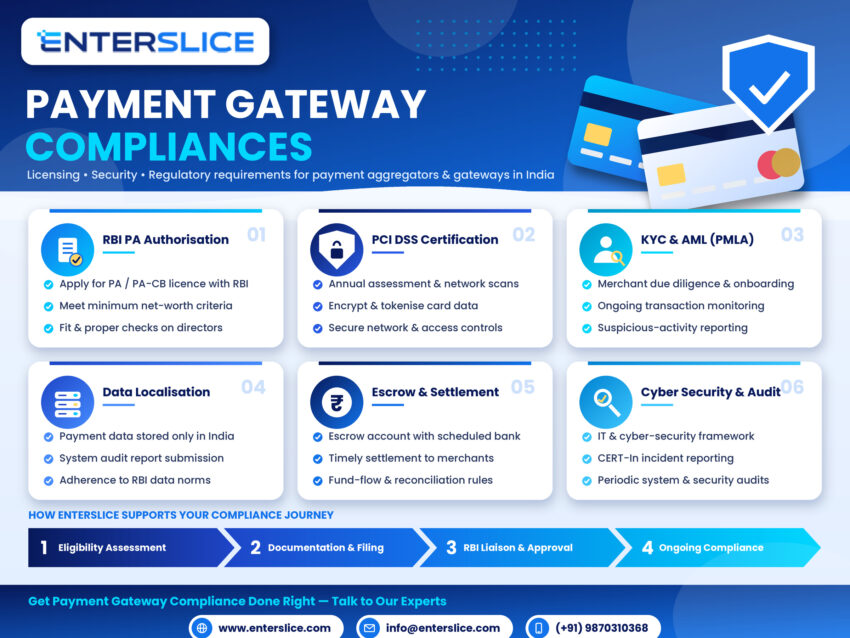
1. RBI Compliance for Payment Gateways
The Reserve Bank of India regulates payment systems under the Payment and Settlement Systems Act, 2007, and applicable directions.
Businesses planning to provide payment services must first determine whether their proposed activities require RBI authorization or approval from a bank or another regulated payment partner. Non-bank payment aggregators generally face specific authorization and operational requirements.
Companies should review their business model, fund flows, merchant relationships, and settlement responsibilities before commencing operations.
2. PCI DSS and Payment Security
The Payment Card Industry Data Security Standard (PCI DSS) establishes security requirements for protecting payment card information.
Depending on the company’s role and technical environment, relevant controls may include:
- Restricting access to sensitive payment information.
- Encrypting data where required.
- Conducting vulnerability assessments and security testing.
- Maintaining secure systems and monitoring suspicious activity.
- Reviewing third-party service providers and security practices.
Businesses should determine their applicable PCI DSS validation requirements rather than assume that using an external payment processor removes every security obligation.
3. KYC and Merchant Due Diligence
Merchant onboarding requires appropriate verification and risk assessment. Payment aggregators should establish procedures to assess merchant identity, business activities, ownership, and risk exposure in accordance with applicable requirements.
Depending on the business model, these procedures may involve reviewing incorporation documents, PAN details, beneficial ownership information, business addresses, bank account details, and the merchant’s website.
4. Anti-Money Laundering and Fraud Prevention
Payment businesses should assess their obligations under applicable anti-money laundering laws and regulatory directions.
Risk controls may include transaction monitoring, suspicious activity escalation, record retention, fraud detection, and employee training. Reporting obligations should be determined according to the entity’s regulatory status and applicable law.
5. Data Protection and Localization
Payment businesses handle information that requires appropriate security and privacy controls. Companies should assess their obligations under applicable Indian data protection laws and RBI directions.
RBI’s payment data storage requirements are particularly relevant to entities covered by its payment system directions. Businesses should review where transaction data is stored, who can access it, and whether their cloud providers and technology vendors meet applicable requirements.
Card-on-file information also requires special attention. RBI restrictions generally prohibit entities in the card transaction chain, other than permitted card issuers and networks, from storing actual card-on-file data. Tokenization arrangements should follow the applicable rules.
6. Customer Disclosures and Grievance Handling
A payment business should provide clear information about its services, fees where applicable, refund arrangements, privacy practices, and customer support.
Depending on its role, it may also need documented complaint-handling procedures, transaction dispute management, and processes for addressing failed payments.
How to Start a Payment Gateway Company
Entrepreneurs researching how to start a payment gateway company should plan the legal structure, technology, commercial arrangements, and compliance framework together.
Step 1: Define the Business Model
Decide whether the company will provide payment gateway technology, operate as a payment aggregator, build a payment application, or provide another payment-related service. This decision determines which approvals and compliance requirements may apply.
Step 2: Incorporate the Business
Establish the appropriate legal entity and prepare the necessary corporate records. The company’s constitutional documents and stated business activities should be reviewed for suitability.
Step 3: Establish Banking and Payment Partnerships
Identify suitable banks, payment networks, processors, and technology providers. Complete their due diligence and contractual requirements before offering services.
Step 4: Build a Secure Technology Infrastructure
Develop or integrate the payment platform with appropriate authentication, access controls, transaction monitoring, incident response, backup, and recovery arrangements.
Step 5: Prepare Policies and Compliance Documentation
Create the policies relevant to the company’s activities. These may include information security, privacy, merchant onboarding, refunds, complaints, risk management, and business continuity procedures.
Step 6: Complete Applicable Approvals and Assessments
Obtain any required regulatory authorization, partner approvals, and security assessments before beginning regulated activities. The exact sequence depends on the business model.
Documents Required for Payment Gateway Compliance
The document checklist varies according to the company’s operations and the requirements of its bank, payment partner, auditor, or regulator.
Commonly requested documents include:
- Certificate of Incorporation, PAN, and applicable tax registrations.
- Memorandum and Articles of Association.
- Director, promoter, and beneficial ownership details.
- Registered office and business address proof.
- Bank account details and relevant financial statements.
- Business plan, product description, and transaction flow diagrams.
- Merchant onboarding and due diligence policies.
- Privacy Policy, Terms and Conditions, and Refund Policy.
- Information security, risk management, and incident response policies.
- Applicable regulatory approvals, audit reports, and security assessments.
Additional documents may be required for payment aggregation, cross-border transactions, or other regulated activities.
What Are the Fees for Payment Gateway Compliance?
There is no single fee applicable to every payment gateway compliance project.
The total cost depends on the services required, the complexity of the technology infrastructure, the company’s regulatory classification, and the assessments or approvals involved.
Typical cost components may include company incorporation, legal and regulatory advisory, security testing, PCI DSS assessments, audit fees, technology implementation, and ongoing compliance management.
Where RBI authorization is required, the applicable financial eligibility criteria and regulatory requirements must be evaluated separately. Businesses should obtain a scope-based quotation instead of relying on a general estimate that may not reflect their actual obligations.
Payment Gateway Annual Compliance: What Should Businesses Review?
Compliance continues after launch. Payment gateway annual compliance and other periodic obligations should be planned through a documented compliance calendar.
Depending on the business model, the review may cover:
- Periodic security assessments and vulnerability testing.
- Updates to privacy notices, customer disclosures, and internal policies.
- Merchant due diligence and transaction monitoring.
- Regulatory submissions and audit requirements, where applicable.
- Review of third-party contracts and payment partner requirements.
- Incident response, business continuity, and disaster recovery testing.
- Customer complaints, refunds, disputes, and failed transactions.
- Changes in ownership, management, products, or business operations.
Not every obligation is annual. Some requirements apply continuously or at specified intervals, so businesses should map each deadline to the relevant regulation or contractual requirement.
Benefits of Professional Payment Gateway Compliance Services
Professional Payment Gateway Compliance Services can help businesses identify gaps and organize their regulatory responsibilities.
The main benefits include:
Reduced compliance risk: Early identification of regulatory gaps can help prevent avoidable operational problems.
Improved payment security: Appropriate controls help protect customer information and reduce exposure to payment fraud.
Better partner relationships: Banks and payment providers may require evidence of sound governance, security, and compliance practices.
Clearer operational processes: Documented procedures support merchant onboarding, dispute management, incident handling, and audits.
Business readiness: A structured compliance framework can help businesses prepare for expansion, due diligence, and new payment partnerships.
Enterslice provides advisory and compliance support for businesses seeking to understand and manage applicable payment gateway requirements. The scope should be tailored to the company’s business model and regulatory position.
Frequently Asked Questions
1. Is RBI authorization mandatory for every payment gateway?
No. The requirement depends on the actual activities performed. Payment aggregators and other regulated payment system operators may require authorization, while a technology-only gateway may have a different position.
2. What is the difference between a payment gateway and a payment aggregator?
A payment gateway primarily provides technology for transmitting payment information. A payment aggregator facilitates payment collection and settlement for merchants. Their regulatory responsibilities can therefore differ.
3. Which security standards apply to payment gateways?
PCI DSS is relevant to payment card data environments. Other applicable requirements may include RBI security directions, contractual security controls, privacy obligations, and requirements imposed by payment partners.
4. What documents are required for compliance?
Common documents include incorporation records, PAN, ownership details, financial information, business policies, website disclosures, security assessments, and applicable regulatory approvals.
5. How much does payment gateway compliance cost in India?
The cost depends on the business model, required audits, security infrastructure, advisory scope, and regulatory obligations. There is no universal fee for all payment gateway businesses.
6. What does payment gateway annual compliance involve?
It can include periodic audits, security reviews, policy updates, applicable regulatory filings, merchant due diligence, and monitoring of changes in regulations. Specific deadlines depend on the applicable requirements.
7. Can an existing business outsource payment gateway compliance?
Yes. A business can engage external compliance professionals for advisory, documentation, audits, and compliance planning where appropriate. Outsourcing support does not automatically transfer the company’s legal responsibilities.
Conclusion
Payment gateway compliance is an important part of building a reliable digital payments business in India. Companies should understand their regulatory classification, secure their payment infrastructure, maintain appropriate documentation, and establish procedures for ongoing monitoring.
The most effective approach is to assess compliance requirements before launch and maintain a clear calendar for recurring obligations. Businesses that need guidance can explore Payment Gateway Compliance Services by Enterslice to identify applicable requirements and develop a practical compliance plan.
Visit Enterslice’s payment gateway compliance page to learn more about the available advisory and compliance support.
Most popular services :
Mortgage Guarantee Company Registration
Regulatory Compliance and Advisory Services